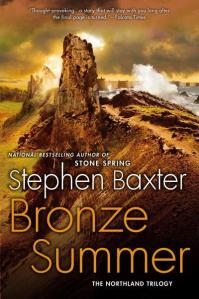
Book review: Bronze Summer by Stephen Baxter

1159 BC. The Trojan War has been over for a generation. The Mycenaean Greek kingdoms are crumbling. The Empire of Hatti–known to the modern world as the Hittites–is hanging by a thread, saved from collapse only by gifts of imported maize and potatoes from a land unknown to our world: Northland. This is the world visited by Stephen Baxter in Bronze Summer, his followup to Stone Spring.

For six thousand years, the hunter-gatherers of we know as the North Sea have built and maintained the Wall, a single continuous building hundreds feet high and hundreds of miles long, keeping the ocean out of their homeland. The Northlanders are a proud and strong people, living off the land, carefully tending the dykes and earthworks of their country, and sending ships across the sea of the Americas. They stand as a bastion against the failing kingdoms of the east.

But when the ruler of Northland is assassinated by a new type of iron arrowhead, her daughter, Milaqa, must investigate and save her country from traitors within. Things grow worse when the Hekla volcano erupts in Iceland, setting off a period of global cooling and famines that will last for 18 years. The self-sufficient Northlanders can survive, but their neighbors, mostly subsistence farmers, are worse off. Soon, armies of bandits roam the countryside, some led by former friends, and all the political alignments must shift if Northland is to survive.

Once again, Mr. Baxter builds the fantastic out of plausible historical threads. The North American Mississippian Culture also maintained large earthworks and cities with relatively simple technology and a light footprint. The Vikings discovered that island hopping around the North Atlantic can get you from Europe to America with relatively short crossings of open water. A primitive form of concrete was used as early as 3000 BC in Mesopotamia. These and a few other precocious inventions of the Northlanders set them up as a major power.

Bronze Summer shares with its predecessor, Stone Spring, a similar style of skipping through time. Though it is admittedly not as much time, there is a remarkably similar pattern of a slow build-up of political intrigue followed by a relatively quick and almost glossed-over conflict. While it is still a very good read, it is not quite as satisfying as it could be with this genre-straddling mode. There is still a savoring of the intricacies of life at the dawn of the Iron Age for the enthusiasts. It is a little more mundane than the more distant world of the alternate Neolithic, but it certainly has its moments as the world faces the sunless years after the “Fire Mountain”.

I can’t fault Mr. Baxter’s style too much, since the pattern is clear and consistent over the course of the two novels, and it works well enough. However, I was a little disappointed in the characterization. The leading lady, Milaqa, is more passive and indecisive than her legendary ancestor, Ana, and her intriguing background as an independent, hard-drinking teenager is heard more than seen. Other great characters, like the mad Mesoamerican sculptor, Caxa, are underutilized, while many unsavory characters are promoted to leading roles. This, too, is part of Mr. Baxter’s conceit, but it makes for a weak point in an otherwise very enjoyable story.

In spite of this, though, I liked Bronze Summer as a worthy followup to its predecessor, and I am looking forward to the final installment in the Northland Trilogy, Iron Winter after its American release this fall.

My rating: 4.5 out of 5.0

Posted in Book reviews | Tagged , | Comments Off on Book review: Bronze Summer by Stephen Baxter

A ringed (?) planet (?) with moons (?) far, far away

Artist's rendition of the suspected ringed planet. Credit: Michael Osadciw/University of Rochester.

Artist’s rendition of the suspected ringed planet. Credit: Michael Osadciw/University of Rochester.

The majestic rings of Saturn are one of the most beautiful sights in our Solar System and a favorite target of stargazers. But all of the gas giant planets in our Solar System have rings, at least very faint ones. Even Earth has a ring, albeit one that we put there.

But do planets in other solar systems have rings? Probably. The same gravitational forces should cause them to form. Have we seen them? Well…maybe.

There is a star that is known only as 1SWASP J140747.93-394542.6, which lies 420 light-years away. Attention was drawn to this star by the SuperWASP planet survey. SuperWASP uses eight small telescopes to watch a big patch of the sky to see if any planets pass in front of their stars. It’s like the Kepler mission, but it covers an area 5 times as large (though less accurately).

Anyway, 1SWASP J140747.93-394542.6 had something pass in front of it, and that something was big. A normal planetary transit lasts only a few hours. Whatever passed in front of this star took almost two months! The star dimmed and brightened four times over the course of the first month, then the pattern repeated in reverse order in the second month. To astronomers, that says one very important thing: rings. First the rings on one side of the planet block the starlight with a certain pattern, then the rings on the other side do it in reverse. And those rings have to be huge: 60 million kilometers (37 million miles) wide. That’s 40% of the distance from Earth to the Sun and almost 200 times as wide as the main part of Saturn’s rings.

So have we found a planet with giant rings? Well…maybe. You see, this star is only 16 million years old. That means any planets it has are still forming. These rings might just be a debris disk from the planet’s formation that it hasn’t finished sweeping up yet. Also, the planet might not be a planet at all. It could be something bigger like a brown dwarf, or even a small star that’s too dim to see directly.

Now, remember that the star dimmed four times on each side of the alleged planet. That means there are four separate rings. Because of how the gravity works out, a big gap in a big debris disk like that suggests that there are moons going around the planet in those gaps. Moons outside of our Solar System are called exomoons, and they are an active field of study, even though they’ve never actually been seen. So have we found a planet with exomoons here? Maybe not. After all, these moons would be millions of kilometers away from the planet, which is awfully far to form naturally. We need better observations to tell if there’s really anything there.

Posted in Planets | Tagged , , , | Comments Off on A ringed (?) planet (?) with moons (?) far, far away

In the sky: Nova Delphini 2013

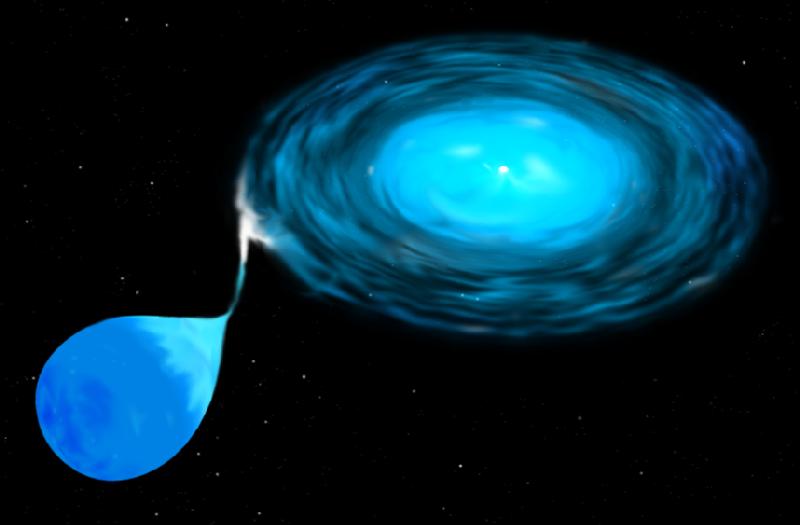
Artists' impression of an accreting binary system. Credit: STScI/NASA.

Artists’ impression of an accreting binary system. Credit: STScI/NASA.

A rare event is happening this month–one that only happens once every few years–a naked eye nova is visible in the night sky. This is not a supernova, but what is sometimes called a “classical nova”, literally, a “new” star that appears in the sky. But a nova is not a new star, but an old one. It occurs when a white dwarf strips hydrogen gas from a companion star an accretes it onto its surface. After a while, the white dwarf’s immense gravity compresses the hydrogen enough for fusion to begin explosively, causing a flare many times brighter than even the companion star.

About 40 novae occur in the Milky Way every year, but most of them are not visible to the naked eye. However, there is one that is visible right now. It’s called Nova Delphini 2013, and you can see it clearly if you’re in the Northern Hemisphere. Here’s how:

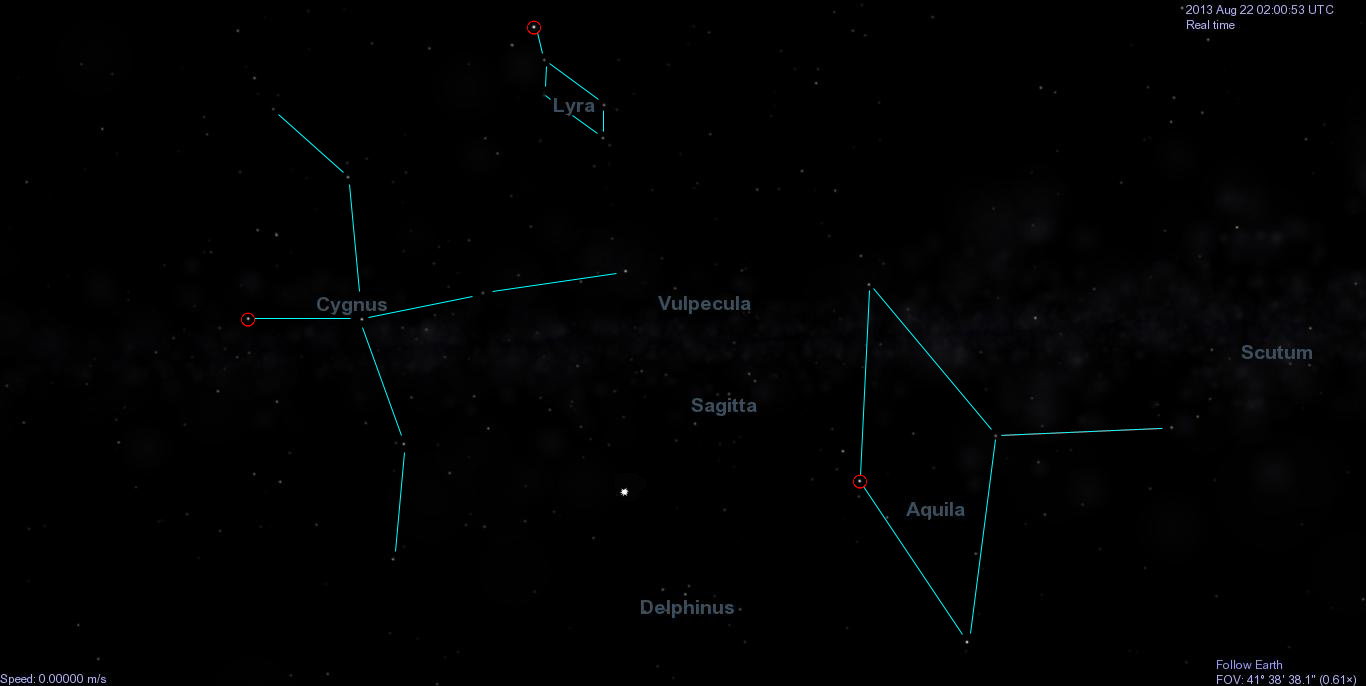
You may be familiar with the Summer Triangle, three bright stars that appear high in the sky in the northern summer (marked in red): Vega in Lyra, Deneb in Cygnus, and Altair in Aquila. These are probably the easiest features in the sky to spot this time of year.

Look a little below the summer triangle, and you will spot the small constellation of Delphinus, the Dolphin, easily recognized by its compact diamond shape. (Delphinus makes for a pretty nice binocular view on its own.) And if you look a little inside the Triangle, you will see Sagitta, the Arrow. Now follow the line of the Arrow, above the head of the Dolphin, and there you will see a star that isn’t marked on regular star charts (the white spot here). That is an erupting white dwarf called Nova Delphini 2013. Here’s a closer look:

Photograph of the area around Nova Delphini 2013. Credit: Oitijhya Hoque.

Photograph of the area around Nova Delphini 2013. Credit: Oitijhya Hoque.

No, it’s not very bright, but it hit a peak magnitude about equal to the stars in Delphinus last week, and it will probably be clearly visible for another week or so. So grab your binoculars, or just walk outside if it’s dark enough, and go take a look.

Posted in Stargazing | Tagged , , | Comments Off on In the sky: Nova Delphini 2013

Kepler Mission officially retires from planet hunting

Artist's rendition of the Kepler spacecraft. Credit: NASA/Ames/JPL-Caltech.

Artist’s rendition of the Kepler spacecraft. Credit: NASA/Ames/JPL-Caltech.

Today, NASA announced that the Kepler Spacecraft has been officially retired from its primary mission of looking for Earth-like planets around other stars. Two of the spacecraft’s four reaction wheels–basically gyroscopes that keep it pointed straight–have failed in the past year, and it needs three to maintain the very precise pointing that it needs to look for planets. Kepler was the best method we had to look for Earth-like planets, so it’s unfortunate that the mission has to end like this. This is kind of a “Good News-Bad News” situation, so here’s my take on it.

Bad news: there’s no new planet data coming in. This is the obvious one. The spacecraft can’t look for planets anymore, so we won’t be getting any new information.

Good news: there’s still lots of planets to find in the data. Kepler has only found 135 confirmed planets, but the database it has created contains over 3,500 candidate planets, some of which are believed to be “Earth-like” (that is, a similar size and temperature to Earth). Confirming all (or most) of those planets will keep astronomers busy for years, and there are probably some great finds hiding in there.

Good news: Kepler finished its originally planned mission. Kepler was only intended to look for planets for 3.5 years, and it actually functioned for 4.5 years, so we have more data than we originally planned.

Bad news: we didn’t get as good data as we wanted. It turns out that the accuracy of Kepler’s measurements weren’t quite as good as the engineers intended. Originally, it was thought that 3.5 years of data was enough to find Earth-like planets. However, with the poorer measurements, we needed 7 years to be really sure, which we didn’t get (although there are probably still Earth-like planets in the database).

Good news: Kepler isn’t dead yet. No, it’s not getting better, but there may still be some science that the spacecraft can do with only two reaction wheels, and the mission is still funded through 2016. One possibility is to let the spacecraft drift around the sky and keep an eye out for new variable stars or supernova, which don’t need as much precision to see.

Bad news: this was preventable. If you need three reaction wheels at all times, and you need them to work for several years, how many are you going to include on the spacecraft? Only four? Probably better to go with five or six. Two complete sets would be good.

Bad news: all of the clever plans failed. Engineers actually knew there was a problem with the reaction wheels earlier–not before launch time in 2009, but not long afterward. The Dawn spacecraft, launched in 2007 to study the asteroids Vesta and Ceres, uses the same kind of reaction wheels as Kepler. It’s wheels started acting up in 2010, and two of them have since failed. (Luckily, Dawn can continue its mission with thrusters alone, even if all four wheels fail.) Engineers studying Dawn realized they could make the wheels last longer by spinning them in particular ways to help keep them lubricated. That kept Dawn’s wheels running for quite a while. Unfortunately, Kepler wasn’t so lucky.

So here’s to a great mission. Even with all the problems, we still found a lot of probable planets, so I’m calling it a good run.

Full disclosure: I have a grant from NASA to work on a very peripheral part of the data analysis for Kepler. However, it does not involve the new data that was coming in.

Posted in Current events, Planets, Space exploration | Tagged , , | Comments Off on Kepler Mission officially retires from planet hunting

In the sky: the Perseids

A Perseid meteor over the Very Large Telescope in Chile. Credit: ESO/S. Guisard.

A Perseid meteor over the Very Large Telescope in Chile. Credit: ESO/S. Guisard.

The most reliable and visible of the dozens and dozens of meteor showers that occur over the course of the year is the Perseid shower. The Perseids occur every year in July and August when Earth passes through the tail of Comet Swift-Tuttle, and bits of rock broken off from the comet collide with Earth’s atmosphere.

The Perseids are sometimes called the Old Faithful of meteor showers. They’re visible in the height of summer, when the nights are warm (at least here in New Jersey), and the skies are likely to be clear. They have consistently high rates of visible meteors, typically 60 to 100 per hour in dark skies. The tail of Swift-Tuttle is spread across a wide swath of space, so you can see a few meteors per hour all the way back to mid-July and for practically the whole month of August. If you see any meteors coming from the northeast this month, they’re probably Perseids.

This year, the Perseids will peak over the next two nights (Sunday night through Tuesday morning), and the crescent Moon will set early, so it won’t wash them out. All you need is a clear, dark sky; the meteors will appear all over the sky. But the best time to see them is 2:00 or 3:00 in the morning. That’s because the meteors come from ahead along Earth’s orbit, and they hit the atmosphere faster. But if you can’t get out that late, late evening will still give you some nice celestial fireworks.

Good luck, and keep watching the skies.

Posted in Stargazing | Tagged , , | Comments Off on In the sky: the Perseids

The diamond planet (that was once a star)

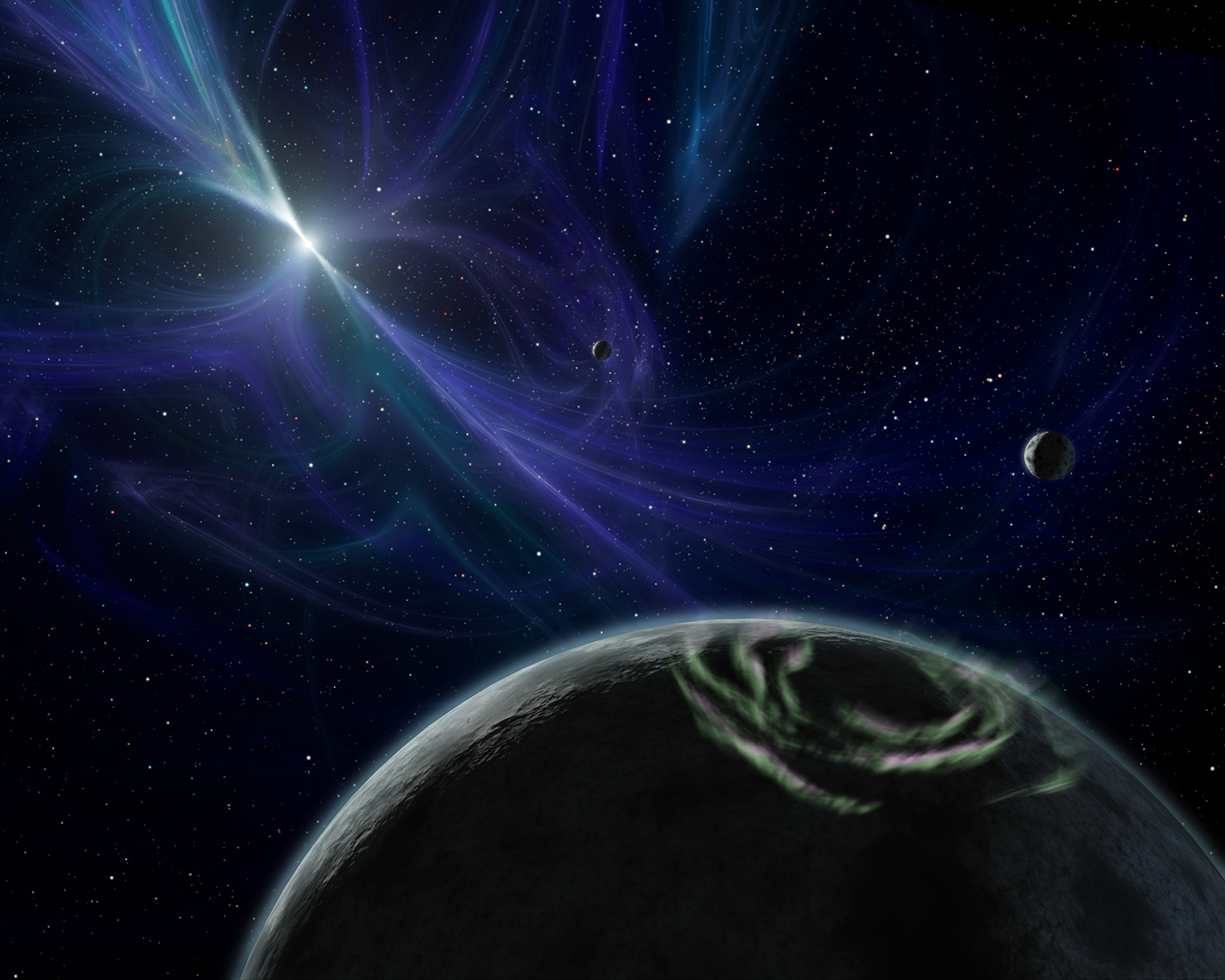
Image Credit: NASA Spitzer Science Center

Image Credit: NASA Spitzer Science Center

I’ve written before about pulsar planets, planets that form from the debris left over after a supernova, or that get captured from another solar system. But PSR J1719-1438 b is not like either of those planets. It’s a fragment of what was once a star and is probably made mostly of (very impure) diamond!

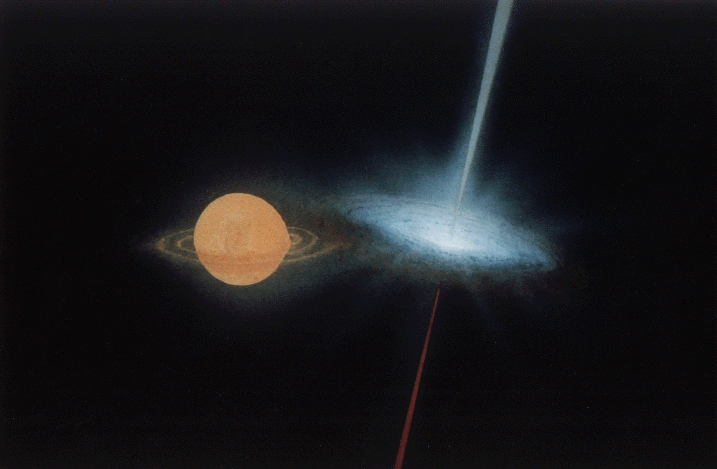
Here’s what happened. PSR J1719-1438 used to be a pretty normal binary star. The larger star exploded as a supernova and became a neutron star. Millions of years later, the smaller star expanded into a red giant. The gravity of the neutron star sucked away part of the atmosphere of the red giant and pull it onto its surface. It probably looked something like this:

Artist's impression of a red giant-neutron star binary. Credit: NASA

Artist’s impression of a red giant-neutron star binary. Credit: NASA

The atmosphere falling onto the neutron star transferred some of the orbital energy of the system to it, making the neutron star spin faster and faster, until it was spinning around over 100 times per second! This is called a millisecond pulsar. Eventually, the atmosphere of the red giant blew away (separately from being sucked away by the pulsar), leaving a white dwarf behind.

But a white dwarf is not a planet. It’s Earth-sized, but it’s nearly as massive as our Sun. It’s generally considered a dead star. So what happened? Somehow, the white dwarf got into an orbit around the pulsar that’s only 2 hours long–perhaps due to tidal forces–and smaller than the radius of our Sun. (Not unlike the planets around Kepler-70.)

The pulsar is extremely hot and emits a powerful beam of hard radiation. And even though the white dwarf was incredibly dense and heavy, that beam was enough to slowly evaporate it away at that close distance. Now all that’s left is a chunk of dead stellar core about the mass of Jupiter, and that’s about the right size to be called a planet. It’s also the densest known planet. At 23 g/cm3, it is denser than any material that exists at the ordinary pressures of Earth, and the planet, though as massive as Jupiter, is only about the size of Neptune, less than half as wide.

A white dwarf is made mostly of carbon, and that’s mostly what’s left of PSR J1719-1438 b. Under the intense pressure, most of it’s interior has likely crystallized into diamond. Sadly, it’s not gem quality. White dwarfs contain huge amounts of impurities like nitrogen and oxygen, and even bits of neon and magnesium. Under the pressure, it would also have a weird cubic crystal structure instead of the octahedral structure of normal diamonds. It’s also probably still evaporating.

So it’s probably not a girl’s best friend, but still, it’s a diamond the size of Jupiter that used to be a star! Don’t ever let anyone tell you astronomy isn’t interesting.

Posted in Planets | Tagged , , , , | Comments Off on The diamond planet (that was once a star)

Book review: Year Zero by Rob Reid

So here’s the deal: aliens exist, and they’re all highly refined artists…except they all suck at music. Humans make the greatest music in the universe, but we’re terrible at all 139 other forms of art that are worth doing. A match made in heaven? Not quite. You see, the aliens have all been pirating our music since 1977, and they just realized that a literal application of our copyright laws (and they’re very particular about literally applying our copyright laws) would bankrupt the entire universe. Some of the less refined beings might say that it would be easier to destroy the Earth than to pay up…

It sounds pretty crazy, but it works in the hands of Rob Reid with his first novel, Year Zero. Reid is the founder of Listen.com, which you might know better at the creator of the Rhapsody online music service. A longtime proponent of reforming America’s copyright laws, Reid brings the same absurdity that leads to the $8 billion iPod to his fictional universe of classic rock-loving aliens, and only Nick Carter, not the Backstreet Boy, but a junior anti-piracy lawyer, can save the world from an evil alien parrot and a vacuum cleaner. (It makes sense in context.)

It sounds rather polemical, and, yeah, it kind of is, but it has a real Douglas Adams meets the Electronic Frontier Foundation vibe. For the most part, the absurdity outweighs the pontificating and creates a fun and interesting story. From the lip-synching alien reality show stars to the disturbingly horrifying teddy bears to the exposition-giving fake Richard Nixon, the book’s strength lies in making the copyright bit one of the less ridiculous things about it.

It’s a little rough around the edges, maybe, especially if hard sci-fi is more your game, but Year Zero is still a fun read, and it may be an eye-opening one if you’re new to the issues it raises. And if you’re an Adams fan, you should definitely get yourself a copy (but don’t pirate it, because who knows what could happen then!)

My rating: 4 out of 5.

Posted in Book reviews | Tagged , , | Comments Off on Book review: Year Zero by Rob Reid

Camp NaNoWriMo: what I learned

Photo credit: Ken Whitley.

Photo credit: Ken Whitley.

Yesterday I completed Camp National Novel Writing Month with a total of 50,118 words. It was a fun month, even if it’s not something I could do all the time. Here’s what I learned.

It wasn’t that hard.

Don’t get me wrong; it certainly wasn’t easy, but it wasn’t the exhausting ordeal I feared it might be. I once did close to 20,000 words in two weeks, and I felt exhausted by the end of it, but if you have a good story lined up, and you really want to write it, most of the writing feels like a breeze. The numbers bear that out, too. Only one in seven people who starts NaNoWriMo (in any month) successfully finishes, but that one in seven accounts for two thirds of all the words written. Most of the rest give up and drop out early. I saw that personally in my own Camp NaNo “cabin”, where two of the six of us kept going on to the end, while the other four wrote less than 4,000 words between them.

NaNoWriMo is conservative with word counts.

This is a nuts-and-bolts issue, but very important. Continue reading

Posted in NaNoWriMo, Writing | Tagged , , , , , , | Comments Off on Camp NaNoWriMo: what I learned

xkcd’s Time: good science fiction in a new medium

Frame 563 of Time, as counted by Geekwagon. Credit: xkcd/Randall Munroe.

Frame 563 of Time, as counted by Geekwagon. Credit: xkcd/Randall Munroe.

For the past four months, perhaps the most unique work of science fiction I have ever personally seen has been playing out over at xkcd: Time. If you don’t know about the xkcd webcomics, you should check them out. They are awesomely nerdy, very funny, and often amazingly informative. This chart alone is worth seeing for a nice “dose” of perspective.

Last year, Randall Munroe created Click and Drag, a huge black-and-white world that you can explore by…clicking and dragging, possibly creating the world’s largest comic strip. Time explores the “third” dimension by showing a single comic strip panel that changes over time: every half hour for the first few days, then every hour after that. In that panel, the story of an idiosyncratic future of wonder and adventure slowly played out. Sometimes like a movie playing super-slow and sometimes like a comic strip updating really fast, and sometimes a puzzle itching to be solved, it always made one want to keep an extra browser tab open for it.

Last Friday, Time finally reached its end after 3,099 frames, lots of carefully crafted worldbuilding, and, by all accounts, a lot of work. Read Randall’s own take on the comic here. I must say that as unconventional as it is, the story is engaging and well-written. And I encourage you to go to this link to click through it yourself. As a coda, the actual comic still changes every hour, shifting randomly between the last five frames.

But the comic is only half the story. The forum that grew up around it has been equally entertaining. In four months, it has amassed over 50,000 posts, making it the third longest on the site and comprising a quarter of all discussion about the comics themselves. Over time, the forum went basically insane, developing its own culture: measuring time in “newpix” (new pictures), creating its own religion, the worship of the “GLR” (Great Lord Randall), describing all animals as “molpies” based on a throwaway comment, and generally trying to solve every puzzle they could find or thought they could find. There’s even a wiki, in case you get lost.

Warning: Spoiler Alert

The forum genuinely enriched the story, as it was they who figured out when the story was taking place (April of 13,291 AD), where (the dried up Mediterranean sea), and making endless (usually silly) predictions about what would happen next.

Will we see anything else like Time in the future? Probably not from xkcd, but hey, it’s a big Internet. Some of the followers of the “OTC” (One True Comic) deprived of their ability to be “timewaiters”, may try to emulate GLR and create their own versions of this comic/movie form. Probably not, but stranger things have happened.

Posted in Art, Fiction | Tagged , , , | Comments Off on xkcd’s Time: good science fiction in a new medium

You’d be surprised what a planet can live through

The inside of a subdwarf B star like Kepler-70. Credit: Uwe W.

The inside of a subdwarf B star like Kepler-70. Credit: Uwe W.

Just one week left for Camp NaNoWriMo. I’m still on schedule with 40,641 words.

In about 5 billion years, our Sun will run out of hydrogen in its core turn into a red giant, expanding by about 200 times until it eats Mercury and Venus, though probably not Earth. Mercury and Venus will eventually be vaporized by the intense heat. After all, what kind of planet could survive being inside a star? Well…it turns out you just need a planet with a little more heft.

Kepler-70 is a peculiar type of star called a subdwarf B star. This is actually a little later in a star’s life than the red giant stage. Normally, after a while, a red giant shrinks down from 200 times the size of the Sun to just 10 when it stars burning helium. This is called a horizontal branch star.

But sometimes, the star loses most of its hydrogen atmosphere so that all that left is a much smaller (only a fifth the diameter of the Sun), much hotter star made mostly of helium. This is a subdwarf B star. How does a star lose it’s atmosphere like that? There are different reasons, but in the case of Kepler-70, it might have had something to do with a couple of planets crashing into it!

Long ago, we believe that Kepler-70 had two gas giant planets: hot jupiters or even warm jupiters in orbits like Mercury and Venus. As the star expanded, it engulfed these two planets. But the outer layers of a red giant’s atmosphere are very thin, and a planet can still orbit inside the star without too much trouble, if it can stand the heat.

But there is a little bit of drag from the star’s atmosphere. This drag force blew away the planets’ atmospheres, leaving only the heavy metal cores, and it caused them to spiral deeper and deeper into the star. At the same time–maybe–the gravity of the planets might have been disrupting the star’s atmosphere, causing it to blow away into space.

Then, about 18 million years ago, Kepler-70 shrank into the subdwarf B star we see today, leaving the planets safely outside it. There’s not much left. Both planets have been burned down to balls of iron about half the mass of Earth, and both of their orbits would fit inside our Sun. These burned down planetary cores are called chthonian planets, and they may still be boiling away. The inner planet, Kepler-70b, orbits the star in just under 6 hours, and it is the hottest planet known at over 7000 K. That’s hotter than the surface of our Sun and more than enough to boil iron.

Eventually, Kepler-70 will turn into another type of red giant called an asymptotic giant branch star, and its planets might boil away long before then, but the fact that they’re still there now is impressive. Planets, at least big ones, are tougher than they look.

Posted in Planets | Tagged , , , | Comments Off on You’d be surprised what a planet can live through