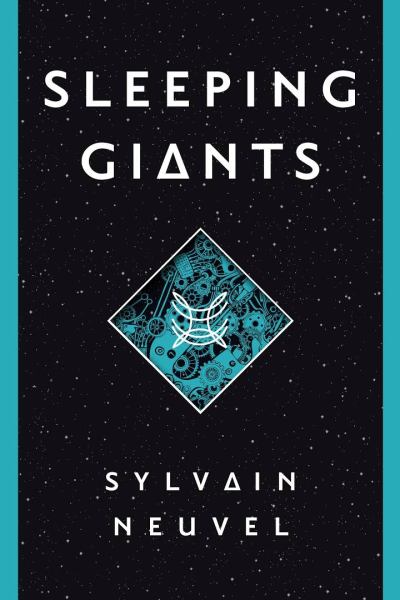
Book Review: Sleeping Giants by Sylvain Neuvel

Sleeping Giants is one of those books I picked up blind. I knew nothing about the author, and I hadn’t heard the book recommended. All I knew was what was printed on the dust jacket.

And I loved it.

Sleeping Giants, the debut novel of Québécois author Sylvain Neuvel, is a sci-fi thriller told in the style of The Martian and World War Z, through journal entries and interview transcripts with someone who seems to be a scary, faceless government agent.

It all started when a young girl named Rose Franklin fell down a hole and landed on a giant metal hand. Years later, Rose is a scientist recruited to study the hand and find more pieces of what turns out to be a giant alien robot, which in ancient times was the inspiration for the Greek goddess Themis.

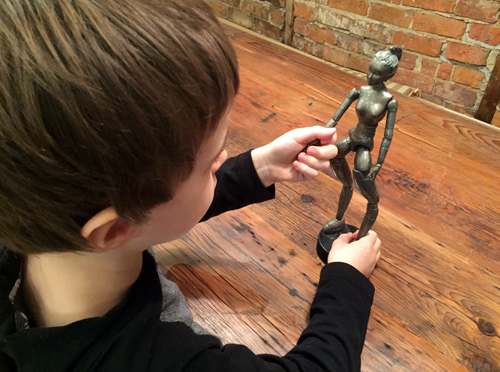
Or, if you're Neuvel's son, a cool action figure. Credit: The University of Chicago Magazine.

Or, if you’re Neuvel’s son, the backstory of a cool action figure. Credit: The University of Chicago Magazine.

Of course, after that, everything goes wrong, and disaster, destruction, political scheming, and the specter of the aliens noticing something amiss all mean that the robot causes a lot more trouble than it solves.

Sleeping Giants is a page turner for sure. It has plenty of personal drama, political machinations, and pretty good science, too. The plot also has at least three big twists coming out of left field to keep things exciting.

I admit I wasn’t completely sold on the book until the very end. I didn’t particularly like where Mr. Neuvel was going with it for a while, but I changed my mind immediately when I saw he was teasing a sequel. The final twist kept the mystery alive and completely changed my perspective on the story without feeling cheap. The sequel, Waking Gods, will be released next April, and I am eager to read it.

My rating: 5 out of 5.

Posted in Book reviews | Tagged , , | Comments Off on Book Review: Sleeping Giants by Sylvain Neuvel

Book Review: Harry Potter and the Cursed Child

Harry_Potter_Cursed_Child_Play

Well…here we go.

I’m a big Harry Potter fan, so when I heard that J. K. Rowling was writing a stage play to follow the adventures of Harry’s son, Albus, and Draco Malfoy’s son, Scorpius, I was disappointed that I would have very little prospect of seeing it…and then excited when I heard that the script would be published on premier night…and then disappointed again at the quality of that script. But it was better than it could have been.

Harry Potter and the Cursed Child is the latest installment in the Harry Potter universe. It’s a stage play, and the script is available in bookstores everywhere. But the reviews have been…mixed. Viewers who actually watched the play on stage loved it, but those who read the story in cold paper and ink were not so enamored. And I’m not just talking about the people who were mad that it’s a script and not a book. Many readers had far more substantive problems with it.

I’m going to be nice and #KeepTheSecrets for now. I’ll probably revisit the substantive plot problems later.

Continue reading

Posted in Book reviews | Tagged , , | 1 Comment

Movie Review: Star Trek Beyond

Star_Trek_Beyond_poster

Well, it’s been a long time coming. It’s crazy how busy it is trying to finish a dissertation. But here it is: my review of Star Trek Beyond. (Dramatic pause…)

That was awesome!

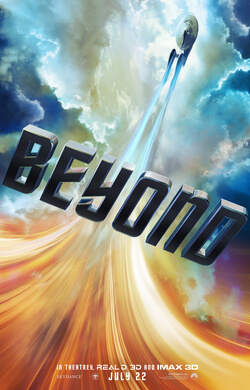
Star Trek Beyond, directed by Justin Lin, is the thirteenth Star Trek film and the third of the reboot/new timeline. And it is hands-down the best of the new movies. I thought Star Trek was pretty good. Star Trek: Into Darkness was a mediocre remake of The Wrath of Khan. So according to the curse, in which alternating films are good and bad, this movie ought to be good…and it delivers. This is the best Star Trek since First Contact.

This isn’t your typical Star Trek film. The Enterprise is destroyed in the first half hour with little more than a glimpse of the mysterious villain, Krall. But that’s thankfully pretty much the only nod to Star Trek III and IV. The story of Captain Kirk and his crew picking up the pieces and stopping a deadly plot is original and brilliantly pulled off, complete with humor, drama, adventure, and a surprise twist at the end.

And don’t get me started on the visuals of Starbase Yorktown. That was some of the most beautiful sci-fi scenery I’ve ever seen. The artists really outdid themselves on that one.

If you haven’t had a chance to see it, definitely check out Star Trek Beyond.

My rating: 5 out of 5.

Posted in Movie Reviews | Tagged , , | Comments Off on Movie Review: Star Trek Beyond

Classic Sci-Fi Recommendation: A Case of Conscience by James Blish

A Case of Conscience, a 1958 novel by James Blish, is one of the few sci-fi novels that really tackles religion and theology head-on, especially in a setting with aliens. I’ll admit that the writing is not stellar, despite the Hugo Award. It’s decent, but the plot is rushed in many places and in my opinion does not explore several key issues in sufficient depth. However, the theological questions it raises are most intriguing.

Continue reading

Posted in Book reviews, Religion, Science Fiction | Tagged , | Comments Off on Classic Sci-Fi Recommendation: A Case of Conscience by James Blish

Flight Training

A Short Story

In a scene that looked almost like it could have been in an ordinary classroom, about fifteen middle children from the ages of five to fifteen were sitting in a lecture hall, waiting for the seminar to start. They all looked normal enough, but you could never tell these days. Twenty or twenty-five of their parents sat in the rows behind them, regarding the scene playing out between the front and back of the room.

Continue reading

Posted in Fiction, Science Fiction | Tagged , | Comments Off on Flight Training

Book Review: The Dark Forest by Liu Cixin

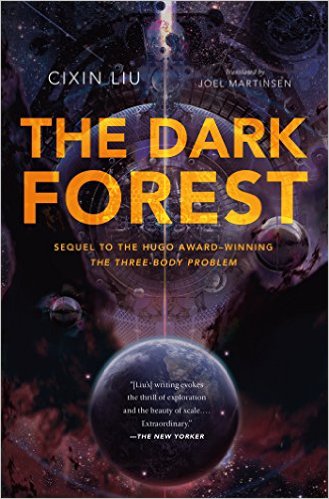
The Dark Forest is the sequel to the The Three-Body Problem, which I reviewed previously. This is the second book in Liu Cixin’s Remembrance of Earth’s Past trilogy, the bestselling science fiction saga in China. The English translation came out last year, and I’ve finally had time to read it.

The Trisolarans, technologically advanced beings from a dying planet around Alpha Centauri, have sent an invasion fleet to conquer Earth and wipe out the human race. But this isn’t the kind of invasion we normally see in fiction. The alien fleet will not arrive for 400 years. The bad news is that they’ve sent sophons–artificial intelligences imprinted on subatomic particles–to interfere with our scientific experiments and stop our technological progress.

Humanity has but one advantage: the Trisolarans are telepathic, and that means they don’t understand secrecy and deception. The United Nations chooses four people to be the Wallfacers–people who will invent secret plans in the privacy of their minds to fight the Trisolarans and will be given great resources to carry them out. Two of the Wallfacers are military leaders and one a brilliant scientist, but the fourth is an unknown Chinese astronomer, Luo Ji, with no major accomplishments to his name. He has no idea why he was chosen and no idea how to save the world. But for some reason, the Trisolarans want him dead…

The Dark Forest is, in many ways, a mystery novel, but with many mysteries to untangle. It’s very well written, with plenty of twists of plot and turns of fortune. Each of the mysteries is well-crafted, and most of them had the desired effect on me (as David Brin says) to make me say, “Of course! Why didn’t I see that before?” The storytelling is top-notch and successful drives the plot from “all is lost” to “all is won” and back more than once while still seeming (mostly) believable. It’s thought provoking, too, and the ending was positively brilliant.

I have to issue a couple of criticisms, however. The first, relatively minor, is that Mr. Liu’s lack of technical knowledge shows more here than in the previous book–thinking that large telescopes are made with lenses instead of mirrors, for example. But my main problem with the book is its deep cynicism. That the United Nations would rule trying to build an escape fleet a crime against humanity because no one could decide who got to go on it may be believable from a Chinese perspective (although I can’t state that with confidence one way or the other), but it seems absurd from my American perspective. And at risk of spoilers, the foolish way Earth’s fleet meets the Trisolaran probe is even worse, and the whole concept of the Dark Forest of space that Luo Ji lays out seems to be obviated by the existence of the sophons.

This cynicism definitely detracted from the story more than in the first book. And yet, the quality of the storytelling kept it very compelling. And with an ending that looks at first glance like a final curtain call, I’m very interested to see what new challenges await in the final installment, Death’s End, which will be available in English this September.

My rating: 4 out of 5.

Posted in Book reviews | Tagged , , | Comments Off on Book Review: The Dark Forest by Liu Cixin

Television Review: The Expanse

Okay, so this is another review that got delayed, and there’s one more coming, but then I’ll be caught up. The Expanse is a new show on Syfy based on the series of novels of the same name by James S. A. Corey (who is actually two people–it’s complicated).

The Expanse is a new space opera series at a time when that kind of thing seems sadly lacking. Like many such recent shows, it takes a darker tone than the light and fluffy Star Trek, going for more of a film noir vibe, but it was pretty well done, despite a few scientific pitfalls.

In the 23rd Century, Mars is an independent nation, and the Asteroid Belt has been heavily colonized by Earth. Belters face chronic health problems from microgravity and resent Earth and Mars for plundering the Belt’s abundant water, forcing them to rely on ice shipments from Saturn. When a desperately needed ice hauler, the Canterbury, is destroyed by what appears to be a Martian warship, Earth, Mars, and the Belt all race against time to survive and stop a war. But something far more sinister may be going on.

Three different “detectives” with very different stories are on the case. UN Undersecretary Chrisjen Avasarala, on Earth, is trying to prove that a Belter terrorists group, the OPA, was behind it all. Jim Holden, a survivor of the Canterbury is trying to figure out who’s destroying ships in the outer Solar System before they get him, too. And Detective Miller on Ceres is just trying to solve a missing person case–except that Julie Mao seems to be tied up with all of it.

The show was well done, with a diverse cast, compelling characters, and a gripping plot that artfully brought its threads together through their various twists and turns. Much of the science was actually really good: the “flip and burn” maneuvers, for example. Some was silly, of course, like the all consuming “protomolecules”, and sound in space was usually applied. And honestly, I don’t think Earth could deplete the vast reserves of water on Ceres in a million years, let alone a hundred, but we can let that go. It was still a pretty good show and worth watching.

My rating: 4 out of 5.

Posted in TV Reviews | Tagged , , | Comments Off on Television Review: The Expanse

The Marble Machine

Hello. No insightful commentary on science or fiction today. I’ll get back to that tomorrow. I just wanted to point out that this is one of the most epic things I’ve seen in a while. I don’t think I’ve ever seen a homemade musical instrument quite like it. Enjoy!

Posted in Music | Tagged , , , | Comments Off on The Marble Machine

Television Review: Childhood’s End

So I’ve had a backlog of TV shows to watch that I’m finally catching up on, and I wanted to review a very special miniseries that Syfy ran last December: an adaptation of Arthur C. Clarke’s Childhood’s End. It was a pretty good adaptation, with just a few shortcomings.

Warning: some spoilers to follow.

Continue reading

Posted in Science Fiction, TV Reviews | Tagged , | Comments Off on Television Review: Childhood’s End

Gravitational Waves Found at Last

Computer-generated image of two black holes in the process of merging. Credit: the LIGO Collaboration.

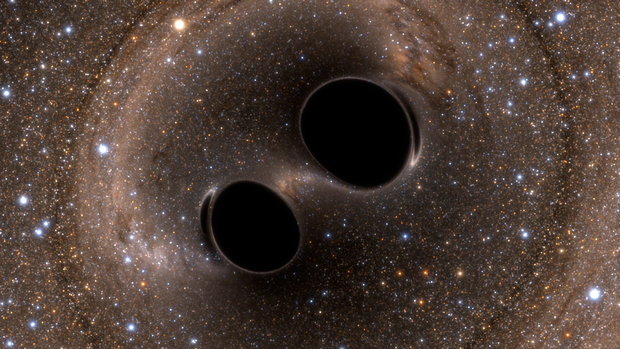
Computer-generated image of two black holes in the process of merging. Credit: the LIGO Collaboration.

One hundred years ago, Albert Einstein published his theory of general relativity. It was a radical new idea that overturned Newton’s theory of gravity and said things got much more complicated when you were near a massive object. Strange as it was, it was widely considered to be proved after Sir Arthur Eddington showed that light from distant stars was bent as it passed near the Sun during a solar eclipse.

Since then, Einstein’s theory has been a runaway success, and numerous other strange predictions that it made have also been vindicated. Time slows down in a gravitational field? Check. Light is redshifted in a gravitational field? Check. Black holes? Check. Gravitational lensing? Check. The expansion of the universe? Check. Some of these Einstein himself didn’t believe until they were proven to him, but they’re all real.

But there was one prediction* of general relativity that hadn’t be proved yet…until now: gravitational waves. Einstein predicted that just as an accelerating charged particle emits electromagnetic waves, so too an accelerating mass produces waves in the gravitational field. These waves would be extremely difficult to detect because the gravitational coupling constant is so tiny–that means that gravity is much, much, much weaker than electromagnetism–by a factor of 10^39! But it turns out there is a way to detect them.

Gravitational waves do two things. First, they bleed off energy from orbiting objects, causing them to slowly spiral together. For very massive objects like neutron stars, this is fast enough to notice. In 1974, the Hulse-Taylor binary pulsar was discovered, where two neutron stars are spiraling together, just like Einstein predicted. But this wasn’t a direct detection–only circumstantial evidence.

The second thing gravitational waves do is stretch and squeeze the space they pass through very slightly. Scientists working on the LIGO and Virgo gravitational wave observatories built laser interferometers to measure distances with incredible precision to see if any gravitational waves were passing through. LIGO can measure a four-kilometer beam path to a precision of one part in 10^21–more than a million times smaller than an atom! This is because of the way the laser beam interferes with itself as it bounces between mirrors that are miles apart.

The strongest gravitational waves in the universe come from black holes colliding and merging together. This produces waves in a very specific shape that last for about a tenth of a second. They’re hard to detect, and rare, but they can be detected from billions of light years away, and after years of searching, LIGO and Virgo saw one, finally proving the last untested prediction of Einstein’s theory right!

The two black holes were an estimated 36 and 29 times the mass of the Sun before they collided, and 3 times the mass of the Sun was lost as gravitational waves. And the collision was so powerful that we could detect it 1.3 billion light years away. See here for the press release and here for a free copy of the primary scholarly paper (one of many). This discovery opens up a whole new field of gravitational wave astronomy. Only time will tell what we can learn from it, but it looks like it’s going to be exciting.

* Technically, we haven’t directly observed a black hole yet, although we have pretty solid evidence. We’re actually getting close to that one, too, though. The Event Horizon Telescope is an effort to take a picture of the black hole at the center of our galaxy with radio telescopes, and it might succeed this year.

Posted in Current events, Science, Space | Tagged , , , | 1 Comment