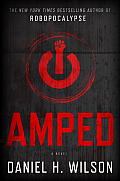
Book review: Amped by Daniel H. Wilson

In the future, brain implants are widespread. They can cure all sorts of neurological conditions, including ADD, epilepsy, learning disabilities, and even autism. They’re great for interfacing with prosthetic limbs, and healthy people can get them as an elective surgery to boost their IQs by three or four dozen points. They sound great, but there’s one big problem. The Supreme Court just ruled that it’s legal to discriminate against people who have them.

This is the world that Daniel H. Wilson, author of Robopocalypse, drops us into at the beginning of his newest novel, Amped. On the heels of the Court’s decision, millions of unimplanted people who fear competition from those with technologically-enhanced abilities, or who simply don’t approve of the technology, begin forcing the half-million “amps” in the country to the margins of society.

In the midst of this chaos, schoolteacher Owen Gray learns from his father that his own amp does a lot more than just treat his epilepsy, and someone is out to kill him for it. Driven from his home, he journeys to an amp-run trailer park in Oklahoma, where he meets his father’s friend, Jim, the only man who knows just what Owen has in his head, and the terrifying “laughing cowboy”, Lyle Crosby, an extremist ex-military amp.

Owen must learn to use his new-found abilities as he navigates around dueling protest groups, Lyle’s own shadowy aims, and the vicious anti-amp rhetoric of Senator Joseph Vaughn. And he had better do it soon, before things spiral completely out of control.

Amped is one of those great pieces of science fiction that both entertains and makes you think. It touches on many aspects of the future of society, from politics and law to morality and the very nature of what it means to be human. Even if Wilson’s points seem one-sided in places, he makes sure to show that things are not all black-and-white, a thread that leads right up to Owen’s final confrontation.

Meanwhile, the story is equally compelling. Owen is the everyman, trying to get by in a world he no longer understands. Stripped of ordinary legal protections, he must fend for himself as he is dragged into ever-murkier circles with surprises at every turn, where no course of action seems completely right. All of Amped is good reading, but it’s the way that Wilson keeps the twists and turns coming right up to the end that puts this book over the top.

My rating: 5 out of 5.
Posted in Book reviews | Tagged , , , | Comments Off on Book review: Amped by Daniel H. Wilson

In the sky: the Geminid meteor shower

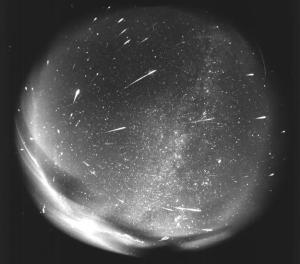
A long-exposure photo of a meteor shower. Credit: Juraj Tóth

A long-exposure photo of a meteor shower. Credit: Juraj Tóth

Tomorrow night, December 13-14, will be one of the most impressive meteor showers of the year: the Geminids. Meteor showers are caused when Earth crosses the orbit of a comet. Even if the comet is nowhere near Earth at the time, there will still be tiny pieces of rock from the comet strung out along its orbit. These pieces collide with Earth’s atmosphere and burn up as meteors. Most of these pieces are mere pebbles, but there will be a few larger chunks that cause bright fireballs that light up the sky and occasionally hit the ground.

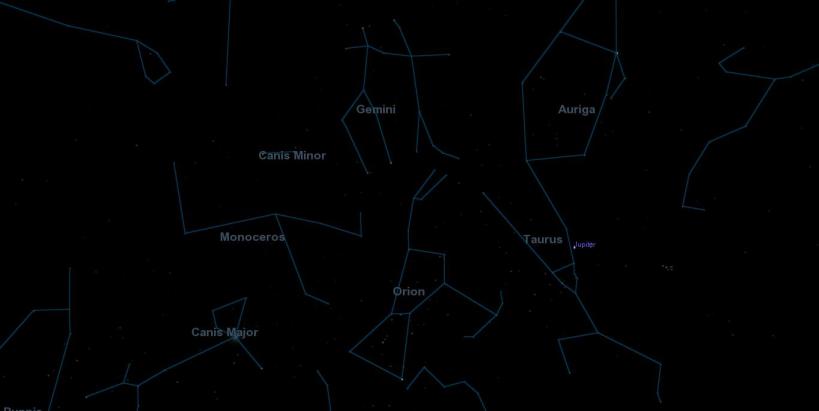
The Geminids are so called because they appear to come from the constellation Gemini. Their true source is the “asteroid” 3200 Phaethon, an old, dead comet that has lost all of its ices, leaving only a loose pile of rock. To see them, look out toward Gemini (near the more familiar Orion and Jupiter). A few hours after sunset (in the Northern Hemisphere), it should look like the picture below, but the best views will be after midnight.

The eastern sky in December, rendered by Celestia.

The eastern sky in December, rendered by Celestia.

It’s best to be in a dark area with a fairly wide view of the sky to see the shower. If you have good viewing conditions, you should be able to see over a 100 meteors per hour after midnight, which is when your part of the world is most face-on to the stream of meteors.

The Geminids are one of the three big meteor showers that are easily visible in the Northern Hemisphere. The others are the Quadrantids in January and the Perseids in August. In the Southern Hemisphere, you can see the Eta Aquariids in April. All of these showers regularly have close to or over 100 meteors per hour, but the Geminids hold the most promise for the future. Unlike the Perseids, which have been observed for over 1,000 years, the Geminids were first seen in 1862 and have steadily increased in intensity over the years.

The neat thing about meteors is that even though they are mostly pebbles and may look rather faint, they burn bright enough to be seen for hundreds of kilometers. If you see a meteor low on the horizon, it may be as far as 800 km (500 miles) away! So if you count 100 meteors per hour, you’re counting all of the tiny pebbles hitting a huge area of Earth. Multiply that by 100, and you’ve got the whole planet covered. That makes sense because the bits of rock scattered along the comet’s orbit have to be spread out enough that we don’t see them as a tail.Meteors can be seen from so far than astronomers can use reports of the same fireball from different places to triangulate where any pieces might have hit the ground. If you see a fireball, you can report it here. So check it out, count a few meteors, and you may get lucky and see something bigger.

Posted in Meteors, Stargazing | Tagged , , | Comments Off on In the sky: the Geminid meteor shower

It’s (not) the end of the world as we know it, part 2

What will not happen on December 21, 2012. Credit: Don Davis/NASA

What will not happen on December 21, 2012. Credit: Don Davis/NASA

In my last post, I explained how the end of the Mayan calendar is not a harbinger of the end of the world. However, you’ve probably seen stories about other predictions, even scientific predictions, that say something very bad will happen on December 21. Luckily, none of these are true either. Here’s a sampling of them to explain why.

Continue reading

Posted in Current events, Debunking, Doomsday predictions | Tagged , , , , , , , | Comments Off on It’s (not) the end of the world as we know it, part 2

It’s (not) the end of the world as we know it

A sketch of stela C from Quirigua, which gives the date of creation as 13.0.0.0.0

A sketch of stela C from Quirigua, which gives the date of creation as 13.0.0.0.0

By now, you’ve probably heard that on December 21, 2012, just two weeks from today, the ancient Mayan calendar will run out, and the world will end! This is approximately as silly as thinking the world will end on December 31 because your wall calendar runs out on that day.

How did this get started? Well, the Mayan civilization of what is now southern Mexico were some of the best astronomers who ever lived before the invention of the telescope. They measured the motions of the planets to great precision and constructed a very accurate and complex calendar system. To express dates over very long periods, they created the Long Count, which can list dates over a span of thousands of years as a string of five numbers.

In the Long Count, the unit 0.0.0.0.1 is 1 day. 0.0.0.1.0 is 20 days. 0.0.1.0.0 is 360 days, or 1 year on the Mayan calendar, even though this doesn’t quite line up with the Sun. Then, 0.1.0.0.0 is 20 years, and 1.0.0.0.0 is 400 years (394 years on our calendar). This unit is called a b’ak’tun.

According to inscriptions translated by archeologists, the Mayans believed the world was created on August 11, 3114 BC, a date that they rendered as 13.0.0.0.0 (sort of like how we start our day at 12:00 midnight in the United States instead of 0:00), The end of this first b’ak’tun was written as 13.19.19.17.19, which was followed by 1.0.0.0.0.

It turns out that on December 20, 2012, the Long Count gets back up to 12.19.19.17.19, the end of the 13th b’ak’tun, which will roll over to 13.0.0.0.0 on December 21. One Mayan text says that the current world is the fourth world, after three earlier worlds were created and destroyed by the Mayan gods. Since the most recent world ended on 12.19.19.17.19, we might be in trouble come December 21, right?

Wrong! Even if you happen to follow the Mayan religion (some people in Central America still practice a Catholicized version of it), the Mayans themselves didn’t believe the world would end with the 13th b’ak’tun. None of the inscriptions make any kind of unambiguous prophecies for that date. In fact, they didn’t even plan to roll over from 13.19.19.17.19 back to 1.0.0.0.0 again, something that would have happened on March 26, 2407. Instead, the calender will just keep going to 14.0.0.0.0, and one inscription extrapolates all the way to October 13, 4772, when 19.19.19.17.19 rolls over to 1.0.0.0.0.0. That’s right, they were ready to add a sixth number to the Long Count.

And that’s far from the most distant gave computed by the Mayans. Another inscription gives an alternate date of creation of 13.13.13.13.13.13.13.13.13.13.13.13.13.13.13.13.13.13.13.13.0.0.0.0! If the world still started on August 11, 3114 BC, we won’t cycle back around to that same date until January 28, 26,871,657,487,833,425,737,694,814,070. (That’s 2.687*10^28 years from now if you don’t feel like counting all those digits.)

One part of the Mayan story is true, though. The Mayans did believe that reaching the date of 13.0.0.0.0 was an important event: specifically, a meaningful anniversary and a cause for celebration. So take a page out of these people’s book, and have some fun with it. And don’t panic: it’s not the end of the world.

In my next post, I’ll explain why some of the particular theories of impending doom are just as absurd as putting stock in the Mayan Calendar.

Posted in Current events, Debunking, Doomsday predictions | Tagged , , , , | Comments Off on It’s (not) the end of the world as we know it

Dark planet

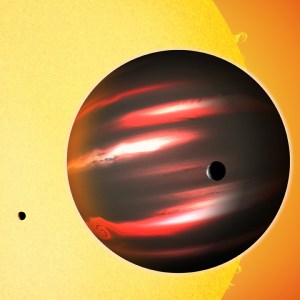
Artist's rendition of TrES-2b. Credit: David A. Aguilar (CfA).

Artist’s rendition of TrES-2b. Credit: David A. Aguilar (CfA).

A mirror is supposed to reflect back all of the light that hits it, but, being made of atoms, mirrors are not perfect. They typically only reflect about 95% of the light that hits them. Fresh-fallen snow also reflects a lot of the light that hits it–80-90%–but in a diffuse way that makes it appear white instead of reflecting an image. This percentage of diffuse reflection is called albedo.

White materials have a high albedo, while dark materials have a low albedo. For example, sand has an albedo of around 40%; for leaves, it’s around 20%; and charcoal, probably the darkest substance you’ll encounter on a regular basis, has an albedo of just 4%.

But some planets are much darker. TrES-2b (also known as Kepler-1b) is a hot jupiter. It orbits extremely close to its star–so close, in fact, that it glows red hot. And yet TrES-2b is one of the darkest objects ever observed in the universe. How is this possible? For that matter, how do we even know that?

TrES-2b eclipses its star as seen from Earth; when it crosses the face of its star, it blocks some of the light, but something similar happens when it goes behind the star. Now, the starlight reflecting off the planet goes away, as does the light the planet emits due to its heat. This is a much smaller change in the total amount of light we see from that solar system (we can’t see the star and planet separately), but we can still detect the change using the exquisitely sensitive telescope on board the Kepler spacecraft. Since we know the planet’s approximate temperature, we can guess how much of the light is reflected and how much is emitted as heat.

It was predicted that for many hot jupiters, the planets’ atmospheres would fill with a very dark haze of sodium and potassium metal, with an albedo of just 3%, but TrES-2b proved to be even darker. The planet reflects less than 1% of the light that falls on it, rivaling the blackest material we can create in a laboratory, even with nanotechnology.

Why is TrES-2b so dark? We’re not really sure. It probably has something to do with that sodium and potassium haze, and maybe titanium oxide (a dark chemical that is known to exist in the coolest stars), but the exact combination of chemicals that can make a planet that dark eludes astronomers.

Our telescopes have only scratched the surface of what’s out there. There’s a lot more planetary weirdness still to come.

Posted in Planets | Tagged , , , | Comments Off on Dark planet

NaNoWriMo wrap-up

It’s December 1, and National Novel Writing Month is over for 2012. According to the NaNo website, an estimated 300,000 writers officially took part this year, with 38,373 winning the event by reaching the goal of 50,000 words, and a total of 3,288,976,325 words were written. The Young Writers Program wrote an additional 419,139,457 words.

As I mentioned in a previous post, I did not participate in NaNoWriMo this year, but I did set an unofficial goal of line editing 50,000 words that I had already written. Line editing is a lot faster than writing things the first time, so despite a difficult week in the middle, I came out on top with 61,592 words edited. How did your NaNo experience go? Leave a comment below if you participated.

But now that the month is over, whether you finished or even participated or not, now what? Well, of course, the answer is, keep writing! Your novel isn’t done just because the month is. For one thing, 50,000 words is pretty short for a novel. In fact, it could almost be called a long novella. Even if you won NaNo, there’s a good chance that you have at least 20,000 more words of story that still need to be put on the page. That’s why many writers say that December is National Novel Finishing Month, or NaNoFiMo.

But even more importantly, if you’re a writer, you have to write, and if you only write seriously in November, then you’re missing out on 91.7% of the year. Or maybe you just need a break for the month of December. That’s fine, too; just make sure you pick it back up in 2013.

As for me, there’s not much slowing down here. I probably have enough of a backlog of editing to last me until spring. I’ll post later on with my some of my personal experiences and advice about the editing process, so keep an eye out for that, and, until then, keep writing.

Posted in NaNoWriMo, Writing | Tagged , , , | Comments Off on NaNoWriMo wrap-up

NaNoWriMo: the home stretch

At this moment there are just three days left in National Novel Writing Month. That may not sound like much, but it’s still 10% of the whole month. So if you’re still a little behind, don’t give up! And even if you aren’t able to reach you goal, don’t stop! Just write as much as you can by the end of the month, and try to write more next year.

Hopefully, some of you were able to catch up over the holiday weekend if you were behind. I actually did catch up and even worked ahead to reach my goal of line editing 50,000 words. Even though that’s not as impressive as it sounds–line editing goes fast–it’s still good to have reached it. So no matter where you are in your writing career, keep at it. In the end, you’re the only one who can stop you.

Posted in NaNoWriMo, Writing | Tagged , | Comments Off on NaNoWriMo: the home stretch

In the sky: Jupiter

Jupiter and its moons as seen through binoculars. Credit: Steve Ryan.

Look to the east after sunset, and you will see a particularly bright star, which is not a star at all–it’s the planet Jupiter. Jupiter is a favorite target of amateur astronomers because it’s one of the easiest objects in the sky to observe, and it’s always changing.

Jupiter is the fourth brightest thing in the sky, after the Sun, the Moon, and Venus. Since Venus stays inside the orbit of Earth, it stays close to the Sun, but Jupiter wanders all around the sky, making it easy to observe during the darkest part of the night.

The first thing you’ll notice about Jupiter, if you look at it through binoculars or a small telescope, is that it has moons. You can usually see some or all of the four large Galilean moons laid out in a line with Jupiter, and if you watch from night to night, you can even see them move.

Jupiter without its Southern Equatorial Belt, and three moons, as seen through a large telescope. Credit: Steve Elliot.

If you have a larger telescope, you can see the cloud features on Jupiter. The easiest things to see are the Northern and Southern Equatorial Belts, two wide brown stripes of clouds across Jupiter’s middle. With good enough eyes, you can also see the Great Red Spot, and the smaller temperate belts zones, although the colors might not come through very well, partly because of Earth’s atmosphere.

Each dark “belt” and white “zone” is a separate jet stream in Jupiter’s atmosphere, and they can move around, just like Earth’s jet stream. Most recently, the Southern Equatorial Belt disappeared for most of 2010, probably by sinking beneath the lower white clouds, before coming back in 2011. The change was easy to see from Earth, as the picture above shows.

The aftermath of the 2009 Jupiter Impact as seen by the Hubble Space Telescope. Credit: NASA, ESA, and H. Hammel (Space Science Institute, Boulder, Colo.), and the Jupiter Impact Team

Now for the observing challenge. Sometimes, asteroids and comets crash into Jupiter. The most famous was Comet Shoemaker-Levy 9 in 1994, but smaller objects hit it every few years. From Earth, these impacts can be seen as a flash of light followed by the formation of a dust cloud that can be as large as Earth and last for days.

The cool part is that there’s almost always someone observing Jupiter, at least when it’s up over North America, so the amateur astronomers can spot all these changes right away, even before NASA does. Recently, amateur astronomer Dan Peterson saw a flash of light on Jupiter that he thought might have been an impact and reported it to other astronomers on the Internet. As it happened, astrophotographer George Hall had his camera rolling at that time and found that he had recorded the impact on video.

So take some time to look at Jupiter, and you just might see something new.

Posted in Stargazing | Tagged , | Comments Off on In the sky: Jupiter

Welcome to the Future, Episode 1

An octocopter similar to the one used by SHARK. Credit: Ville Hyvönen

Ah, “the Future”: an era of flying cars, jet packs, ray guns, and robotic maids…well, from that list, it looks like we’re doing pretty well for ourselves.

No, the future isn’t quite what we expected. The Internet has made us more connected than anyone dreamed possible, but a lot of us still want our Moon base and robots that do more than just vacuum. Household amenities are near an all time high in western countries, but poverty, lack of education, and even access to water remain very real problems throughout much of the world.

But every few months, I see a story that reminds me that we really are living in the Future. A lot of the classic futuristic developments we’ve been waiting for have come about in the last three years or so, or are about to soon, from commercial rocketry to the impending eradication of polio.

Here’s the latest one: the animal rights group SHARK (Showing Animals Respect and Kindness) has been locked for months in a battle with pigeon hunters around the country. Their tactic is to send aerial drones similar to the one pictured above to video record the shoots in the hopes that the footage will convince those in power to ban the events. The hunters didn’t take kindly to this and responded by shooting down the drones four times.

The point here isn’t about hunters versus animal rights activists. It’s the fact that the animal rights activists are using drones in the first place. The robotic aircraft aren’t just for the military anymore. They’re poised to make a huge breakout in both the public and private markets in the coming years, with applications for police surveillance, emergency responders, and even paparazzi photographers. With prices starting at around $300, they could become common in the hands of ordinary people by the end of this decade. That may sound unsettling, but it is probably inevitable.

But what makes drones so much better than the remote-controlled aircraft that you can buy already? There are two main reasons. First, they don’t have to be human-controlled. They can fly on a predetermined path and navigate by GPS. Second, because of this, they don’t have to stay in range of a radio transmitter. They can save video and report back later, or connect by ordinary Wi-Fi or whatever else happens to be available.

If all this surveillance worries you, you’re in good company. Just as the amount of computing power in the world doubles every two years, so does the number of cameras. Think about it; in the days of film, most people only used cameras on vacation or at family gatherings. Today, two out of every three people on the planet carries a cell phone everywhere, and most of those cell phones have cameras. At this rate, it’s conceivable that every public space on Earth could be under constant watch within a few decades, often by drones.

But there’s another side to this equation; if cameras become that cheap and widespread, then huge numbers of them will be publicly accessible. So if someone’s watching you, there’s a good chance you’ll be able to watch them back, and that changes everything.

So welcome to the Future. No matter what happens, one thing’s for sure; it won’t be boring.

Posted in Welcome to the Future | Tagged , , , | Comments Off on Welcome to the Future, Episode 1

NaNoWriMo halfway (and a bit) through

If you’re participating in National Novel Writing Month (or NaNoWriMo), we’re a little over halfway through. If you’ve kept pace so far, at the end of the day today, you should be up to 28,333 words. Even if you’re behind, don’t worry. There’s plenty of time to catch up. As for me, I’m currently at 22,400 words of my personal 50,000 word editing goal for the month.

The month of November was selected for NaNoWriMo on the theory that the bad weather will keep people indoors and writing. Unfortunately, the Thanksgiving holiday can throw a wrench into that idea, and it’s particularly bad in the academic field, where November is one of the busiest months of the year. But if you’re not traveling this year, and you work in an industry that slows down around Thanksgiving, you can use some of that extra time for writing (as I’m hoping to do).

On the other hand, if November just doesn’t work for you, you can always pick a different month; your writing career doesn’t have to end on December 1 (and shouldn’t–more on this later). NaNoWriMo runs two summer sessions called Camp NaNoWriMo in June and August, and you can find informal novel writing events for every month of the year.

The first rule of writing is, “You must write”. It’s also the last rule, in my book, and probably a couple in the middle for good measure. It doesn’t matter what month it is; just keep putting one word after another, and you’ll get there eventually. So keep writing.

Posted in NaNoWriMo, Writing | Comments Off on NaNoWriMo halfway (and a bit) through