Two naked-eye comets in the northern skies

Photo of Comet ISON on November 16. Credit: Michael Jaeger.

Photo of Comet ISON on November 16. Credit: Michael Jaeger.

The northern hemisphere has been drawing the short straw when it comes to comets for the last few years. The last few really bright comets have all been in the southern sky. But that streak finally appears to be ending, with not one, but two comets in the northern skies that are visible to the naked eye.

You’ve probably been hearing about Comet ISON lately. The will-it-or-won’t-it hype has been growing as it finally brightens up, a little late. In a couple of weeks, ISON will make a harrowing perihelion pass only about 2 million kilometers from the Sun’s surface. Hopefully, it will survive, since other comets have gotten even closer to the Sun and survived. If it does, astronomers expect it to put on quite a show.

But right now, ISON is an early morning object. You’ll get your best view of it if you go out an hour or two before sunrise and look to the east. Near the bright blue star Spica, you should see a faint streak pointing straight up away from the horizon. That will be Comet ISON.

If your, a night owl, though, try and take a look at Comet Lovejoy, which has made a surprise comeback from a brief appearance earlier this year. You can see Lovejoy from about midnight on. Just look beneath the bowl of the Big Dipper. Lovejoy is making its closest approach to Earth right now (November 19), so don’t miss it!

Both ISON and Lovejoy are about at magnitude 5 right now, which is pretty faint, but not too hard to spot if you’re not in a city. But try to find some dark skies and dig out the binoculars, since that will likely give you the best view. Good luck.
Posted in Comets, Stargazing | Tagged , | Comments Off on Two naked-eye comets in the northern skies

Movie review: Ender’s Game

Poster by Summit Entertainment.

Poster by Summit Entertainment.

Ender’s Game by Orson Scott Card is considered one of the modern classics of science fiction, about a genius boy named Ender Wiggin, who is recruited to fight a war against alien invaders. Now, the movie is out, and I must say I was pleasantly surprised.

I would have thought that Ender’s Game was unfilmable (and I’m not the only one). It’s definitely not your traditional sci-fi action movie. Not only is it deeply character-driven, but it’s also incredibly dense with psychology, politics, and military tactics, much of which are integral to the plot. It’s impossible to show all of that in a visual media, and yet I thought that the film of Ender’s Game did an admirable job of it given the two-hour format.

As with any adaptation, fans of the book will note numerous omissions. For example, the entire B-plot of Ender’s siblings Peter and Valentine taking over the world through the power of the pen has been omitted, but that’s understandable for such a complex story. More difficult is the fact that the episode of the Giant’s Drink, and in fact many of the psychological obstacles that are put in Ender’s path are glossed over, skimming over the profound impact they have on him.

I think my chief complaint about the movie, though, is, ironically, that it suffers from a bad case of “show, don’t tell” with Ender’s time in Battle School. We see a few scenes demonstrating Ender’s tactical genius, but we have to be told how good he is by Colonel Graff. We also get a couple of scenes of his training with Petra and his development as a commander who earns the dedication of his troops. But in the novel, we read about Ender’s tactics in multiple battles, and he undertakes an extensive program of training the other recruits from the start. In the film, both of these sequences pass by without so much as a montage.

Even so, the film turned out pretty well. True, it feels a bit rushed, which is to be expected from such a dense story, but the story flows remarkably well. It’s coherent, entertaining, and at the most important themes of the novel still filter through clearly. Even the complexities of Ender’s character shine through, although this may be somewhat at the expense of the others. And I have to admit, the climactic final battle was much cooler than the one in the book.

All in all, it seems that they have done the impossible and made Ender’s Game into a reasonably good sci-fi movie. Like the novel, they even left the story open for a sequel. However, I’m not expecting Speaker for the Dead any time soon, since even Orson Scott Card himself thinks that is unfilmable.

My rating: 4 out of 5.

Posted in Movie Reviews | Tagged , , | Comments Off on Movie review: Ender’s Game

National Novel Writing Month begins

Photo Credit: Antonio Litterio.

Photo Credit: Antonio Litterio.

It’s that time of year again. Hundreds of thousands of writers around the world are gearing up for the biggest writing event of the year: NaNoWriMo. The goal is simple: write 50,000 words of a novel in the month of November. I did the same thing back in July, and I found it was easier than I expected, and a lot of fun.

Now, I don’t have any specific goals for November because I’m an academic, but if you’re not encumbered by the academic calendar, go for it. You may be surprised at what you can do. And for kids, there’s a Young Writers’ Program, where you can set your own goal.

If you’re not ready to start something new, don’t let that stop you. Finish a project. Edit a project. Outline a project. Write poetry. Even if you don’t join the official list, you can still make your own goal for November. As for me, I’m going to keep powering through my novel from July. 89,000 words and still a long way to go. Wish me luck.

Posted in NaNoWriMo, Writing | Tagged , , , | Comments Off on National Novel Writing Month begins

Mismatched planets

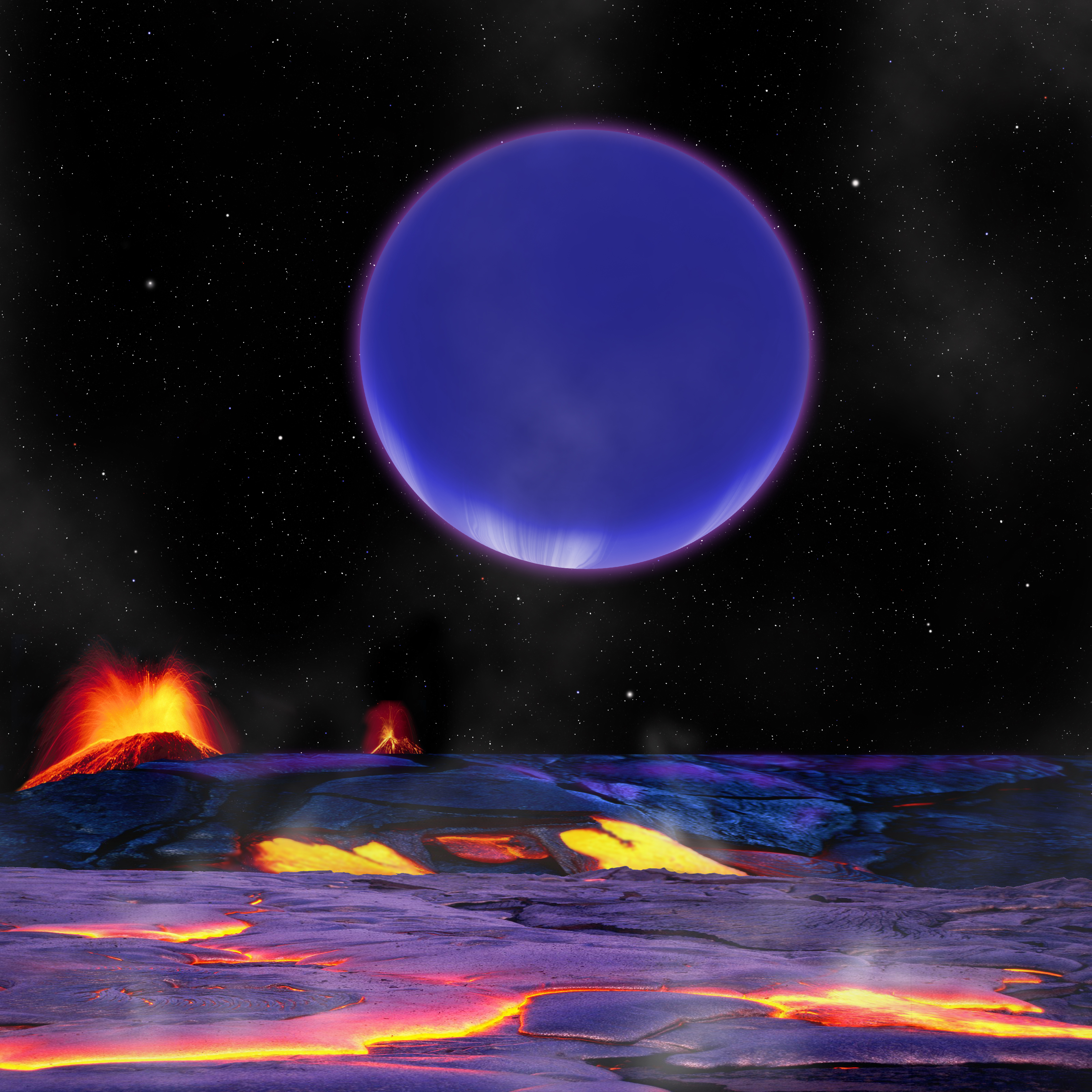
Artist's concept of the planets orbiting Kepler-36. Credit: Harvard-Smithsonian Center for Astrophysics/David Aguilar.

Artist’s concept of the planets orbiting Kepler-36. Credit: Harvard-Smithsonian Center for Astrophysics/David Aguilar.

We would expect that planets that form close together would be similar to one another. We would also expect that planets that form close together would stay close together and planets that form far apart would stay far apart. Therefore, we would not expect planets that orbit close together to be very different from each other.

Well, we expected a lot of things about planets.

The Kepler-36 solar system is arguably the most recent in a long line of exoplanet oddities. It has two planets that orbit very close together: the closest together of any known planets. The orbit of Kepler-36c is only 11% larger that that of Kepler-36b, a difference of only a few times the distance to the Moon. The larger planet would look 5 times the size of the full Moon in the sky at that distance.

The two planets’ gravity strongly affects each other’s orbits: the orbits are probably only stable because they are in an orbital resonance. Every time Kepler-36b orbits 7 times, its neighbor Kepler-36c orbits 6 times. That’s weird enough by itself, but the really strange thing is that the two planets look nothing alike. Both planets are super-Earths, a few times as massive as Earth. But Kepler-36b is almost as dense as iron, meaning it has to be pretty much all rock and metal. Kepler-36c, on the other hand, is less dense than water! The only way that could happen is if it’s a very small gas giant–a mini-Neptune.

How did planets that are so different wind up right next door to each other? The only guess is that they formed in different places and migrated to their current locations. We wouldn’t have expected them to be able to get so close, but there they are. Who knows what other strange new planetary discoveries await us in the next few years?

Posted in Planets | Tagged | Comments Off on Mismatched planets

Government reopens, NASA back on track

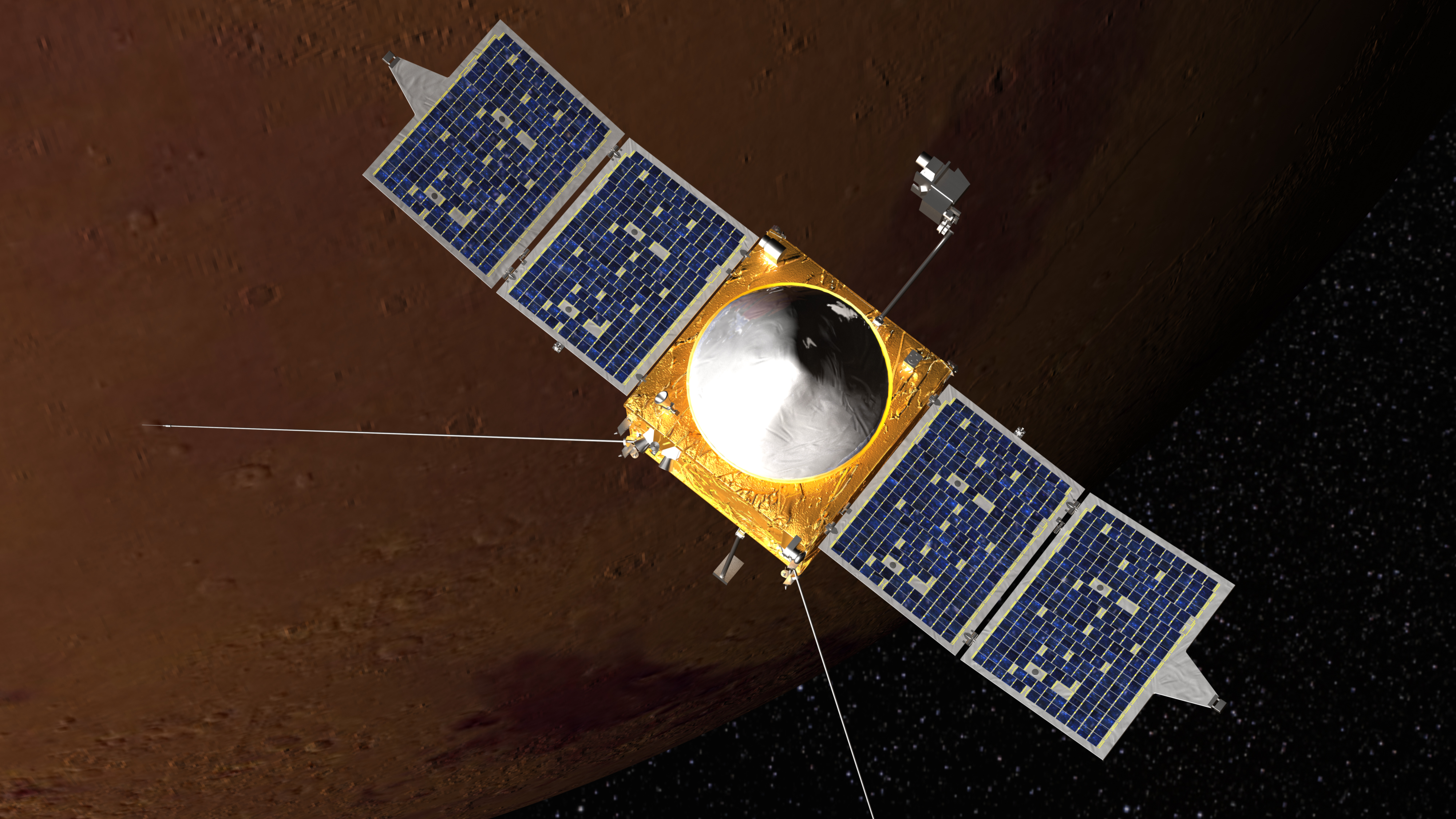
Artist's concept of the MAVEN spacecraft. Credit: NASA.

Artist’s concept of the MAVEN spacecraft. Credit: NASA.

On Wednesday, the US Congress passed a budget deal reopening the government and avoiding the much worse debt ceiling collision by only a couple of hours. Of course, we can expect loads more fun when the short-term deal runs out in January. But for now, government operations are back on track, and for NASA enthusiasts, that’s definitely a good thing.

NASA had been 97% closed during the shutdown, one of the highest ratios of any federal agency. Only critical operations for active space missions were running. The shutdown particularly threatened the MAVEN mission to Mars, which is due to launch in late November or early December.

NASA announced early on that MAVEN was cleared for launch as soon as the planets were properly aligned, but if a protracted shutdown had extended into November or December, the launch probably would still have been threatened.

Reopening NASA also means that other important operations like doing actual science, watching for dangerous asteroids, and maintaining the websites can start up again. So it’s all smooth sailing for now…at least until after the holidays.

Posted in Current events, Space exploration | Tagged , , | Comments Off on Government reopens, NASA back on track

Confirmed! 9 lost episodes of Doctor Who recovered

The Doctor fights his evil twin. Image credit: BBC.

The Doctor fights his evil twin. Image credit: BBC.

Doctor Who is an excellent British science fiction show about the titular time traveling alien, which has enthralled audiences literally for generations with the help of (depending how you count them) 13 lead actors. It celebrates its 50th anniversary next month and over the past half-century has inserted itself deep into British culture, including the meme of hiding behind the sofa whenever Daleks appear and a (sadly very short) shout-out in the opening ceremony of the 2012 Olympics. If you’ve never seen it before, you need to check it out.

Sadly, many of the episodes from the first 6 years of the show’s run were thrown away by the BBC to save shelf space, since there was no archiving policy until 1978. Many of those episodes have since been recovered from copies sent to branch offices around the world, but 97 episodes remain missing today. The audio recordings, however, are all still available.

But just this week, the BBC confirmed the find of nine missing episodes of Doctor Who in a storeroom in Nigeria, staring the second actor to play the Doctor, Patrick Troughton. The find includes all five missing episodes of The Enemy of the World, in which the Doctor must fight an evil future dictator who happens to look just like him, and four of the five missing episodes of The Web of Fear, where he faces down the Great Intelligence, who was also his main enemy in the most recent season. The Web of Fear also features the first appearance of soon-to-be Brigadier Alistair Gordon Lethbridge-Stewart, the longest-running character on the show besides the Doctor himself.

Even though it is smaller than was hoped, this is an amazing find, especially so close to the 50th anniversary. And since I’m one of those uber-nerds who has seen or listened to the audio tracks of all 798 episodes, I am definitely checking it out. If you’re in the mood for 60s-style science fiction, you should take a look, too.

Posted in Current events, Fiction | Tagged , , , | Comments Off on Confirmed! 9 lost episodes of Doctor Who recovered

Movie review: Gravity

Poster by Warner Bros. Pictures.

Poster by Warner Bros. Pictures.

Well, this is a treat. It’s not often you see such quality hard science fiction on the big screen these days. Gravity is a film about two astronauts trying to survive after the Space Shuttle is destroyed by flying space junk. And I have to say, not only is the science 99% accurate, even down to a rare portrayal of no sound in space, but it is also really well done.

Now mind you, a lot of the stuff that happens in the film is highly improbable, from the Hubble Space Telescope being so close to the International Space Station to the speed with which the deadly debris field forms. Neither of those is impossible, but the satellites would have to be deliberately moved into those orbits. You can see a fairly comprehensive list of the errors at Bad Astronomy. I’ll only add that in the scene where George Clooney is hanging on at the end of the tether, he actually could be pulled away if the Space Station is spinning, even slowly, although that doesn’t explain why Sandra Bullock drifts back toward it.

Yes, the plot is a bit thin, but it works in this case. Just three and a half hours of in-movie time is compressed into one and a half hours of real time, so we can afford to stop and admire the detail. And we jump right in with a beautiful and terrifying opening sequence: 13 minutes without a single camera cut, beginning with picturesque views of the Space Shuttle against the backdrop of Earth, through the same being shot to pieces by debris, even into and out of Sandra Bullock’s rapidly spinning space helmet, and finally into the darkness of Earth’s shadow.

We see all of the interesting parts of the next three harrowing hours in almost real time, as we learn about the pasts of the two astronauts. We see the long, narrow corridors of the Space Station, the cramped Soyuz capsule, and more, all portrayed true to life. We also see some truly quality acting and storytelling, especially for a film where we only see two (living) characters’ faces from start to finish.

The small cast is, indeed, the film’s Achilles’ heel, since it’s hard to overcome the challenges of such restricted storytelling, but the fact that it was so well done in spite of this, and while stubbornly refusing to use any cutaways or flashbacks, is admirable in itself. As of work of art, it’s one of the best films I’ve ever seen. As a work of storytelling, it’s “only” pretty good.

And I will add, you need to see it in 3D. I usually avoid post-converted films like this one, preferring to spring for the 3D experience only for movies that are shot in 3D, like Avatar and The Hobbit, but Gravity is a lot of CGI anyway, and in a rare success, the 3D really does add something. In fact, I think the 3D helps Gravity more than any other film I’ve seen except maybe Avatar.

If you like hard sci-fi, if you like the real-life space flight experience, I cannot recommend this film highly enough, and it has a lot to offer the more casual fans as well.

My rating: 4.5 out of 5.

Posted in Movie Reviews | Tagged , , , , , | Comments Off on Movie review: Gravity

Government shuts down: now what?

Image credit: Martin Falbisoner.

Image credit: Martin Falbisoner.

By now, you’ve probably heard that the United States government is shut down, having failed to pass a budget, something that last happened in 1996. I’ll spare the annoying political details and just say that neither of the two parties seems to have any serious interest in negotiating. The U.S. Constitution, of course, forbids the government from spending any money that is not appropriated by law–a law that Congress has not yet passed.

Now, a lot of the government is still running. Social Security checks are still going out. The mail is still being delivered. The airports are still open…although the TSA isn’t getting paid, which is a little disconcerting. All these things are covered by other laws, often multi-year deals.

On the other hand, a lot of “non-essential” things have stopped. National parks have closed. Many government websites are offline or are not being updated. A lot of agencies are closed, paperwork not being processed, and workers furloughed.

NASA has been hit particularly hard. The only people working there right now are the ones keeping the astronauts on the Space Station alive and keeping current missions like Curiosity and Dawn running (though not doing science). Many of its webpages are down, and while the data pages are still running, so non-NASA scientists can keep working with them, they aren’t being updated.

But the real danger here is to NASA’s next Mars mission, MAVEN. MAVEN is an orbiter intended to study Mars’s upper atmosphere and help with future ground missions. However, it has to launch between November 18 and December 7. Preparations for that launch have ceased. With the launch window so close, even a short delay could mean missing it, delaying the launch until 2016 and costing tens of millions of dollars in additional overhead.

So now what? Well, in a sane world, Congress and President Obama will resolve this in a few days. After all, the real trouble comes on October 17, when Congress has to raise the debt ceiling. If that falls through, then things get much worse. So politicians who know that “It’s the economy, stupid” certainly wouldn’t want to mess that up.Right…?

Posted in Current events, Space exploration | Tagged , , , , , | Comments Off on Government shuts down: now what?

In the sky: Venus

Venus, the nearest planet to Earth, has long been an object of interest in the heavens. It is the brightest point-like object in the sky (for now: it only narrowly edges out the International Space Station), and aside from the occasional bright comet and glints of sunlight off of satellites, it is the third brightest object overall after the Sun and Moon.

The ancients named Venus the Evening Star and the Morning Star, because it was visible when no other stars were. In the 1600s, Galileo’s observations of the phases of Venus were crucial to proving that the planets orbited the Sun–before, there was no proof that Venus actually went behind the Sun. And today, it is still a great target for stargazers.

Venus cycles between Morning and Evening Star every 19 months, and right now, it’s moving into its Evening Star period. It’s easy to spot: just look to the west after sunset, and it’ll be obvious. The hard part is not mistaking it for a UFO.

But there are some interesting quirks to observing Venus. On November 1, Venus will be at its maximum elongation–its greatest distance from the Sun–47 degrees. Depending on your latitude, that could be as far as halfway up the sky at sunset. Around that time, it will be most possible to see Venus during the daytime. No kidding. If you know exactly where to look, you can see Venus in broad daylight because it’s brighter than the daytime sky.

I’ll post more on how to do this later, but Heavens Above is a good reference for the right direction. You should stand in a shadow where you can’t see the Sun, find the approximate place in the sky, and look carefully around that area. You should see a tiny pinprick of light, and that’s Venus. I’ve done this myself up to an hour before sunset. If you look at Venus through a telescope at maximum elongation, it will be at half phase.

On December 11, Venus will be at its greatest brightness in the sky. At this time, Venus will be at crescent phase. Even though less of the visible part of the planet is lit up, it will be closer to Earth, so that will be the brightest time. At maximum brightness, the crescent of Venus is almost an arcminute long. That means if you have 20/20 vision, you will just be able to tell that it’s not a round disk. It will be easier if you have better than 20/20 vision or better than 20/20 eye wear.

Finally, let’s remember that Comet ISON is coming in December, and if it’s half as good a show as the models are predicting, it’ll be a beautiful sight, and probably even brighter than Venus. The two objects won’t really be in the same part of the sky, but there’s a good chance that Venus will have to give up its number 3 spot for a while.

Posted in Stargazing | Tagged , , , | Comments Off on In the sky: Venus

Welcome to the Future: the year we became an interstellar civilization

Artist's rendering of Voyager 1 in interstellar space.

Artist’s rendering of Voyager 1 in interstellar space. Credit: NASA.

When the Voyager 1 spacecraft was launched in 1977, it’s mission was to explore Jupiter and Saturn. But 35 years and 122 astronomical units later, the venerable probe entered interstellar space. Read that again:

We put a spacecraft in interstellar space!

Even with its nuclear batteries running down, Voyager is still doing science, taking readings of the tenuous gas at extreme distances from the sun. The Solar wind streams away from the sun at high speeds until is gets to about 100 times the distance from Earth to the Sun. At that point, it’s so spread out that it gets blocked by interstellar gas and gets swept away by the interstellar wind. Space is pretty empty to start with, but that far out, it took a whole year to get enough data to be sure that the spacecraft had crossed over into this interstellar medium. Last week, NASA announced that it had. In fact, Voyager 1 has been traveling through interstellar space–beyond the electromagnetic influence of the Sun–since August of 2012.

Let that sink in for a minute. Interstellar travel is hard. Just ask any rocket scientist. Getting anything far enough out to directly measure the interstellar medium is incredibly hard, just because it’s so far. But now Voyager is doing it.

This is history being made. The human species can now send probes clear out of our solar system. This should really be up there with landing a man on the Moon, leaving Earth’s influence to become an interplanetary civilization. Now, though unmanned, we can also leave the Sun’s influence and go interstellar.

Okay, so it’s not quite accurate to say we’ve left the Solar System. Comets fly much father away–sometimes over a light-year. But even if this is a largely symbolic gesture on those scales, it’s a pretty important one. Being able to directly interact with the Galaxy at large is no small matter. After all, that’s why we sent a message with it.

Posted in Space exploration, Welcome to the Future | Tagged , , | 1 Comment