Happy National Squirrel Appreciation Day

And now for something completely different! If you’re like me and facing impending wintry doom here in the Northeast, you could probably use a break. If you’re somewhere else in the world, here’s a highly random diversion for you anyway.

January 21st is National Squirrel Appreciation Day.

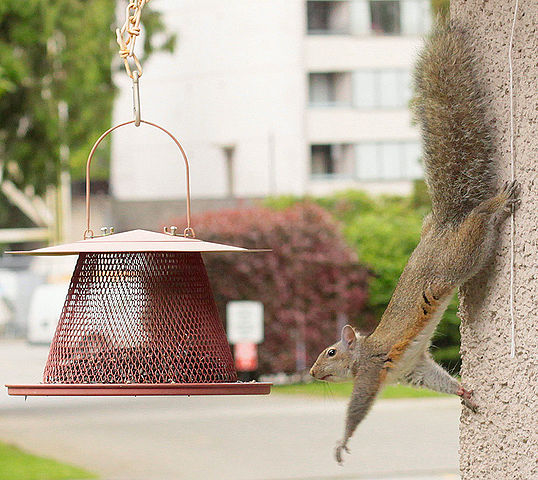
Eastern gray squirrel. Credit: waferboard (Wikipedia).

Eastern gray squirrel. Credit: waferboard (Wikipedia).

Squirrels are the only mammals that can climb down trees headfirst. This is because they can turn their feet around backwards.

Black squirrel (actually an eastern gray squirrel). Credit: D. Gordon and E. Robertson.

Black squirrel (actually an eastern gray squirrel). Credit: D. Gordon and E. Robertson.

In some parts of the country, including here in Princeton, you can see black squirrels. These are actually a subtype of the common eastern gray squirrel.


Fox squirrel. Credit: Davefoc (Wikipedia).

Fox squirrel. Credit: Davefoc (Wikipedia).

In the eastern half of the United States, gray squirrels coexist with fox squirrels, which may be distinguished by their larger size and brown undersides.

Squirrels are surprisingly intelligent and tenacious. Here is a fox squirrel successfully infiltrating a “squirrel-proof” bird feeder.

It would appear that “squirrel-proof” is a relative term.

Posted in General | Tagged , , | Comments Off on Happy National Squirrel Appreciation Day

The Magic Spreadsheet at one year

Photo Credit: Antonio Litterio.

Photo Credit: Antonio Litterio.

Nearly a year ago, I posted about the Magic Spreadsheet, which is a method to write at a steady pace by demanding you write a minimum of 250 words per day. In my case, it wasn’t the spreadsheet or the elaborate point system that I needed. It was just the mindset. 250 words is only one double-spaced page and isn’t that hard to write in 15 minutes, but it’s also enough to draft a complete novel in a year. Keeping that in mind is what motivated me to keep at it.

And it worked! I am pleased to announce that today marks 365 consecutive days of writing at least 250 words per day!

…Okay, so I have to cheat a little and define a day from 9AM to 9AM, but that was just the one time! Even so, I have written 150,000 words of original fiction in the past year, along with a fair bit of outlining and editing. And I did that in spite of having a considerably more difficult year than I anticipated.

I’ve learned two important things from this experience.

1. Sleep is important. Seriously, you cannot keep running your body on 5-6 hours of sleep night after night. Not even with caffeine. I learned that the hard way. You may feel like you don’t have the time, but trust me, you will be more productive if you take the extra two hours at night so you can actually be awake in the morning.

Basically, if your life starts to sound like this song, you’re doing it wrong.

2. Don’t give up! Even if you miss a day, it’s no big deal. Just keep at it, and make it up if you can. If you’re stuck on one project, work on a different one. Or do some outlining. Just keep the creative flow going. It definitely improves with practice.

Now, I’m still trying to solve my other problem: how to keep a steady pace of editing. If I ever figure that out, I’ll be sure to post it. Stay tuned.

Posted in Writing | Tagged , , , | Comments Off on The Magic Spreadsheet at one year

Of mice and men and monkeys

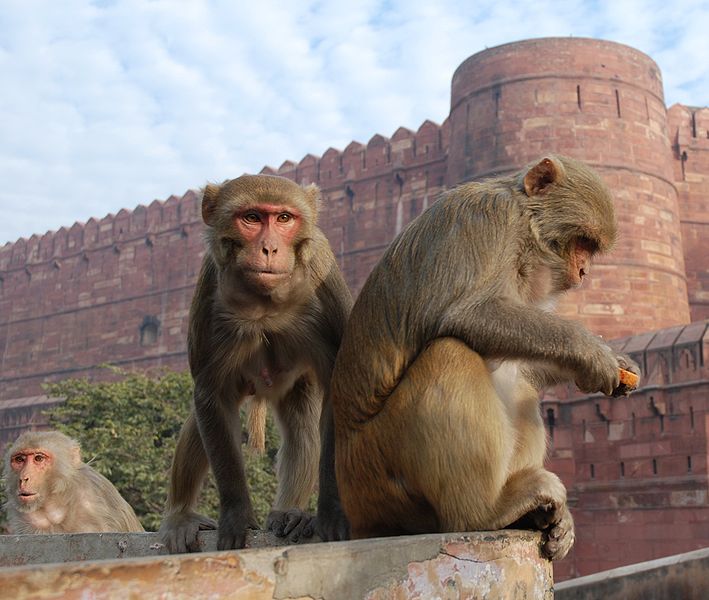
Rhesus monkeys in India. Credit: Thomas Schoch.

Rhesus monkeys in India. Credit: Thomas Schoch.

Caloric restriction is a diet in which humans or animals eat fewer calories than they normally would–anywhere from 20% to 50% less. It has become a fad diet for some, not just for losing weight (which is the obvious result), but also for improving overall health and extending one’s lifespan because of experiments that have been carried out particularly with rodents since the 1930s.

Caloric restriction (or CR) produces results in many species of mammals, but perhaps the most striking is in mice, where we see a very surprising result: if you feed mice half as much as usual, they live twice as long.

Now, proponents of the CR diet swear that by eating less–if you get your vitamins and maintain a healthy weight–you can live longer and healthier. But while their may be some health benefits when the diet is maintained correctly, you don’t see any Tibetan monks or members of other ascetic religious movements across the centuries living to 150. Obvious, caloric restriction doesn’t work quite as well in humans as it does in mice. So what gives?

Well, a recent study by the National Academy of Sciences this week presents an intriguing new answer. According to their analysis, it turns out that humans already eat half as much as other mammals. Apparently, we and other primates have very slow and efficient metabolisms that allow us to live longer lives.

This is already in line with something else we’ve noticed about mammals. Small mammals live very short lives, while large mammals live long lives, but most mammals live for about 1 billion heartbeats.

Consider this chart. A mouse’s heart beats 450-750 times per minute. Mice can live for about 3 years in captivity. That works out to between 700 million and 1.2 billion heartbeats. An elephant’s heart beats 25-35 times per minute. Elephants live 60-70 years. That’s between 700 million and 1.2 billion heartbeats.

But the average human can live for 3 billion heartbeats when well-cared for. And other primates are no slouches either. Our chimpanzee cousins can live for 2-2.5 billion heartbeats. It would appear that our slower primate metabolisms have already taken care of the easy caloric restriction solutions for longer lives for us. That’s bad news for anti-aging research, but it’s good news for human civilization. Having at least some people live to see their grandchildren grow up it very valuable for passing knowledge down from generation to generation. It’s a big part of what let us advance to the point of being able to do useful anti-aging research in the first place.

So don’t give up yet. Caloric restriction may be (mostly) a bust, but I’d say we have a decent chance of fixing some key diseases of aging in this century.

And then maybe we can get to 4 billion heartbeats.

Posted in Biology, Current events, Medicine | Tagged , , , , | Comments Off on Of mice and men and monkeys

GPI: a new way of planet-hunting

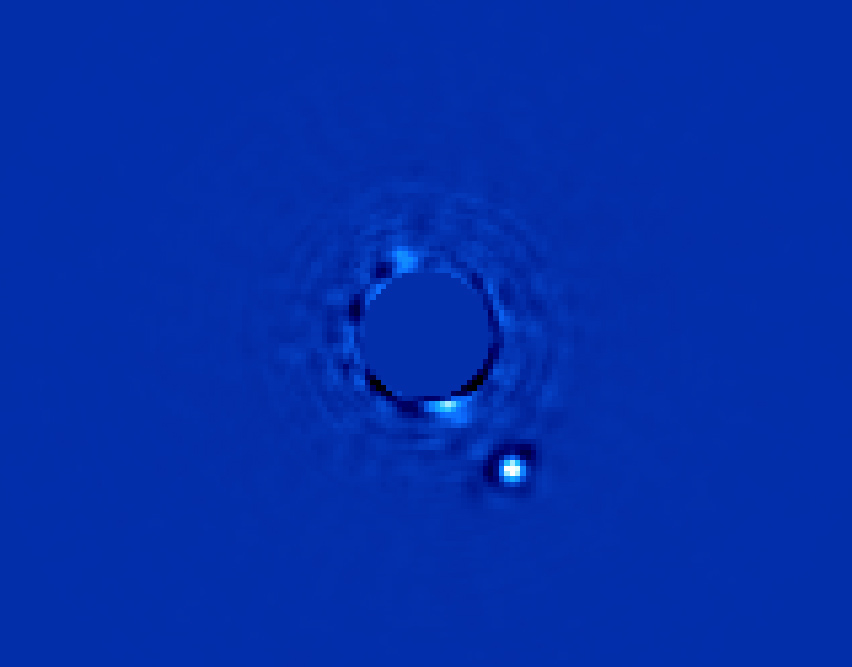
Infrared image of Beta Pictoris b from GPI. Photo processing by Christian Marois, NRC Canada.

Infrared image of Beta Pictoris b from GPI. Photo processing by Christian Marois, NRC Canada.

We’ve had the capability to find planets by taking pictures of them directly for a while now, usually in the infrared, but sometimes in visible light. But now we have the capability to do a whole lot more of it. GPI (pronounced GEE-pie) is the Gemini Planet Imager, the latest tool in the hunt for extrasolar planets, and it just came online this month.

GPI uses a telescope with a mirror the size of a studio apartment and a camera the size of a compact car to take pictures of planets not unlike Jupiter. GPI is expected to find dozens of these planets, at least, and better yet, take good enough pictures to study the infrared light they emit and find out what their atmospheres are made of.

So is GPI any good for finding Earth-like planets? Sadly not. We’ve got a long way to go to get there.

The first problem is that Earth is old. It’s five billion years old, which means it’s cooled down too much to give off much infrared light. To find old planets, we have to rely on reflected starlight in the visible range, and stars are much brighter and produce much more glare in visible light than in infrared.

The second problem is that Earth is small. That means it doesn’t reflect much light. A Jupiter-like planet in the same orbit would reflect over 100 times as much sunlight as Earth, making it that much easier to see.

The third problem is that Earth orbits close to the Sun. GPI is designed to see planets 5 times as far as Earth is from the Sun, or more. The glare from the star gets exponentially worse the closer in you go, so finding an Earth-like planet is that much harder.

Put all these things together, and you have what sounds like an impossible task. In fact, the task of spotting an Earth-like planet around a nearby sun-like star is roughly equivalent to–and I am not making this up–to spotting an ordinary flood lamp, just on the other side of town from an atomic bombfrom Mars.

And yet, people are working on it. There are fancy ways of using interferometry to combine two picture of a star so that the starlight all cancels out, and you only see the planet. Of course, you have to put some rather large telescopes in space to do it, and all the potential NASA missions for the job have been scrapped. But who knows, maybe one of them will be resurrected. It hasn’t stopped the proponents from trying. So maybe in twenty years or so, we’ll have a real life photograph of another Pale Blue Dot.

Posted in Planets | Tagged , , , | Comments Off on GPI: a new way of planet-hunting

Reading the Bible

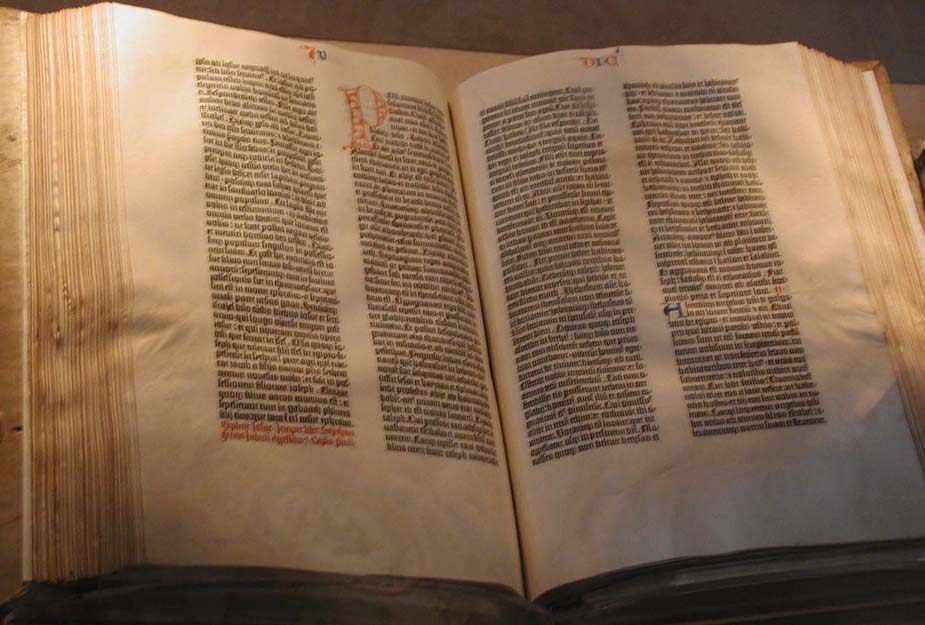
A Gutenberg Bible. Probably not the most practical version for reading. Credit: Mark Pellegrini.

A Gutenberg Bible. Probably not the most practical version for reading. Credit: Mark Pellegrini.

I have read every part of the Bible at least twice and probably a majority of it three times. But one thing I have not done is to read the whole thing cover to cover in order. So I decided that I would do that in 2014. However, I was not satisfied with the various reading plans that are available, so I decided to write my own, which I am now sharing here. After all, whether you’re a believer or not, reading through the Bible is at the very least a valuable cultural exercise.

Click here to read the plan.

In my close reading of the Bible over the past several years, I began to notice the importance of the larger narrative structure within books and even, to some extent, across books, which is easily missed in the way that we typically read the Bible. Reading short passages in church or single chapters in Bible studies are valuable modes of study, but they break apart the longer narratives that are intended to be read as a unit, for example, the story of the Flood, which stretches across four chapters.

Unfortunately, many reading plans that cover the Bible in one year do not take the narrative structure into account. The organization varies, with some plans being topical and some being chronological, but even those that run cover to cover often do little better than blindly dividing the text into three chapters a day. Followed strictly, this would put a break in the middle of the Flood narrative, which I feel is the wrong way to read it.

Therefore, in my reading plan, I took the narrative structure into consideration, which I consider to be at least the more logical way to read it, and in some cases is very likely the original intent. For example, Paul’s letters were each intended to be read in a single sitting, something that I have preserved, except for the longest ones. And the cover-to-cover organization is, indeed, important because that is the natural and traditional way to read the Bible since it was compiled, and it keeps all of the books in one piece.

I had two considerations in writing the plan. The first was to honor the layout of the text by keeping coherent narratives intact to the best of my ability. This often resulted in readings of very different lengths, with anywhere from one chapter to seven (Micah) eight (Songs of Songs) and in the case of the shortest Psalms, twelve.

The second consideration was to try to equalize the lengths of the readings based on the actual word count of each book. Since the lengths of chapters and verses can vary widely, simply dividing the text into sections of three chapters would result in very different lengths of readings by itself. Looking at the word counts allowed me to mitigate this issue by combining or breaking up the readings, at least where there is enough flexibility in the narrative. As a result, the shortest reading is 3 John, at 300 words, while the longest is probably all of Lamentations at 3400 words, which is only about one and a half times the average length.

I have also endeavored to make the readings consist mostly of whole chapters, but this is not always possible. For example, all of the clearly written breaks in the action in Mark occur in the middle of a chapter. For clarification, whenever a single number is written instead of chapter and verse, it always refers to a whole chapter.

Posted in Reading, Religion | Tagged , , , | Comments Off on Reading the Bible

2014 is coming! Are we ready for it?

Science fiction author David Brin has argued here and elsewhere that the defining year that begins a new century is not the year ending in 00, but the year ending in 14.

It’s an intriguing trend. After World War I began in 1914.

And the defeat of Napoleon (aside from his Hundred Days’ return) came in 1814.

Now, two datapoints aren’t much of a trend, but I contend that Brin has missed something. Students of history may remember what happened in the year 1714.

In 1714, the Treaty of Rastatt ended the War of the Spanish Succession, considered by some to be the first ever world war (others argue that the Nine Years’ War was the first).

The trend does not continue further back, although the start of the Thirty Years’ War in 1618 is something of a near miss. Even so, it is a pretty interesting coincidence. Given the frequency with which wars of that scale occur, the odds that any of their start or end dates would occur in the same year in three consecutive centuries are somewhere on the order of 5%.

2014

So will 2014 continue the trend? Hopefully not, but sadly, there are plenty of trouble spots around the world. On the other hand, with commercial space travel, jet packs, and a host of other technological innovations coming in 2014, maybe, just maybe, the twenty-first century will have a different kind of defining moment. Well, if we’re lucky.

Posted in Current events, General, Welcome to the Future | Tagged , , , | Comments Off on 2014 is coming! Are we ready for it?

Mapping the galaxy: Gaia takes off in time for Christmas

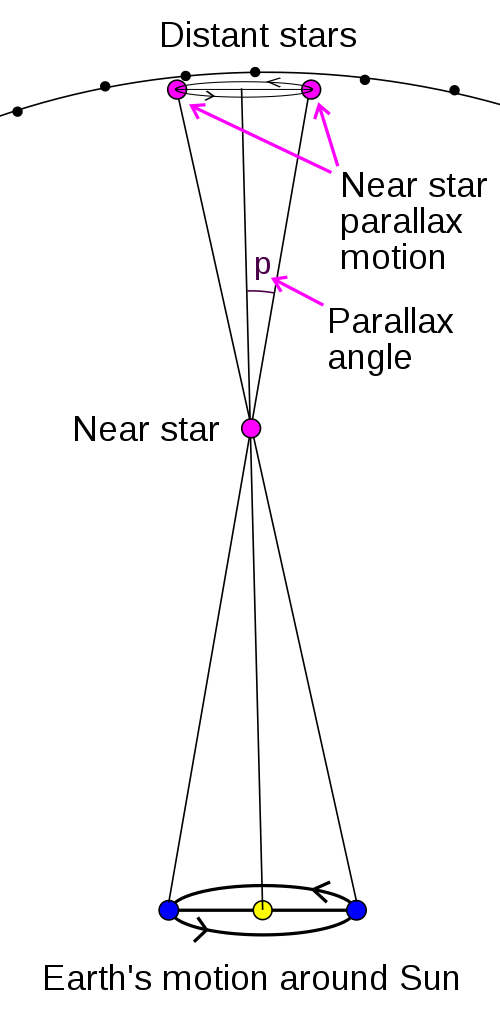
How distances to stars are measured with parallax.

How distances to stars are measured with parallax.

Measuring distances in space is hard. Measuring them accurately is very hard, mainly because everything is so far away. The best method is to look at the stars from places that are very far apart. Like, say, the same place on Earth…six months apart, when the planet is on opposite sides of its orbit. If you can do that, a little trigonometry will tell you how far they are, a technique known as stellar parallax.

The trouble is that stars are so far away, only large telescopes placed in space, above the atmosphere, can measure their positions accurately enough to measure distances to anything but the nearest stars. We’ve made great progress. The European Space Agency’s Hipparcos satellite measured the distances to 100,000 stars out to distances of hundreds of light-years, but that is not enough to get a good picture of the Galaxy as a whole.

Well that’s about to change with the new Gaia satellite, also built by the ESA. Gaia lauched last week, lifting its billion-pixel camera to the heavens to measure distances to the stars to unprecedented accuracy. By carefully comparing the amount of light that falls on adjacent pixels from the same star, Gaia will be able to measure parallaxes of 200 million stars as far away as the center of our Galaxy.

These measurements will let us make the best map of our Galaxy ever compiled, but that’s not the only thing it will do. Watching the positions of stars over time will show us the overall motion of stars in the galaxy. Slight wobbles in position will help us find planets with the previously-unsuccessful astrometric method, which will provide rarely-obtainable true masses. And on the side, it will be able to detect new asteroids and quasars, and test General Relativity.

Expect big developments over the next six years as Gaia begins its observing campaign.

Posted in Space exploration | Tagged , , , | 1 Comment

No, Wi-Fi does not hurt plants–or anything else for that matter

Harmful effects of Wi-Fi? Not so fast. Image credit: 9b Hjallerup School.

Harmful effects of Wi-Fi? Not so fast. Image credit: 9b Hjallerup School.

Few things make me more irrationally angry than the news stories that circulate on the Internet every year or so about the supposed health hazards of cell phones and Wi-Fi signals. It seems like there’s no end of studies that are inconclusive–that say, well maybe it causes problems, we can’t really say yet. And there are a few that actually purport to find harmful effects of these signals, up to and including brain cancer.

Part of this is a publication bias–studies that don’t find anything interesting are less likely to be published, and when they are, they don’t get as much play in the popular media. This is bad enough by itself. It creates sensational news stories that raise doubts where none should really exist. But some of the problems are far more insidious.

This story is an old one, but it’s been making the rounds again recently, about a Danish 9th grade class that tested the germination of cress seeds placed next to Wi-Fi routers versus those grown away from such signals. In the experiment, the seeds near the routers fared much worse, as illustrated by the picture on the left above, barely sprouting at all while the others were very green.

It looks like the seeds were very badly damaged by the Wi-Fi signals, but were they? From the experimental design alone, we can say probably not. This post breaks down the problems with the Danish experiment better than I ever could. The highlights include not paying attention to temperature, not reporting that a second group of seeds with Wi-Fi signals did just fine, and, most egregiously, misrepresenting the results in the above photo to make it look worse than it was. With all due respect to the budding 9th grade scientists, there are serious problems with this experiment that prevent any real conclusions from being drawn.

But the real problem goes deeper than this. I think the fundamental error of those who see a link between cell phones and other EMF radiation and cancer is failing to understand that science in medicine and science in physics are done differently. Since we’re worried about health effects, the natural thing to do is to look at the science of medicine. This can be seen in, for example, Congressional panels on the subject that don’t include a single physicist. But you can’t do that blindly on this issue because it mixes the two fields.

Science in physics is based on mathematical laws. Science in medicine is based on rules of thumb. If you drop a rock off a 49-meter-tall building, it will always hit the ground in exactly 5 seconds (ignoring air resistance), just because that’s how gravity works. If it doesn’t, you almost certainly did something wrong because if you didn’t, then there’s something wrong with gravity, and you had better go back to basics and think long and hard about what that might be, just like Einstein did.

On the other hand, in medicine, if you give the same drug to 10 different patients–or for that matter to the same patient on 10 different days–you’ll get 10 different reactions, and (and here’s the key) you probably won’t fully understand why. We don’t have the basic laws to work from–or at least not in nearly as much detail.

The fact is: based on the well-tested laws of physics as we understand them. Cell phones and Wi-Fi cannot cause cancer because the signals they emit don’t have enough energy. Let me repeat that:

Cell phones can not cause cancer. They don’t have enough energy.

The laws of physics say that. That means if you run an experiment that says they do, you almost certainly did something wrong, because otherwise, something is seriously wrong with the laws of electromagnetism.

This is the problem with the medical studies. They pretty much never postulate a physical mechanism for how cell phone signals could possibly cause cancer. Probably because there isn’t one. Under the laws of physics as we understand them, such an explanation does not exist.

This is more than just a rant against Luddites. The misreporting on this issue worries people unnecessarily and wastes the effort of everyone who keeps trying in vain to restrict cell phone and Wi-Fi coverage. Yes, there is something to be said for the precautionary principle–better safe than sorry–but in the words of a quote I read a while back (and cannot currently locate), “Worrying about your cell phone giving you cancer is like worrying about your dog mauling you to death, when your dog doesn’t have any teeth, and you don’t even have a dog.”

Edit, May 8, 2018: Years after I wrote this, I had a brainwave about this quote, and I wanted to correct it, especially since this remains my most-read post. The original quote wasn’t about cell phones at all. It actually came from the book Strange Matters by Tom Siegfried and addressed whether a particle accelerator could destroy the world by creating…well, strange matter. The quote was this: “[W]orrying about strangelets is like fearing your dog’ll bite you to death, when your dog has no teeth, and you don’t even have a dog.” I still believe the sentiment is valid regarding cell phones causing cancer, though.

The bottom line is this. If anyone ever managed to produce clear and convincing evidence that cell phones and Wi-Fi signals caused cancer or any other serious health effects, then we would have to go back to the drawing board and seriously rethink the laws of particle physics and run lots of new experiments down at the chemical and molecular levels to figure out just how electromagnetic signals that weak can possibly damage cells. Until and unless such a thing occurs, I’m not worrying about my wireless.

Posted in Debunking | Tagged , , , , , | Comments Off on No, Wi-Fi does not hurt plants–or anything else for that matter

A second planet seen in visible light–and it’s a weird one

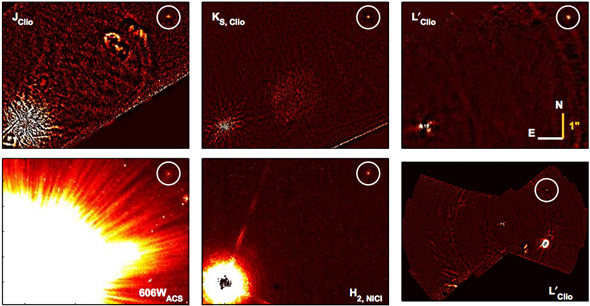
Images from various telescopes of HD 106906b. The bottom left is in visible light from the Hubble telescope. Printed in Bailey et al. (2013).

Images from various telescopes of HD 106906b. The bottom left is in visible light from the Hubble Telescope. Printed in Bailey et al. (2013).

You may have recently heard about HD 106906b, the latest of many oddballs in the rapidly growing exoplanet family. This planet orbits far away from its star, far enough that it is not lost in the glare, and can be seen with some of our best telescopes. In fact, it orbits farther from its star than any other known planet: an astounding 650 times the distance from Earth to the Sun. That’s 30 times the distances to Neptune.

We have no idea how this planet got there. Planets are supposed to form from a disk of gas and debris surrounding a young star, but there shouldn’t be enough gas that far out to form a planet this big. After all, it’s 11 times the mass of Jupiter. More likely, it collapsed directly out of the protostellar nebula along with the star itself. However, we’re still not sure how to make objects that small that way.

But its weird location is not this planet’s only claim to fame. A few planets have been directly imaged by telescopes before, but they’re usually in infrared light, where stars are dimmer and planets are brighter. Only two planets have ever been imaged in wavelengths of light that our eyes can see. The first was Fomalhaut b. The second is HD 106906b.

This planet was spotted in red light by the Hubble Space Telescope. It was possible because it not only orbits very far from its star, but it is also very young–only 13 million years. At that age, the planet is still glowing red hot from its formation, making it possible for Hubble to see it. Seeing smaller, more Earth-like planets is a much more difficult problem that we don’t yet have the technology to do…but we’re working on it. However, that is a story for another day.

Posted in Planets | Tagged , , , | 1 Comment

Watch Comet ISON skim the Sun tomorrow

The latest picture of Comet ISON as seen by the SOHO spacecraft. Credit: NASA.

The latest picture of Comet ISON as seen by the SOHO spacecraft. Credit: NASA.

On Thanksgiving Day, the much-anticipated perihelion passage of Comet ISON will occur, and astronomers around the world will be watching.

NASA is turning its fleet of Sun-observing spacecraft to watch as ISON plunges toward a fiery date with death or destiny. You can already see it in the pictures from SOHO. Click here or here to get the latest images, updated every few minutes. You can also see it in pictures from the far side of the Sun with STEREO.

But tomorrow is the main event. As ISON reaches its closest point, as close to the Sun’s surface than the size of the Sun itself and moving at 1% the speed of light, NASA will broadcast live pictures from the Solar Dynamics Observatory. There will also be a Google Plus Hangout here. The show starts at 1:00 PM Eastern, so if you’re not busy eating Turkey, check it out.

Tomorrow will be crucial to determining whether ISON becomes the Great Christmas Comet of 2013, or just a dud. After a slow start, it’s brightening nicely, and was visible in the early morning skies for the past week. NASA scientists are all but guessing at whether or not it will shatter under the Sun’s intense heat, but the very latest reports remain promising. Tomorrow, we will see in real time if ISON survives. Here’s hoping for a great show.

Posted in Comets, Stargazing | Tagged , , , | Comments Off on Watch Comet ISON skim the Sun tomorrow