Pluto Update: Mountains, Moats, and Methane

New images from space missions are often slow to be released. The Deep Space Network isn’t exactly broadband, and they have to process the images to make them look presentable. But we still have a few new shots of Pluto and it’s moons from New Horizons over the past week.

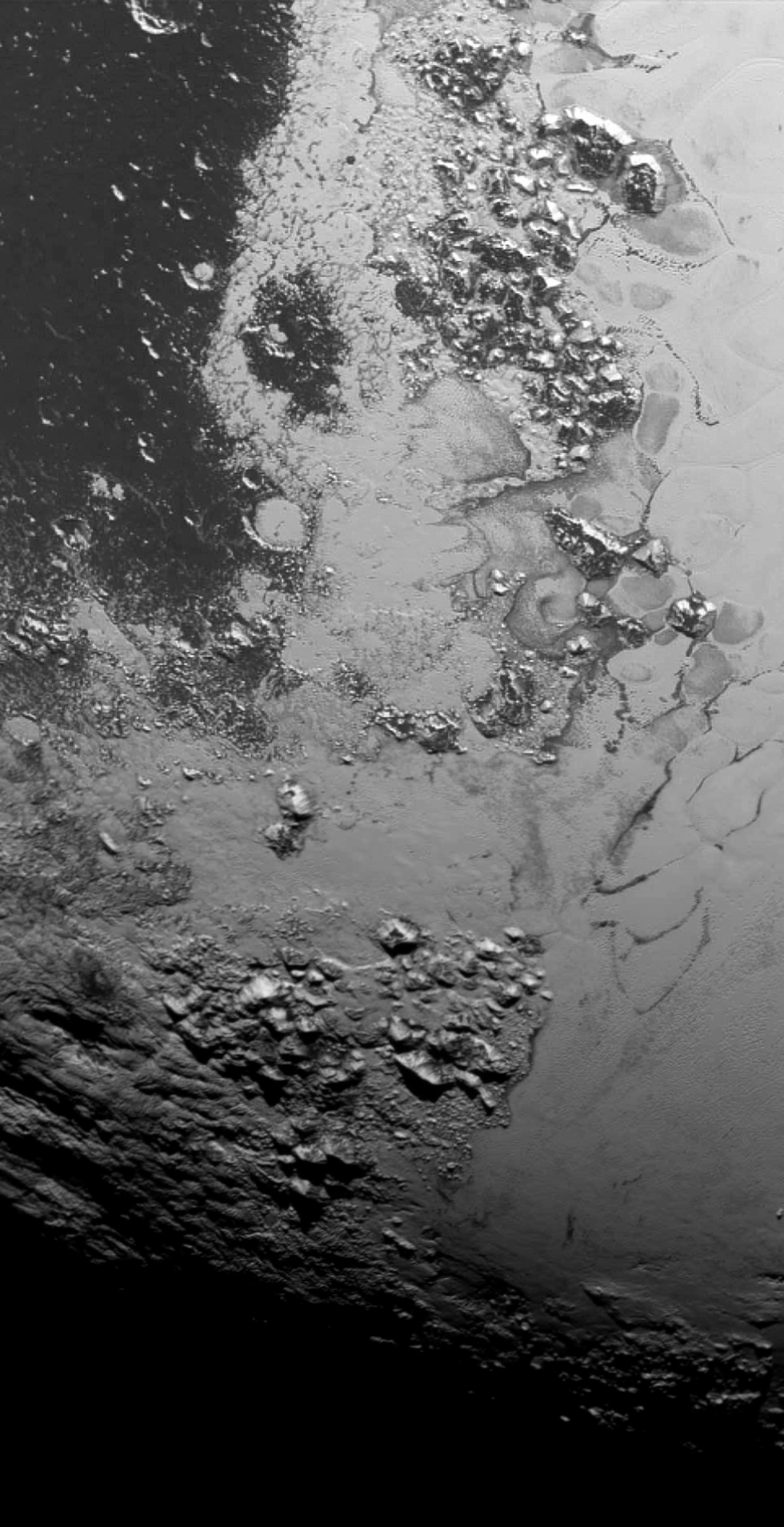
Mosaic image of the mountains in Pluto’s Tombaugh Regio. Credit: NASA. Click to embiggen.

That is a close-up of the southwest part of Tombaugh Regio, also known as “the Heart”. You’ll definitely want to click to see the full-size version. We see two mountain ranges, one in the north and one in the south, both the equal of the American Rockies–which appear to be plateaus of water ice sticking up about the crust. To the east are plains of bright carbon monoxide ice, while to the west are dark, cratered lowlands, probably covered with methane ice and tar.

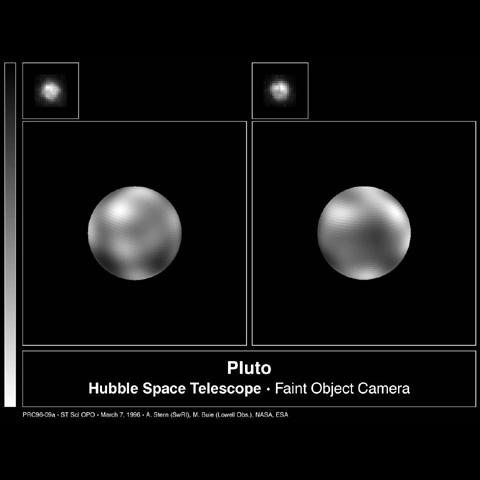
Hubble Space Telescope images of Pluto taken in 1996.

I’ll note that despite being covered with volatile carbon monoxide ice, which melts at 68 kelvin (9 degrees colder than liquid nitrogen), it’s actually a long lived feature, visible in Hubble Space Telescope images as far back as 1996. It’s kind of hard to tell, but it’s the bright spot on the left said of the right-hand frame.

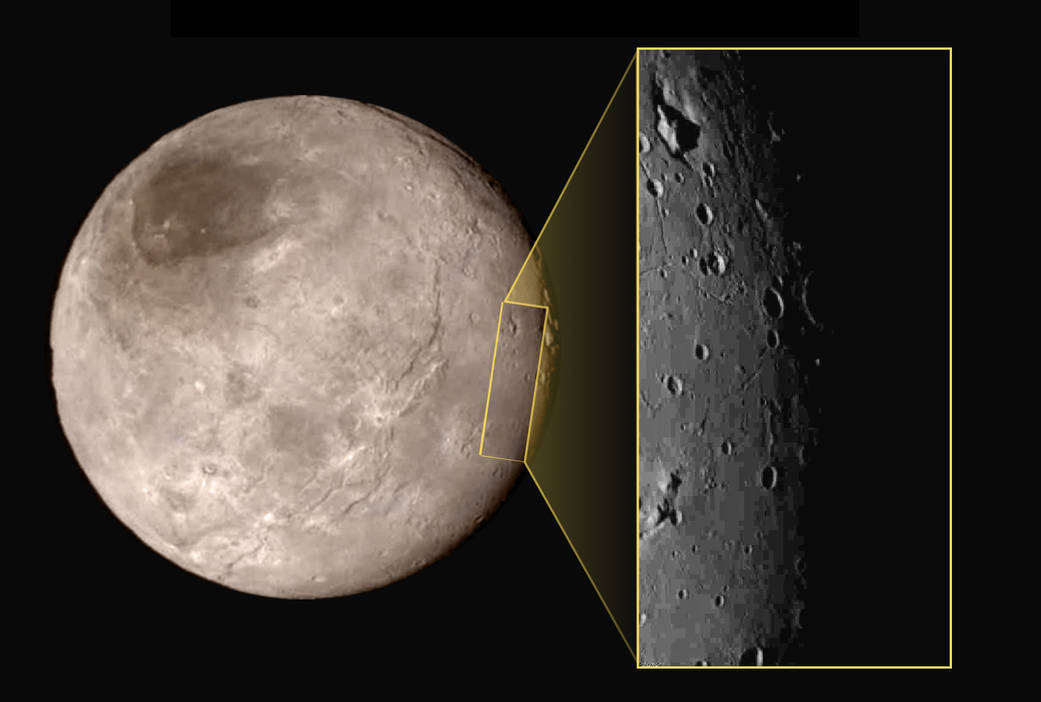
Close-up of Pluto's large moon, Charon. Credit: NASA.

Close-up of Pluto’s large moon, Charon.

Astronomers got a big surprise when they took a close look at Pluto’s big moon, Charon. That’s a mountain that appears to be surrounded by a moat. Nobody really knows what it is. My guess is that it’s some kind of weird volcano or some kind of weird crater–or maybe both on top of each other.

The best current images of Nix and Hydra.

The best current images of Nix and Hydra.

These are two of Pluto’s small moons, Nix (left) and Hydra (right). Nix is distinctly red, which, again, is probably due to methane-based tar on the surface. Hydra has a lopsided, comet-like shape, much like Comet 67P/Churyumov–Gerasimenko, as seen by ESA’s Rosetta mission.

Posted in Current events, Space exploration | Tagged , , | Comments Off on Pluto Update: Mountains, Moats, and Methane

Weird and Active Pluto and Charon

The New Horizons spacecraft successfully completed its flyby of Pluto on Tuesday and collected all the scientific data it was planned to without a hitch. On Wednesday, we got our first pick at what these new data revealed.

Methane Ice

False-color image showing the chemicals on Pluto's surface. Credit: NASA.

False-color image showing the chemicals on Pluto’s surface. Credit: NASA.

This is an earlier false-color photo from before the flyby showing where the methane is. The “heart”, now Tombaugh Regio, is on the left, just rotating into view. This chemical signature shows that the yellowish region at the north pole and the bright patch of Tombaugh Regio are both covered in methane ice, while the mid-tones are not. The dark patches south of the equator are also methane, but from their dark color, they are clearly not the same. The mission scientists haven’t explained this yet, but I suspect these are regions where methane ice has been turned into a tar-like substance called tholins by exposure to ultraviolet light from the Sun. This would indicate a much older surface.

Charon’s Young Surface

Pluto's largest moon, Charon. Credit: NASA.

Pluto’s largest moon, Charon. Credit: NASA.

Pluto’s largest moon, Charon, is also full of surprises. My money is on tholins again for the dark spot at the north pole and it appears to be a thin layer, since there are bright white crates blasted into it. But the rest of the surface is surprisingly bright and is probably made of water ice. This isn’t too unexpected. We assume that Charon formed in a giant impact like our own moon, then molecules like nitrogen, methane, and carbon monoxide that would form an atmosphere and other types of ice and frost would have been blasted away into space. The surprise is how few impact craters there are. That suggests that the surface of the moon is very young. The most likely reason for that is if the moon has cryovolcanoes that churn up new layers of ice to the surface, but Charon is small and has no tidal heating like the moons of the gas giants, so it was not expected to have volcanoes. The volcanoes would have to be powered by radioactive decay of natural uranium and thorium in Charon’s core. Charon also has canyons several times deeper than the Grand Canyon.

Pluto’s Rugged Terrain

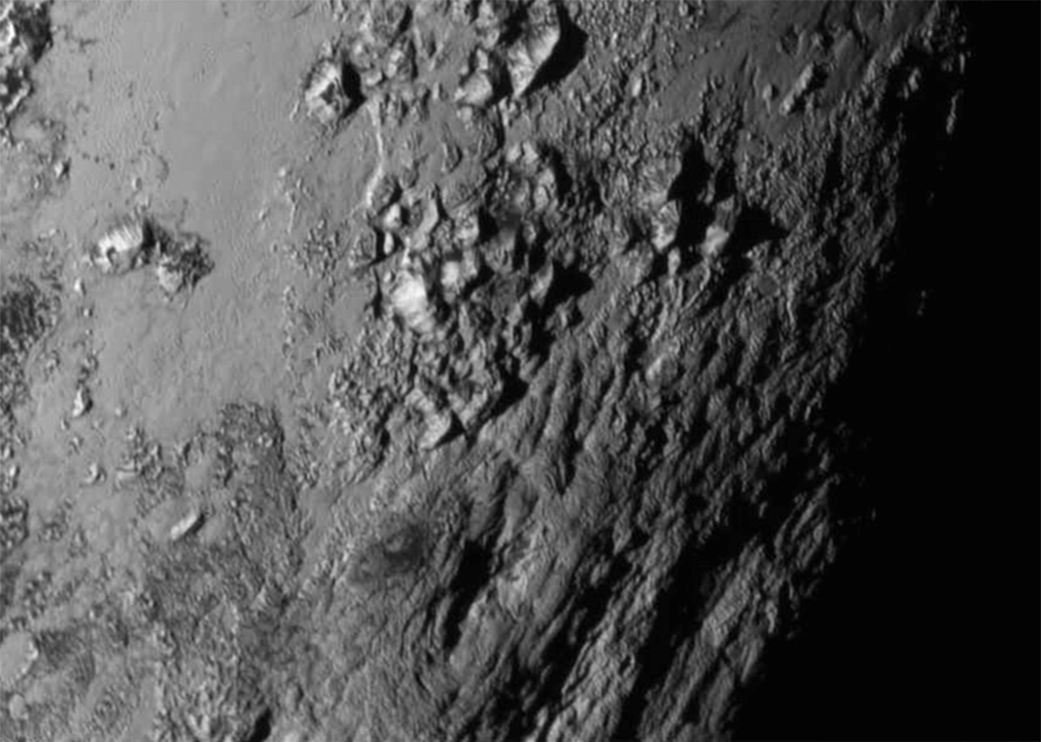
Closeup of the equatorial regions of Pluto. Credit: NASA.

Closeup of the equatorial regions of Pluto. Credit: NASA.

This is a close-up photo of the part of Pluto near the bottom of the picture, southwest of Tombaugh Regio. The big surprise here is that Pluto looks nothing like Neptune’s moon, Triton, which was thought to be very similar to it. Triton is weird-looking, but it’s flat. But this mountain range on Pluto is 11,000 feet high. On Earth, they would rival the Rockies or the Alps. Being that high, they have to be made of water ice. There also are no identifiable craters in this picture. That means the surface is only about 100 million years old, which is a big deal. That’s as young as most of Earth’s surface. If ice volcanoes are the cause, as we suspect, that means Pluto is as volcanically active as Earth!

We’ll have more pictures on Friday, and I’m definitely looking forward to them.

Posted in Current events, Space exploration | Tagged , , , , | Comments Off on Weird and Active Pluto and Charon

Pluto Update: Pictures and Video!

Update: New Horizons is alive! The flyby went as planned with no computer glitches. All the data appears to be there.

Also NASA TV is working now, and UStream appears to be offline, so click there for the press conferences. Expect more pictures tomorrow.

The last image of Pluto from before the New Horizons flyby, July 13, 2015. Credit: NASA.

The last image of Pluto from before the New Horizons flyby, July 13, 2015. Credit: NASA.

The New Horizons spacecraft is making its closest approach to Pluto right now! (Actually, I’m pretty sure that’s not counting the light travel time.) This is real time, but the first “I’m alive!” signals won’t get to Earth until 8:53 PM Eastern time tonight. The spacecraft will be too busy taking pictures to send us any data until then, but we got one last great image of the dwarf planet, shown above. It’s a lot more interesting than Mercury, let me tell you.

If you want to see this historic event live, NASA TV is covering everything, but don’t bother with the main page. It is overloaded, probably because of too many people trying to watching. Instead, click on the UStream feed here. To find out what events and pictures to expect over the next hours and days, check out this post.

This is a historic moment 15 years in the making–6 on the ground and 9 in space. Fittingly, today is also the 50th anniversary of the first ever flyby of another planet, Mariner 4’s flyby of Mars. It took 50 years to explore all the planets (what were considered to be all the planets for most of that time). Here’s even more exploration in the next 50 years.

Posted in Current events, Space exploration | Tagged , | Comments Off on Pluto Update: Pictures and Video!

Breaking News: Pluto is the Largest Dwarf Planet!

Pluto (right) and Charon (left) as seen by New Horizons, July 12, 2015

Pluto (right) and Charon (left) as seen by New Horizons, July 12, 2015. Credit: NASA.

At this writing, the New Horizons spacecraft is only hours away from its closest approach to Pluto. Except in the unlikely event that it crashes into something (*knocks on wood*) or the more likely event that its computer crashes (*knocks harder*), in a couple days, we will get long-awaited good-quality photos of Pluto, just like all of the planets. (Or the other Planets, if you’re still disgruntled about that.)

But we already have some photos that are just good enough to give us a good idea of what Pluto and its giant moon, Charon, look like, and the results are surprising. Pluto is an odd tan color, while Charon is slate-gray. Pluto has a large heart-shaped light area and a band of dark splotches. Charon has one weird dark spot at its north pole and chasms larger than the Grand Canyon. We don’t know what these features are yet, but we should soon.

Compare the best picture we could get with the Hubble Space Telescope:

There’s one big new surprise, though, which is that Pluto is larger than we thought. With the first ever good pictures, we now know that Pluto is 2,370 kilometers (1,473 miles) in diameter. The event that triggered Pluto being demoted from a planet to a dwarf planet was the discovery of Eris out beyond Pluto. But Eris is only 2,326 kilometers (1,445 miles) across.

So Pluto is the king of the underworld Kuiper belt once again! Well…not so fast. Pluto may be bigger around but Eris is still 27% heavier. How is this possible? Eris is denser because it’s mostly made of rock, while Pluto has a lot more ice, making it bigger despite being lighter.

But there’s a twist to this. Pluto reflects only about 60% of the light that hits it. That’s pretty normal for ice and a lot more than most other natural surfaces. (Earth reflects 30% and the Moon only 11%.) But Eris reflects a staggering 96%! With those kinds of number’s you’d expect Eris to be covered in fresh-fallen snow, except it’s too cold for any common chemical to snow there.

Mike Brown (the astronomer, not the football player or the guy who was shot in Ferguson) speculates here that a red color (redder than Pluto) is caused by methane frost slowly turning to tar under the exposure of the feeble sunlight, so Pluto may have some of that to explain its color, but Eris is something of a mystery. Unfortunately, at more than twice as far from the Sun as Pluto, Eris won’t be getting a visit from a spacecraft any time soon.

Next post, I’ll show the results of New Horizons’s encounter with Pluto, and after that, I’ll take on what may be most most controversial subject: why Pluto really shouldn’t be a planet (sorry, Pluto fans).

Posted in Current events, Space, Space exploration | Tagged , , , , | 1 Comment

Fan Fiction Review: Star Trek Continues, Episodes 1-4

Photo credit: Farragut Films, Dracogen Strategic Investments and Vic Mignogna.

Photo credit: Farragut Films, Dracogen Strategic Investments and Vic Mignogna.

I wrote about Star Trek Continues two years ago. It aims to create new episodes of the original Star Trek series in a style as close to the original as possible. I consider Star Trek Continues to be the best of the many Star Trek fan films and series, from the scripting, to the follow-ups to original series episodes, to the cheesy special effects, to Vic Mignogna’s spot-on overacting as Captain Kirk. There are now four episodes released, and I have to say they have about the same level of quality as the original series. That means they’re hit-or-miss, but there are gems in there.

Episode 1, “The Pilgrim of Eternity” features the return of the alien “god”, Apollo, from “Who Mourns For Adonais?”, and it was pretty good. I thought it was a really creative revisit to the concept with an interesting twist, and well worth watching.

Episode 2, “Lolani”, is the story of an Orion slave girl seeking her freedom. I disliked this one. The script was sub-par, and Kirk wasn’t thinking things through, even by his standards.

Episode 3, “Fairest of them All” follows immediately from “Mirror, Mirror”, showing how Mirror Spock begins reforming the Terran Empire in the Mirror Universe. I always enjoy seeing the characters hamming it up in the Mirror Universe, and this was no exception. I recommend this one.

Episode 4, “The White Iris”, explores the character of Captain Kirk in a rarely-seen depth. While some elements are pretty contrived, I very much enjoyed the exploration of how deeply hurt Kirk is by losing so many of the alien women he romances shows that there is much more to the captain than a space cowboy. I thought the primitive holodeck was a little over the top, though.

If you’re a Star Trek fan, definitely watch at least Episodes 1 and 3. If you’re a die-hard Original Series fan, I think you’ll enjoy all four. They could easily have been in the original series.

My rating: 4 out of 5 (on average).

Posted in Science Fiction, TV Reviews | Tagged , , , | Comments Off on Fan Fiction Review: Star Trek Continues, Episodes 1-4

You Know that Thing Where…?

What do you do when Google doesn’t understand what you’re talking about?

Google is a brilliant tool for the modern era. It can search for anything in the blink of an eye…well, not quite. Searching for print books and other copyrighted material is incomplete, at best, and for scholarly articles, you’re better off looking through a dedicated database like ADS or JSTOR. And let’s not even start on the open access issue.

But there is another problem I’ve noticed with Google over the years (and to be fair, this applies to search engines in general, not just Google). The problem is when you don’t know how to search for something because you can’t adequately describe it, or worse, you can describe it, but it’s apparently not in the terms that everybody else does. I’m talking about the kind of thing where you could tell an actual human being, “I’m looking for X,” and they would immediately respond, “Oh, you mean Y.” A real human would find what you need instantly, but Google will go on blindly searching for X, maybe even synonyms of X, but unless you get lucky it will never lead you to the magic word, Y, that will actually answer your question).

What do you do then? I have no idea.

If you’re still confused, here are some examples. (And if you know the answers to any of them, please comment.) None of these are particularly notable. They’re just the ones that happened to cross my mind that I’ve had trouble finding in the past.

1. How long would it take a microscopic black hole created by the Large Hadron Collider to eat the Earth? (Please note: there are good reasons to think this is impossible.) I’ve looked for this answer a few times and never really got very far. It’s not an obvious question because you need to figure out how often a micro black hole, which is much smaller than a proton, would eat a proton, which is a quantum waveform, anyway. That’s complicated because the Earth is under pressure, but it turns out there is a name for the amount of time it takes for a black hole to eat its own weight in gas. It’s called the Eddington time, and it’s about 400 million years. Any faster, and it generates too much heat, repelling the gas. The Eddington time is really only mentioned in scholarly articles, but it’s related to the better-known concept of the Eddington luminosity.

This is the problem with Google. It happens when there is only one way that something is commonly described, and related search terms don’t turn anything up. If you flail around, searching for “How long would it take a black hole to eat the Earth?” and a bunch of other, related things, you’re not going to turn up scholarly articles because scholars don’t talk that way. They only use the phrase “Eddington time”. So it’s only if you’re already an astrophysicist, and you already know the magic incantation, “Eddington time”, that you’re going to find you’re answer. It’s an Internet Catch-22.

2. Is there a concept in psychology for when children are more frightened by their parents’ reaction to a scary thing than the scary thing itself? For example, a child might climb a tree without fear, but when they see their parents freaking out about them being up a tree, they might freak out then and develop a fear of heights. What little information I could find suggests that this is rare. However, I have heard this idea voiced multiple times in the past. I just can’t remember where. And I was surprised that none of the obvious search terms turned up anything.

3. What’s the deal with calling kings, queens, and lords by the names of their countries? This is a form of metonymy that has been used for a long like. An example comes from Shakespeare’s Macbeth, where Macduff addresses the rightful king, Malcolm, as “Oh, Scotland, Scotland!” Scotland is used for Malcolm’s name, not the country.

An even more specific construction, not used by Shakespeare here, would take the form “Scotland of Scotland”. That is, Scotland (the king) of Scotland (the country). I’ve seen this in multiple places. In Doctor Who, the king of the planet Peladon is called “Peladon of Peladon”. In the 25th century world of The Stars My Destination, the CEOs of the centuries-old mega-corporations have become feudal lords with names like “Kodak of Kodak”. It doesn’t seem to be a new construction.

I don’t even know how to begin to search for this because it doesn’t have a fixed form. The only word that’s constant is “of”, and I don’t know any historical examples to look for.

Edit, July 15, 2018: When I wrote this post, it mostly out of frustration, though I believe most of what I said is still valid. However, I did find an answer to this specific question. I eventually stumbled on a commentary on The Stars My Destination that explained that this is the standard form of address for the heads of Scottish clans. It’s still a really weird direction for future megacorps to go.

4. What do you call the very phenomenon I’m talking about? Searching for how to search for things doesn’t turn up anything useful. I found a few references to “magic words”, but they apparently weren’t magic enough for me to dig deeper. This is the most frustrating part. I can’t search for things I can’t describe properly, and I can’t figure out how to search for them because this is one of them.

Maybe Google just needs to hurry up and invent A.I. that can understand human language.

Posted in Internet | Tagged , , , , , , | Comments Off on You Know that Thing Where…?

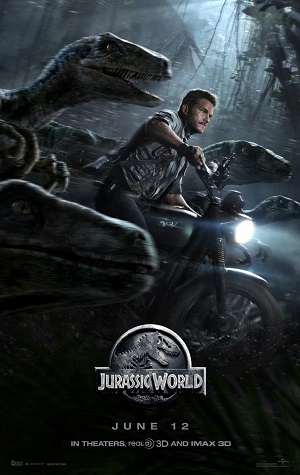
Movie Review: Jurassic World

Two decades after the disastrous events of Jurassic Park, Jurassic World is a wildly successful theme park serving millions of visitors every year. That is, until the experimental, genetically modified, highly-intelligent super-predator (because regular dinosaurs are boring, now), Indominus rex, escapes its cage and starts eating people. Oh, and the raptors are trained now.

That’s about all you need to know about the long-awaited fourth installment in the Jurassic Park series. After ten years in development hell and multiple, wildly-varying rumors of scripts, the dinosaurs are finally back on the big screen.

So how was the film? Eh, not as good as I’d hoped. I’d rank it above Jurassic Park III (which isn’t hard to do), but below The Lost World. The movie’s chief flaw is that it tries to do too much, and it’s more than a little derivative. The writers essentially tried to squeeze too many references and plot elements from the first two movies into a two-hour script, making it “bigger, scarier, and cooler”, just like Indominus rex, but the result was disjointed and too short on exposition.

There are also two big technical problems I have. One, I just can’t suspend my disbelief that they couldn’t control the dinosaurs better, even an intelligent hybrid. And two, Mosasaurus was not that big. Probably closer to half the size.

That said, there are a lot of great scenes in the movie, and many of the references to the original film were really well done. I just could have done without the corrupt corporate executives and such. If you liked the original, I would recommend you go see this one, too.

My rating: 3.5 out of 5.

Posted in Movie Reviews | Tagged , | Comments Off on Movie Review: Jurassic World

Movie Review: Tomorrowland

Tomorrowland: a parallel dimension somehow accessed by Thomas Edison and Nikola Tesla in 1887, in which the world’s most brilliant inventors and creators built a utopian, futuristic city to solve all the world’s problems. In the 1960s, the people of Tomorrowland were ready to share their technology with the world. But then something went wrong.

Today, the future looks bleak. All the news is bad, and no one is trying to push the limits of human achievement anymore. Casey Newton (Britt Robertson), a brilliant and tech-savvy teenage girl, is one of the few optimists lefts, and when she tries to stop NASA from tearing down the old launch pads, she is approached by a robotic girl named Athena (Raffey Cassidy) to recruit Tomorrowland exile Frank Walker (George Clooney) to try to fix both worlds. What follows is an adventure of killer robots, a well-intentioned extremist Hugh Laurie, and some surprisingly deep philosophical thought–and a story that I think has been underrated.

My rating: 4 out of 5.

Warning: spoilers below. Continue reading

Posted in Movie Reviews | Tagged , , , , | Comments Off on Movie Review: Tomorrowland

What If? Rejects #6.1: A Well-Balanced Meal, Part 2

Part 1. Part 2. Part 3. Part 4.

In Randall Munroe’s What If?, one of the most complex questions that he declines to answer is the following:

What is the total nutritional value (calories, fat, vitamins, minerals, etc.) of the average human body?

Since he didn’t answer, I took it upon myself to try. Previously, I calculated that the average human body contains 560 3-ounce (85-gram) servings, each containing 200 calories. Now, let’s break down some of the nutritional details.

Calories from Fat

On average, the dry weight of the human body is about 44% protein, 36% fats, 4% carbs, and 16% minerals, and fats contain 8.8 calories per gram. Cooked meat is about 55% water. Do the math, and that means the human body has 120 calories from fat (60% of total calories) per serving. Wow, we are not a healthy diet, are we?

Macronutrients and Percent Daily Values: Fats

This is the middle part of the nutrition facts label (except sodium and cholesterol). This tells how much of the basic dietary components you’re eating–fats, carbs, and proteins. For example, our 85-gram serving of human contains 14 grams of fat. The labels will also give a “% Daily Value” for each nutrient, which is the fraction of the recommended daily amount of that nutrient you get per serving. Percent Daily Values are calculated based on a 2,000-calorie diet. For fats, the recommended daily amount is 65 grams or less, so you’re getting 21%.

Nutrition facts labels also list two subtypes of fat that are supposed to be especially bad for your health: saturated fat and trans fat. I couldn’t find anything about the amount of specific types of fat in the human body, but a typical saturated fat fraction for red meat is about 35%, so we’ll go with that. That gives us 5 grams of saturated fat, or 24% DV.

Trans fats are rare in nature, mostly being found in processed food, but cattle and sheep have 2%-5% of their body fat in trans fats. In humans, this varies with trans fat consumption and is as low as 1% in people who don’t eat much trans fat, but can be as high as 7% in the United States. Making some allowances for the average global diet, let’s go with 2%. This gives humans 0.3 grams of trans fat per serving, rounded down to 0 grams. There is no Percent Daily Value for trans fat because the recommendation is as low as possible.

Cholesterol

Cholesterol isn’t a nutrient per se, although you can classify it as a type of fat, but it’s grouped with the other macronutriets, so we’ll examine it here. An average 61-kilogram human body contains 31 grams of cholesterol, or 56 mg per serving. This is 19% of the Daily Value.

Carbohydrates

Unlike plants, for which carbohydrates are a structural material, animals have relatively little carbohydrates in their bodies, and they are mainly used for energy storage, while fats are the main structural material. Our hypothetical serving of human only contains about 2 grams of carbohydrates, or less than 1% of the Daily Value. We are an extreme low-carb diet.

The primary forms of carbohydrates in the human body are glucose, a sugar, and glycogen, a starch. Most other carbs are converted to one of these two forms or passed as fiber. In a healthy adult, only about 5% of this energy storage is circulating as glucose at any one time, so the sugar content per serving is basically zero. Ditto for fiber, which is just a less digestible form of carbohydrate.

Protein

Animals have lots of protein, more than any other type of nutrient. In this case, the amount is 17 grams per serving. Protein does not have a recommended daily amount, hence the relative popularity of low-carb and low-fat diets.

Next time: vitamins and minerals (and sodium, which is technically a mineral).

Posted in Biology, Medicine, What If? Rejects | Tagged , , | 1 Comment

What I Learned From Writing The Wayfarers

Photo Credit: Antonio Litterio.

Photo Credit: Antonio Litterio.

Last week, I published one of my short stories, The Wayfarers, and previously, I also described my writing process that went into one of my other stories, The Lacertan Indicent, and what I learned from it, so I wanted to do the same for this one.

Interestingly, the main takeaway from The Lacertan Incident was not to be too sure of yourself and to recognize the flaws that go into an initial draft. However, the main lesson I learned from The Wayfarers was not to give up on a bad story.

The Wayfarers was the first story that I tried to publish. I wrote it in 2008, and while it wasn’t the first original story that I wrote, it was the first that I tried to polish up and make it good enough to put in print.

It wasn’t. Not in that draft, anyway. I didn’t get any bites, set it aside for six years, and then took another look at it for this blog. Honestly, the story never thrilled me from the start, but when I reread it, I saw massive structural flaws. There were too many characters, the dramatic arc was completely jumbled, the writing was stilted and too verbose, and to top it all off, the science was wrong.

The original story didn’t have the sky on the ships being lit a natural sky blue by the blueshifted microwave background. It was pitch black, with distant galaxies barely visible without a telescope, and that was a big part of the tone–darkness, isolation, and a profound silence in the universe outside. The story falls in a distant part of the same fictional universe as The Lacertan Incident. At the time, I hadn’t fully worked out how faster-than-light travel should work, and when I did, all that changed.

This meant I had to make a choice: either abandon the dark and silent tone of the story that had been a big part of its initial appeal, or throw it out of its fictional timeline and spin it off into a standalone story. Either option would have meant rewriting half the story, and given the flaws in the writing itself, I decided to take a third option: I threw it in the proverbial trunk and forgot about it.

For about twelve hours. After sleeping on it, I thought about the story again and decided that the structural flaws weren’t insurmountable. It did take a lot of rewriting, though. Most of the descriptions had to change to reflect the revised science. I cut out one character entirely and downplayed Thurgood’s wife. The part where they activate the engines was originally early on, and I moved it to the more emotionally satisfying end position, and in doing so, I consolidated the whole thing down from eight scenes to five, greatly simplifying it. This in addition to revising and proofreading to improve the flow of the words.

It took a lot of work for the length of the story, and it’s not perfect, but I salvaged it. What I learned from writing this story is not to give up on your writing. Even if something is seriously wrong with it, if you think carefully and are creative, you can usually find a way to fix it.

Posted in Fiction, Writing | Tagged , , , | Comments Off on What I Learned From Writing The Wayfarers