Book review: The Shambling Guide to New York City by Mur Lafferty

Mur Lafferty is the author of the excellent I Should Be Writing podcast, which provides useful advice to writers of all calibers. After self-publishing a variety of fantasy and science fiction works, Lafferty now debuts her first professionally-published novel, The Shambling Guide to New York City.

The Shambling Guide’s Zoë Norris has made a small name for herself as a travel guide editor and is looking for a fresh start in the Big Apple. While she manages to land a new job, she is introduced to the underground world of the “coterie” (“monsters” is derogatory), filled with vampires, zombies, demons, fairies, and more–a world where most of her coworkers want to eat her, and they’re not even the most dangerous things around. Just a few weeks into her new job, Zoë must face off against zombie hoards, a perfidious incubus, and a modern day Frankenstein in order to save her adopted city.

(I feel the need to warn that there is some explicit sexual content in this book. While the scene serves an important purpose, sensitive readers may wish to skip to the next chapter when things start to heat up.)

Sometimes funny, sometimes suspenseful, always entertaining, The Shambling Guide to New York City will appeal to readers of urban fantasy and to anyone who loves deconstructing and reconstructing the classic stories. The world of coterie New York is vast and complex, with huge swaths of the life of the city hinted at beyond what we can see on the page, and the historical references are rich and far reaching. Zoë leads us into this world with confidence (when things aren’t going too crazy) as she discovers it for herself and tries to find her place.

It may have taken Ms. Lafferty nearly eight years to get a novel onto the store shelves, but that practice has paid off. The Shambling Guide to New York City is a great story with unforgettable characters, compelling mysteries, danger lurking in the shadows, and more than a few laughs along the way.

My rating: 5 out of 5.

Posted in Book reviews | Tagged , , | Comments Off on Book review: The Shambling Guide to New York City by Mur Lafferty

The backwards planets

Our Solar System formed from a single, spinning gas cloud in a nebula not unlike the Orion Nebula we can see in the sky today. The whole cloud was spinning the same direction, which means that as it collapsed, almost everything in our Solar System that formed from it is spinning the same direction, namely, the same direction the Sun rotates. The few things that don’t were knocked into weird orbits by collisions or close gravitational encounters with other objects. For the next biggest thing in our Solar System–Jupiter–to orbit the opposite direction would almost certainly be impossible.

Well, nobody told that to WASP-17b. WASP-17b is already notable for being a “puffy planet” with one of the lowest densities of any known planet. It turns out that it’s also orbiting the opposite direction from the rotation of its star, or retrograde, in defiance of all common decency of angular momentum.

Wait a minute, you might say. How can we even measure that? Well, it turns out that it’s not that hard. We can tell which way a planet is orbiting from something called the Rossiter-McLaughlin Effect.

Illustration of the Rossiter-McLaughlin Effect. Credit: Nicholas Shanks.

Illustration of the Rossiter-McLaughlin Effect. Credit: Nicholas Shanks.

The Rossiter-McLaughlin Effect takes advantage of the Doppler shift caused by the star’s rotation. The left half of the star in the picture above is rotating toward us, so the light it emits is slightly blueshifted. The right half is rotating away, so its light is slightly redshifted.

A normal planet, which orbits in the same direction as the rotation, blocks part of the bluish half of the star first, then part of the reddish half. But WASP-17b orbits backwards, so it blocks the red light before the blue light. Soon after, we found another retrograde planet: HAT-P-7b.

So we can measure it, but we still have the problem that the biggest planet in a solar system can’t wind up orbiting backwards. There’s no gravitational anchor by which to move it. Exoplanets surprise us all the time, but as far as we know, that’s still true. So what happened?

Option 1 is that WASP-17b is not the largest planet in its solar system. Perhaps there is a more massive planet in a more distant orbit, not visible from Earth, whose gravity knocked WASP-17b into its weird backward motion. This is believed to happen frequently for hot jupiters, although most of them just wind up in tilted orbits and not backward one.

Option 2 is that the star itself simply flipped over. This could happen if the star’s magnetic field interacted in some strange way with the planet-forming disk early in its life. In this case, the planet is “right”, and the star is “wrong”. Magnetic fields are the go-to culprit in astronomy when something weird happens, to the point where it can sometimes become a joke. However, we are learning that they really are very important, and we are only beginning to understand all the ways they can affect stars and galaxies.

Posted in Planets | Tagged , , , | Comments Off on The backwards planets

How to be a writer: getting feedback

Photo Credit: Antonio Litterio.

Photo Credit: Antonio Litterio.

So you wrote something. Great! Maybe it’s a short story. Maybe it’s a novel. Maybe it’s an epic 300,000-word tome (although if it is, you might have some issues).

It’s always good when you can finish a project, but now what? If you’re like a lot of writers (but not all!) you might want to get your masterpiece published. Hold on a minute, though. If you want to be a pro, you have to look like a pro first, and that means you need to get some feedback.

Feedback is essential to any professional-quality writing. It gives you a heads-up to fix any inconsistencies, plot holes, character problems, or just embarrassing typos along the way. You may have a great story, but fiction is a massive buyers’ market, and any one of those things makes you more likely to be immediately rejected.

So get some feedback to sniff out the problems. Probably, the first person you’ll want feedback from is yourself. Set your piece aside for a while, then re-read it. You’ll be surprised how many problems you find. It may seem like the first draft was terrible, but press on. That shows you how much better it could be the second time around.

After you’ve done all your revisions and made your piece about as good as you can on your own, it’s time to start asking other people to help. If you’re feeling adventurous, you might even ask them before you revise it, but remember that you are probably the person you are most comfortable with being critical of your work. Make sure you’re ready before you put it in someone else’s hands.

Who should you ask for feedback? If you’re in a writing group, try taking it there first. You won’t be guaranteed to get any readers (after all, writers are always busy with writing, if nothing else), but it’s a good place to start, and they’re usually pretty good at it. Next, you can try politely asking friends and family members who are interested in the kind of things you write and who you can trust to give honest feedback. It’s good to have some non-writers take a look, since they make up most of your audience.

Finally, if at all possible, you should send your work to several people for feed back, because everyone who reads it will look at it differently and see different things–sometimes very different. Here’s an example: I once sent a short story to two friends to read. The first once thought it was amazingly good, while the second one thought it was amazingly bad. After she pointed out the glaring flaws in the plot, I realized that my second friend was right. That’s not to say that my first friend was wrong–after reworking the plot, I got much better reviews, but it did need some serious reworking.

And remember, even if you’re waiting for feedback, keep writing!

Posted in Reading, Writing | Tagged , , , | 1 Comment

In the sky: Saturn

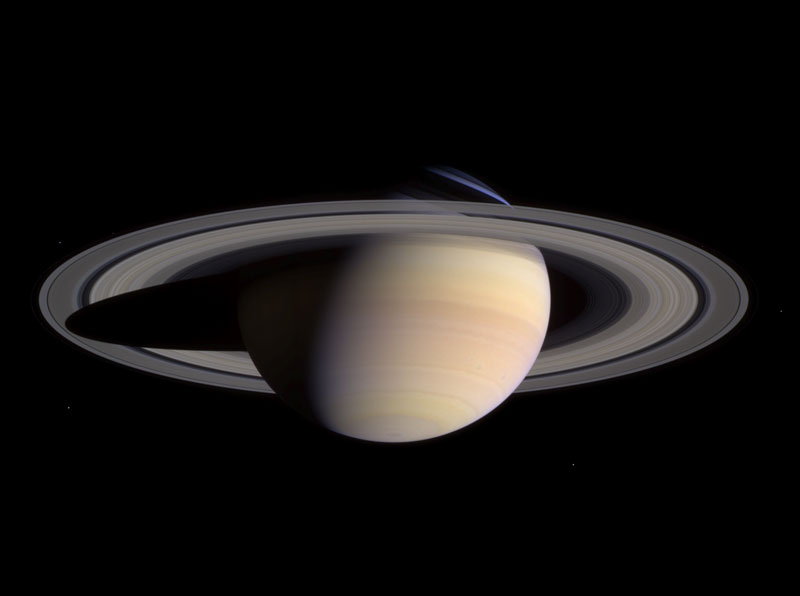
Saturn as seen by the Cassini Spacecraft. Credit: NASA.

Saturn as seen by the Cassini Spacecraft. Credit: NASA.

Saturn is an old favorite for stargazers. The most distant of the classical planets, and widely regarded as the most majestic, its stately 30-year orbit means that it doesn’t move too much from year to year, making it easier to find, almost a fixture of the night sky.

This decade, Saturn shows itself prominently in the evening skies of late spring and early summer (in the northern hemisphere). While not as bright and obvious as Jupiter, it’s easy to spot. Just look to the south in the hours after sunset. They only other things that come close to it in brightness are Antares, which is much redder, and Spica, which is much bluer.

But the real beauty of Saturn comes when you train a telescope on it. The ringed planet is unique in the night sky in that it looks too vivid to be real. People looking at Saturn through a telescope for the first time will sometimes say it looks like a sticker stuck on the lens. Nothing else, not even Mars or Jupiter, looks anything like it.

With a small telescope–from 2 inches to perhaps a few inches–you’ll be able to see the rings, plus Saturn’s largest moon, Titan. If you can get your hands on a bigger telescope, say, 8 to 12 inches, then you might be able to see as many as 5 moons. You can also make out the Cassini division (that big gap between the two largest rings), and although the color is not as vivid as Jupiter, you might be able to see the cloud bands in the atmosphere, too.

Summer is a great time for stargazing, both because it’s warmer and because it’s usually clearer. So take some time, and watch the skies.

Posted in Stargazing | Tagged , , , | Comments Off on In the sky: Saturn

Four far-flung planets

An infrared photograph (no, really!) of the HR 8799 system. Credit: Ben Zuckerman.

An infrared photograph (no, really!) of the HR 8799 system. Credit: Ben Zuckerman.

Some solar systems have a lot of planets packed in close to their stars. Others are just the opposite. HR 8799 is a young star that is more massive than our Sun. It’s so young–about 30 million years–that it’s planetary system is still forming, and it will probably only live for 2 or 3 billion years.

But HR 8799’s young planetary system is filled with surprises. That’s not an illustration up there. That’s an actual infrared photograph takes by the Keck Telescopes. It’s possible to take this picture because the star’s four planets are young and hot, so they show up in infrared, and because they orbit so far from the star. The innermost planet orbits farther than Saturn does from our Sun, and the outermost planet is more than twice as far as Neptune.

That’s a lot different from our own Solar System. In fact, we think that Neptune started quite a bit closer, then moved out later. It’s not clear how these four planets got where they are. And they’re big planets, too. All four are 5-10 times the mass of Jupiter. Our own Solar System didn’t even have that kind of mass available.

So what does this mean? Well, we’re not seeing the finished product here, so it’s hard to tell what we’re seeing in terms of the other, older planets we’ve discovered. Perhaps the massive outer debris disk around the star will scatter the planets into deep space, and it will start to look more like the other solar systems we’ve seen. Or perhaps the planets will stay close where they are, like Fomalhaut b. Fomalhaut b has an even wider orbit, nearly four times the size of Neptune’s, and it’s elliptical, so it does appear to have been scattered some.

Or maybe some stars have different kinds of debris disks than others and produce different kinds of planetary systems. It’s too early to tell. But if we can better understand what’s going on with HR 8799, we’ll have made a big step toward figuring out how all planets form.

Posted in Planets | Tagged , | Comments Off on Four far-flung planets

Book review: Inferno by Dan Brown

In spite of all logic, I have a soft spot for Dan Brown. I genuinely enjoyed his early work. I got started on Angels and Demons, which I thought was pretty good at the time, despite some errors. I also liked his spy thrillers, Digital Fortress (despite the laughable computer science) and Deception Point (despite the dismissive attitude toward NASA). Unfortunately, his work has gone downhill since. Like many Christians, I found The DaVinci Code offensive. More recently, The Lost Symbol was just plain underwhelming. Even so, I thought I would give him one more chance with his latest installment, Inferno. Unfortunately, Mr. Brown misses the mark.

Spoilers to follow

Continue reading

Posted in Book reviews | Tagged , , , | 1 Comment

Movie review: Star Trek Into Darkness

Honestly, this is one of the more plausible parts of the movie. Poster by Paramount Pictures.

Honestly, this is one of the more plausible parts of the movie. Poster by Paramount Pictures.

You probably won’t be surprised to learn that I’m a life-long Trekkie. I’ve seen all of the movies (even the absurd Star Trek V) and most of all five series. I also thoroughly enjoyed J. J. Abrams’s in-universe reboot of Trek history four years ago as a great revival for the ailing franchise. Unfortunately, I have to say that the follow-up to that film, Star Trek Into Darkness, aims at topping it predecessor and seriously overshoots. It was fun to watch, but while the result has the veneer of Star Trek, under the hood, it’s too much over-the-top B-grade sci-fi to be really good.

Warning: spoilers below:

Continue reading

Posted in Movie Reviews | Tagged , , | Comments Off on Movie review: Star Trek Into Darkness

A planetary six-pack

Comparison of the Kepler-11 System and our Solar System. Credit: NASA/Tim Pyle.

Comparison of the Kepler-11 System and our Solar System. Credit: NASA/Tim Pyle.

Mercury, the closest planet to our Sun, is often thought of as being super-close to the Sun and super hot. But really, it’s 40% of Earth’s distance from the Sun, and it’s only 430 degrees Celsius (800 Fahrenheit) on the day side. We already knew about hot jupiters, of course. These giants can be as close as 5% of Earth’s distance from the Sun and as hot as 1000 degrees Celsius (1800 Fahrenheit).

But the thing with hot jupiters is that they have to migrate to get where they are, and that migration would throw off the gravitational balance of the whole system and scatter the other planets into space. (Well, that’s what we think, anyway.) So we wouldn’t expect to see five planets all orbiting a star closer than Mercury, would we? Better check that picture again.

Kepler-11 is a yellowish star not too different from our Sun, but it does, indeed, have five planets orbiting closer than Mercury, and one more a little outside them. And these aren’t small planets, either. They’re not Jupiter-sized, but they’re all super-Earths or bigger. Some of them look like water worlds, but some of them are less dense than water, meaning that they have thick hydrogen atmospheres, like Neptune. That means they probably migrated from farther out in the solar system.

How did so many planets wind up in such a small space without getting scattered around by each other’s gravity? This is one of the many questions about planet formation that we’re still trying to understand. What we do know is that these planets are about as close together as they can be without being gravitationally scattered (this is called being dynamically packed). We also know that this situation is fairly common, and Kepler-11 is only the most vivid example.

We also know of solar systems that are more spread out, like ours, but they are harder to find with current technology. It will be interesting to see what gets turned up by the next generation of planet hunters.

Posted in Planets | Tagged , , | Comments Off on A planetary six-pack

Quality control, part 3: the arts

Art done the old-fashioned way.

Art done the old-fashioned way.

This is final post in my series on quality control. Click the links to see part 1 and part 2.

The Internet gives everyone a voice. It either has become or is becoming our library, our newspaper, our encyclopedia, our television, our social circle, and our classroom. And it is not so much professionals as much as the world’s 2.7 billion Internet users who are doing it. (Follow that trend line, and practically everyone who wants to be online will be within 10 years.)

But giving everyone a voice has a dark side. There’s an old saying in science fiction called Sturgeon’s Law, and it says, “90% of everything is crud.” When everyone has a voice–when everyone can publish anything they want on a global scale–when even the 10% is enormous–how to we make sure the most deserving work gets the most attention? There are few places where quality control is a more difficult problem than in the arts, where so many people are so passionate about getting noticed and becoming famous.

The old quality control system was the one-to-many media. Traditional publishers were the gatekeepers for the books that were worth publishing. Hollywood was the gatekeeper for movies that were worth producing. Music producers and radio stations were the gatekeepers for music that was worth hearing.

I say “were” for all of these things, even though these are still very powerful companies, because the times have changed. Today, it’s very easy to publish your own writing online, play your own music online, release your movie online, or even publish your own magazine online (or else how are you reading this?) It sounds great, but the thing is, so can everybody else.

The old system of gatekeepers, where a few powerful people who knew what they were doing controlled what people would see, was always an imperfect one. As the money in the various industries grew, it got worse, at least in creative terms. For example, Hollywood has become notorious for the fact that it’s too risky to put huge amounts of money into anything that doesn’t already have a following. The result is an endless string of sequels, remakes, adaptations, and derivative comedies and horror flicks. Some very good movies have come out of this trend, but that doesn’t change the fact that it’s a creative desert with few bold, original ideas.

But what can we replace it with? The closest thing we have to a new quality control system is social media’s viral distribution, where a bunch of people promote what they happen to see and like. Some great stuff comes out of this as well, but is it really working as well as it could? One example: the list of the 30 most-watched YouTube videos contains 29 professional music videos and 1 home movie. Does that mean that “going viral” is not the best system or that indie music isn’t ready for prime time? Or both?

I don’t know. I’m a writer much more than I’m a musician, and I don’t even know where that’s going. The whole industry has been freaking out about it for years now. Maybe we’ll find a more useful viral “rating” system for self-published books. Maybe the arts will come up with a peer rating system more like the sciences. Maybe it’ll be something we can’t even imagine yet. The important thing is to watch out because the Times Are still a-Changin’, and no field is going to look the same when it’s over.

As for me? Well, I’m old-fashioned. For now, I’m still looking at traditional publishing, but I’m definitely keeping an open mind.

Posted in Art, Technology, Writing | Tagged , , , , , | Comments Off on Quality control, part 3: the arts

Quality control, part 2: the sciences

Science done the old-fashioned way. Click here for details.

Science done the old-fashioned way. Click here for details.

In my last post, I discussed the implications of interconnected world of the Internet as it failed to track down the Boston bombers before traditional methods did. In this post, I discuss the broader implications as they pertain to my own profession and the sciences in general.

“The best thing about the Internet is that it gives everyone a voice. The worst thing about the Internet is that it gives everyone a voice.” This saying has become far too widespread to track down who originated it, and it’s hard to deny that it’s true. Ideally, if everyone has a voice, we still want the good stuff to be widely read and the bad stuff to be suppressed, but how do we do that? This is the problem of quality control.

Science, of course, has a very good system of quality control in place. It’s called peer review. All scientific articles are looked over by other scientists to make sure they make sense before they’re published. The system works pretty well, but times are changing, and we as scientists and scientifically-minded citizens have to be aware of what the Internet is doing.

One of the best things about the Internet is that it’s an incredibly powerful democratizing force. Not only does it give everyone a voice, but it also tears down the financial barriers that can get in the way. Look no further than Wikipedia, which for all its faults is nearly as accurate as an expensive print encyclopedia and far more expansive. It’s no textbook, but knowledge, often even advanced knowledge, has never been easier or cheaper to get.

The sciences are gradually getting the message. Many scientific journals now make back issues publicly available for free online. Hopefully, this trend will accelerate (something which would be invaluable for anyone who needs to do their own homework on medical research, among other things). In my own field of astrophysics, it gets even better, because we have arXiv.

arXiv (pronounced “archive”) is a free database for pre-prints of scientific papers maintained by the Cornell University Library. These are the articles as first submitted to journals, before peer review. Anyone can submit an article with minimal oversight and have it be seen the next day. Physicists, mathematicians, and computer scientists all post articles to arXiv, but by the numbers, astrophysicists appear to use it most heavily. Nearly all new English-language papers in the field get posted there at the same time they are submitted to traditional journals.

arXiv is valuable for several reasons. For one, it allows instant feedback: any major errors in a paper will be spotted by the community at large long before the peer review process sorts them out. Second, it keeps all the other astronomers much more up-to-date on the work that’s being done. It a field that moves as fast as astrophysics, it’s vital to stay ahead of the curve. For this reason, most astrophysicists pay at least as much attention to arXiv as to the journals, although we still go to the journals for the peer-reviewed versions if they’ve been published.

Third, it’s an easy one-stop shop for anyone else who has an interest in the latest developments in the field, whether they’re a scientist or not. It consolidates all the journals, is easily searchable, and is updated with the latest news daily, even if the articles aren’t always the final versions.

Of course, the downside of arXiv is those two words, “minimal oversight”, from a few paragraphs back. The website is used so widely in the field because it is so easy to post there. But that also means that it’s easy to post erroneous or pseudoscientific articles as well. In practice, though, there aren’t that many, since the site isn’t used that much by non-scientists, and there is some oversight–joke articles like this one may be left up, but obviously bad ones can be taken down.

Astrophysics is a small field, with only 50 or so new articles per day, and it’s usually easy to spot any bad apples from the titles alone. Other fields are much larger, but the work of just a few people should still be sufficient to keep things running smoothly. I’d like to see more fields picking up this model in the future.

Speaking as an astrophysicist, I think our system works. arXiv creates a powerful democratizing force in the field, while peer review cleans things up. Thus, we have harnessed the power of the Internet while maintaining the old quality control structure.

But what happens when the old quality control structure breaks down, like in the case of the other half of my blog’s title? More on that in the next post.


Posted in Science, Technology | Tagged , , , | Comments Off on Quality control, part 2: the sciences