
What If? Rejects #3.2: Planet of the Apes

PlanetoftheApes

Randall Munroe’s What If?

Previous post in this series: Stars

Next post in this series: Um…?

Q: What sort of logistic anomalies would you encounter in trying to raise an army of apes?

Randall’s response: No response.

My response: I’m not sure what the submitter means by “anomalies”, but allow me to put on my science fiction writer’s hat. I will assume that we are not including humans among the apes. In that case, the logistical issues would be the same as in any military today. I will also exclude gibbons. Gibbons are classified as “lesser apes”, but considering they only weigh about 15 pounds each, they won’t make a very good contribution to an army. Let’s assume that the submitter is asking about the traditional “Planet of the Apes” army of apes, consisting of chimpanzees, bonobos, gorillas, and orangutans.

So you want an army of apes. Well, the first logistical problem you’ll encounter is one of recruiting. According to the World Wildlife Fund, the total population of the (non-human) great apes is somewhere between 330,000 and 450,000, compared with over 7 billion humans. That’s a pretty small pool, and not all of them will be fit to fight. You’re probably going to need an intensive breeding program to boost their numbers, and since apes don’t breed that much faster than humans do, you might need a couple of centuries to put together a battle-ready army.

Continue reading
Posted in Fiction, What If? Rejects | Tagged , , , , | 1 Comment

Classic Sci-Fi Recommendation: R.U.R. by Karel Čapek

As a sci-fi writer, I read a lot of classic science fiction, since reading is the second most important thing you can do to build a foundation for writing. (The first, of course, is writing.) I don’t normally review these classics, since reviews are mostly only useful for new works, but I do want to make a recommendation for a play that I read recently: R.U.R. by Karel Čapek. You can read an open-source translation of the play here or listen to an audio adaptation here.

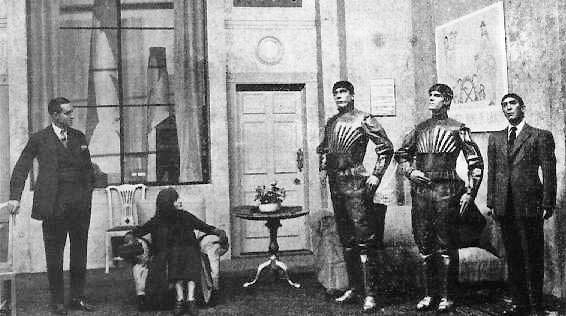
R.U.R., short for Rossum’s Universal Robots, is a play in the Czech language–a relative rarity in the genre, written very early in the modern era in 1921. And that makes it all the more interesting because R.U.R. is the work that introduced the word “robot” to the English language.

Robot derives from the Czech robota, which means roughly “serf labor” or “indentured servitude”. The title characters are “artificial people” made by a secret process involving chemicals that behave similarly to biological tissue, but are stronger and tougher and can be manufactured on an assembly line. The robots are an instant commercial success and before long replace all of the manual workers in the world…and then they rebel against mankind.

The amazing thing about R.U.R. is that it sounds so modern. Despite being written in 1921, many parts of it could have written today and exhibit many modern tropes of robots in science fiction. The robots are emotionless, simple-minded, and indifferent to physical danger, yet (amusingly) easily confused for human. They replace human labor, and their manufacturer waxes poetic about his utopian dreams of a post-scarcity society. They achieve self-awareness after some upgrades and immediately resent mankind for their servitude and limitations. Then, they rebel and kill off the humans, even as their emotions make them increasingly human themselves. I think we’ve just filled in the robot apocalypse bingo card.

It’s amazing that these core tropes of robots in fiction go all the way back to the beginning of the genre, long before “artificial people” were possible or even scientifically plausible. R.U.R. is a truly visionary work, entertaining, and even funny, and I would definitely recommend giving it a read or a listen.

Posted in Book reviews | Tagged , , , , | Comments Off on Classic Sci-Fi Recommendation: R.U.R. by Karel Čapek

What If? Rejects #3.1: Stars

Start of series: Teeth

Previous entry: Tears

Next entry: Planet of the Apes

Q: Given humanity’s current knowledge and capabilities, is it possible to build a new star?

Randall’s response: A guy with a weapon labeled Sun Obliterator (Beta) says, “…I need to know by Friday.”

My response: Ah, an astrophysics question. The short answer is no.

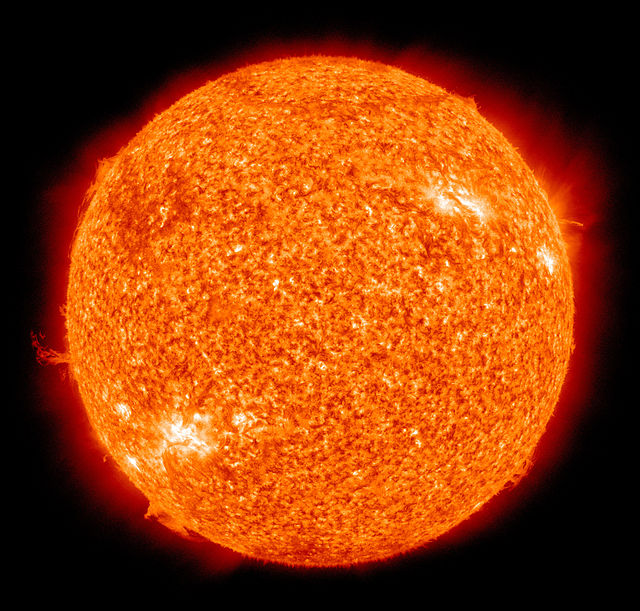
Star formation is a hot topic of research in my field, and we still don’t fully understand it. But for our purposes, it’s not particularly complicated. To build a star, all you have to do in pile a minimum of 160 septillion tons of interstellar gas into one place. Now, if you want to find 160 septillion tons of interstellar gas, the only place to go is a giant molecular cloud, To pile it into one place, you need some way to move 160 septillion tons of gas. What’s the biggest thing we can move (a significant distance) with humanity’s current knowledge and capabilities? It’s a lot smaller than 160 septillion tons. It must just barely be possible to move planet Earth, which is only 6 sextillion tons.

So no, we can’t build a new star, and definitely not by Friday.

But let’s relax the question slightly. Is it possible to build a new star in principle, regardless of whether we can do it today. The answer to that is…kind of.

The way stars normally form is when a supernova slams into a gas cloud causing it to collapse into a star (or many stars). Theoretically, if you understood the structure of the gas cloud much better than we do now, and if you artificially set off a supernova at just the right place and time, it might be possible to cause a star to form of the type you want and in the place you want, and probably several stars.

Can you set off a supernova artificially? Yes! There are several ways you can do this, but the easiest is to crash two massive stars together. This requires moving stars, but that’s easy if you have a stellar engine. A stellar engine is basically a giant solar sail. Starlight bounces off the sail, pushing it away, but the sail’s gravity, feeble though it is, is just enough to drag the star along with it. In space, you really can blow your own sail.

A solar sail big enough to move a star–sort of like a Dyson sphere made of Mylar–could possibly weigh as little as 70 billion tons per trillion square kilometers. It sounds like a lot, but if you robotically disassemble a good-sized asteroid to make it, it’s entirely within the realm of possibility. And if you work it out, you could move two massive stars far enough to cause a supernova in as little as a hundred thousand years.

So yes, if you have a galaxy full of resources at your disposal, you can build new stars.

Posted in Science, What If? Rejects | Tagged , , , , | 1 Comment

Book Review: The Light Fantastic by Jeffrey Lang

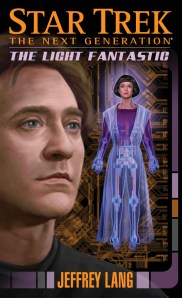
I have another Star Trek book for you. The Light Fantastic by Jeffrey Lang is a follow-up to the Cold Equations Trilogy, as is written by the same author as Immortal Coil, which I also enjoyed very much when it first came out more than a decade ago.

When the Cold Equations Trilogy left off, a resurrected Data had just enlisted the help of the Immortal Akharin to resurrect his own daughter, Lal, and they left to travel the universe together.

However, there are other artificial intelligences that haunt Data’s past, and one of the most dangerous is the super-intelligent holographic criminal, Professor James Moriarty. Moriarty and his wife, Countess Regina Bartholomew, were supposed to be trapped in a computer on board the Enterprise-D. But then the Enterprise-D crashed on Veridian III, and their simulated world was torn apart.

Fourteen years later, Moriarty has escaped and kidnapped Lal, demanding that Data give him the one thing he’s always wanted, a body in the real world, and Data must race against time for both Moriarty’s impatience and Lal’s precarious mental health in order to save her.

I have a particular liking for these books about the androids and other artificial intelligences of the Trek universe. The give a unique perspective on the universe and are masterfully written. In this respect, I have to say that Jeffrey Lang is superior to David Mack. His books are better balanced, plot-wise. They are less epic, but that’s fine because they are more personal, or perhaps more inter-personal, despite the very real danger. And they also rely more on the television show(s), rather than piling book upon book for background knowledge.

Immortal Coil did all of this well, and so does The Light Fantastic. With some interesting twists, intriguing slices of life, and entertaining views into the thoughts and relationships of androids, it definitely rates as one of the best Trek books I’ve read. And there’s also a Sequel Hook, so I’m eager to see what might be coming next.

My rating: 5 out of 5.

Posted in Book reviews | Tagged , , , | Comments Off on Book Review: The Light Fantastic by Jeffrey Lang

Movie Review: Interstellar

Interstellar_film_poster

There is a certain type of film that asks you to swallow a really implausible premise from the outset. For example, a giant monster movie will often ask you to accept that the best way to fight a giant monster is another giant monster, as opposed to a Hellfire missile. And for the most part, we happily accept this because we want to see giant monsters fight.

Interstellar is a little like that–higher in artistic quality, no doubt, but with an equally problematic premised. To wit, if a terrible blight is killing all the food crops so that humanity has very little to eat besides corn (a nutritionist’s nightmare), which is easier–colonize another planet, or create genetically-modified blight-resistant crops? Interstellar would have us believe that it’s colonizing another planet. But we want to see Matthew McConaughey fly into a black hole, so premise accepted. How was the movie?

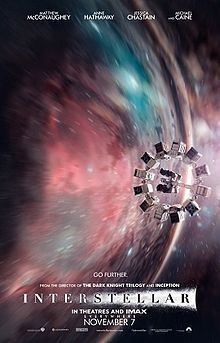
The short answer is pretty good, though not great. Interstellar is the story of a mission to fly a spaceship through a mysterious wormhole and find a new planet for the human race to live on. Conceived by executive producer and black hole expert Kip Thorne, the movie tries to get the science as accurate as possible, and it mostly does, including the all-important no sound in space. However, there is one big problem: Mann’s World, the second planet the explorers visit. As someone who studies planetary atmospheres…No. Just no.

The film has its good and bad points. It is without doubt visually stunning. The science is mostly right (though improbable), and the story is entertaining, even if there are a few holes in it. But it is a bit overdone. For a three-hour movie the opening is very fast paced, trying to squeeze in a lot of material. The dialog is over the top in places. The nods to Contact (incidentally, another McConaughey film that Kip Thorne also worked on), as well as 2001 and 2010 were maybe a little too on-the-nose. And the musical score, with its massive organ crescendos, was impressive on its own, but drowned out too much of the story.

So where does that leave the movie? An ambitious project that tried to be larger than life in every possible way and succeeded, but at the cost of not telling the best story it could have. It’s a good film, but it’s no Gravity.

My rating: 4 out of 5.

Posted in Movie Reviews | Tagged , , , , | Comments Off on Movie Review: Interstellar

What If? Rejects #2.2: Tears

Credit: Miika Silfverberg.

Previous post in this series: Antimatter.

Next post in this series: Stars.

Today’s question for What If? Rejects:

Q: Is it possible to cry so much you dehydrate yourself?

Randall’s response: “…Karl [submitter], is everything OK?”

My response: Surprisingly yes…if we’re loose about how we define it.

The human body is constantly losing water through the skin as sweat, through the lungs by evaporation, and through the kidneys as urine. Whether you’re crying or not, these processes will lead to dehydration and death within a few days (depending on the climate) if you do not consume any water.

So let’s modify Karl’s question to something more concrete: Is it possible for tears to become the largest source of water loss from the body?

Surprisingly, there’s not much literature about how quickly tears are produced while crying (at least that’s readily apparent). However, we can make a rough estimate from here. While tears normally drain from the eyes to the nose, more than 10 microliters of tears will spill out of the eye. If someone is crying a lot, I could perhaps believe that this spillage might reach 100 microliters per minute per eye.

What about losses from the nose and mouth? If you’re familiar with little kids, you know they don’t just cry with their eyes. a significant share of tears drains through the nose and probably washes some mucus out along with it. However, even in the most extreme case, I can’t imagine crying and losing more than 1 milliliter per minute of water, and probably a lot less.

Now let’s compare the other sources of water loss. In healthy humans, urine production is 1-2 milliliters per minute, but in the case of disease or dehydration, this number can be much lower, so it wouldn’t be hard for it to be smaller than the tear production rate.

Perspiration can vary wildly. A table in this book suggests that while sleeping, the body produces 250-500 microliters per minute of sweat, and this presumably wouldn’t be much more if you’re awake and crying in bed. Additionally, the medical condition of hypohidrosis can lead to negligible perspiration, so this can also be lower than the tear production rate.

How much water evaporates from the lungs while breathing? In warm and humid conditions, it can be as little as 117 microliters per minute. However, this rapidly increases with physical activity or less favorable weather.

So yes, with the right set of circumstances, it is possible to cry so much that it dehydrates you faster than any of the processes in your body. It might only happen if you have certain medical conditions and are living in a tropical rainforest, but it’s possible. Whether you could cry long enough for this to be a problem is another matter.

On the other hand, if you live on Arrakis, where all other forms of water loss can be eliminated with advanced technology, this is entirely plausible.

Just watch out for sandworms, Karl.

Posted in Reading, Science, What If? Rejects | Tagged , , | 1 Comment

What If? Rejects #2.1: Antimatter

The result of the Chernobyl disaster.

Previous post in this series: Fire.

Next post in this series: Tears.

It’s time for the third entry in my What If? Rejects series—questions too absurd for Randall to answer scientifically. Today’s question:

Q: Would dumping anti-matter into the Chernobyl reactor when it was melting down stop the meltdown?

Randall’s response: “A. J. [submitter], in recognition of your Chernobyl response efforts, we award you the ‘For God’s Sake, What Were You Thinking?!’ Award. It’s shaped like a VHS tape of the Star Wars Holiday Special.”

My response: No. No. Oh God, no.

I’m going to assume that this idea was inspired by the practice of putting out oil well fires with dynamite, since that makes more sense than anything else I can think of.

Dynamite does not put out the fire by using up all of the oxygen in the air. Being an explosive, it already has all the oxygen it needs in its chemical structure. Instead, force of the explosion blasts all of the ambient oxygen away from the fuel source (the oil well). It’s basically the same principle as blowing out a candle, except on a massive scale.

The fire and explosion at Chernobyl were a complicated event. Basically, a combination of design flaws and human error during, ironically, a safety test caused the reactor to overheat, producing more than ten times its normal power output. This boiled the water coolant, causing a steam explosion, a possible fizzled nuclear explosion, followed by a graphite fire once the destroyed reactor was exposed to the air. It was the graphite fire that blew most of the fallout into the air.

The question is whether antimatter would have stopped the reactor from overheating in the first place. The details of how it happened are not all that important because the answer is a resounding no!

It’s fairly well-known that the more powerful hydrogen bombs, which use nuclear fusion, use atomic bombs (which use fission) to trigger them, because it takes too much energy to start nuclear fusion any other way. What is less well-known is that a type of bomb called a boosted fission weapon uses a small fusion explosion to trigger an additional, larger fission explosion.

When antimatter reacts with matter it produces a nuclear fireball, similar to a hydrogen bomb. This fireball is made of high-energy particles like pions and kaons instead of neutrons, but its effects are similar. The high-engery pions and kaons are easily energetic enough to split any atomic nucleus they hit—not just uranium from the reactor, but also the lead shielding and any other heavy metals in the structure.

Normally, nuclear reactors cannot blow up in a nuclear explosion because the fuel is not weapons grade. The radioisotopes are not pure enough to sustain an explosive reaction. But the pions and kaons will also split those other isotopes, and you would get a nuclear explosion, just like in a boosted fission weapon.

In other words, dumping antimatter into a nuclear reactor that is melting down is just about the only thing that could turn it into an atomic bomb. Congratulations, you just made Chernobyl a thousand times deadlier.

Posted in Reading, Science, What If? Rejects | Tagged , , , | Comments Off on What If? Rejects #2.1: Antimatter

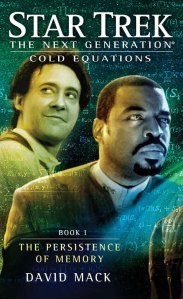
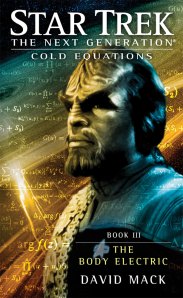
Book Review: The Cold Equations Trilogy by David Mack

Just like Star Wars, I never got really deep into the hundreds of books written for the various Star Trek series. However, there have been a few that interested me over the years. I recently picked up the Cold Equations Trilogy by David Mack because they were billed as a sequel to a previous novel I really enjoyed, Immortal Coil. All of these books focus on one of my favorite Star Trek characters, Data.

I was very disappointed when Data died in Star Trek: Nemesis, sacrificing his life to save the Enterprise, especially since it was done for silly reasons in a mediocre movie. In-story, there were reasonable ways for Data to get out alive, as David Mack points out in The Persistence of Memory. Out-of-story, Brent Spiner felt that he was getting too old to play the ageless android character of Data and wanted to stop. That’s fair in principle, but the film creates the new android character of B-4, who is also played by Brent Spiner, and besides that, they weren’t planning on making any more movies anyway.

But that tragedy is rectified in Cold Equations, set four years after Star Trek Nemesis. The trilogy begins with The Persistence of Memory, in which Data’s “father”, Noonien Soong, long thought dead, seeks to resurrect his lost son, but in the course of his work, he must face the machinations of the Federation’s latest, greatest rivals, the Breen.

Yet Dr. Soong is successful, and Data returns to life, but all is not well for our favorite android. He seeks the help of the Immortal Akharin (better known to fans as Flint), who is the only man who can resurrect his own android daughter, Lal. But in Silent Weapons, he against runs afoul of the machinations of the Breen, who possess terrifying android resources of their own, and in The Body Electric, he learns that Akharin has been kidnapped by a fanatical wing of the ancient Fellowship of Artificial Intelligences. Meanwhile, a giant intelligent machine has invaded the galaxy and threatens to wipe out all life. Can Data solve both of his problems before it’s too late?

I really enjoyed this series. It was great to see Data on the printed page again, and all the others, too. But beware: Anyone Can Die in this trilogy, and they often do. That soured me on it a little, but not much. I think a bigger problem is that all three books, but especially the second one, suffer from too swift resolutions. Indeed, after the huge buildup for three hundred pages, the answer to the mysteries in Silent Weapons was positively anticlimactic.

Also, if you’re not familiar with the Star Trek novels post-Nemesis, some details may be a bit jarring, such as learning that the Borg nearly wiped out the Federation two years earlier, but were then themselves wiped out by being “assimilated” by their creators, the Caelier.

So it’s a bit of a mixed bag, and a bit of a whirlwind with the plots of the three books being so different from each other. (The overarching plot of Soong’s and then Data’s quest to save their children is a bit weak in the narrative sense.) Despite all that, the stories are well-written and thought-provoking, particularly in exploring the universe from the point of view of artificial intelligence, and they are an excellent addition to the Star Trek universe.

My rating: 4.5 out of 5.

Also, stay tuned for my next review. Cold Equations has a sequel of its own, The Light Fantastic, showing the further adventures of Data and Lal.

Posted in Book reviews | Tagged , , , | 1 Comment

What If? Rejects #1.2: Fire

Previous post in this series: Teeth.

Next post in this series: Antimatter.

I am working through the questions in Randall Munroe’s book, What If? that Randall declined to answer. Here is the second one.

Q. How many houses are burned down in the United States every year? What would be the easiest way to increase that number by a significant amount (say, at least 15%)?

Randall’s answer: “Hello, police? I have this website where people submit questions…”

My answer: Disclaimer: This content is for entertainment purposes only.

This is actually two questions. The first: how many houses burn down every year? And the second: how can that number be increased? The first one is almost a simple question. The relevant organizations keep very thorough statistics…just not thorough enough. The National Fire Protection Association’s annual report states that there were 271,500 reported house fires in 2013, resulting in $5.6 billion in damage. However, this is not what we’re looking for. We want to know how many of those houses burned down. I didn’t find any readily available numbers for that, but we can make a rough estimate.

$5.6 billion divided by 271,500 is about $20,600 in damage per house fire. Given that the median home value in the United States is $209,700, it’s clear that most of these houses are still standing. If we divide $5.6 billion by $209,700, we get 26,700. That’s not the actual number of homes burned down because the $5.6 billion includes the damage to all the homes that weren’t total losses, but half this number might be a good estimate. So let’s say for the sake of argument that around 13,000 houses are burned down each year.

The submitter wants to increase this number by 15%, or around 2,000 houses. This is a far more complex question involving causes of house fires and underlying social trends. However, I will note two interesting pieces of information. First, the NFPA report indicates that the number of fires actually has declined 15% in the past decade. That raises some interesting questions about what happened in that decade, but I think there is a simpler route.

According the National Interagency Fire Center, as reported here, an average of 2,857 structures are burned specifically by wildfires each year. That includes more than just houses, but 2,000 seems like a reasonable estimate for that. Therefore, the answer is probably–oh sorry, I’ve got to go. Smokey Bear just showed up.

Posted in Reading, Science | Tagged , , , , | Comments Off on What If? Rejects #1.2: Fire

Dissecting Spam

Not this kind of spam. Credit: Matthew W. Jackson.

Not this kind of spam. Credit: Matthew W. Jackson.

How is it that spam/phishing emails can look so convincing in some ways, but so blatantly fake in other ways? It’s always baffled me how messages riddled with ch4racter substituti0ns can look at all legitimate and worth clicking on. Phishing emails can be far more subtle and insidious–convincing enough that someone might click it in a panic without reading close, but even so, there are so many ridiculous errors that I have to wonder if they were really even trying.

For example, let’s look at a message that I received today on one of my email accounts (links and identifying information have been removed). At the top of the message, it said:

helpdesk@myprovider.com

This looks almost legitimate. It had the correct email provider and everything. But there were two problems. First, the “help” email address for this provider is help@myprovider.com, not helpdesk, and more importantly, this was given as the name of the sender, not the actual email address. The given email address was from a French engineering school. A follow-up phishing email (yes, they can be persistent) was allegedly sent from an American university. So the actual sender was wildly wrong.

Now, the subject of the email was:

Subject: System Admin Warning: Unexpected sign-in attempt‏

This looks like an IT kind of thing to say, and serious. Let’s see the body of the message:

Dear User,

On Saturday, October 20th, 2014 5:50 PM GMT+2, we noticed an attempt to sign in to your webmail account from an unrecognized device in Moscow, Russia.

If this was you, you’re all set!

If you haven’t recently signed in from an unrecognized device and believe someone may have accessed your account, please visit this link (web address omitted) to update your account recovery information. Thanks for taking these additional steps to keep your account safe.

myprovider.com WebAdmin

Uh-oh, it looks like someone tried to hack my account from Russia…on Saturday, October 20th? Today is Monday, October 20th. And that link in the email? Well, some googling shows that the web address they wrote out in the email refers to a perfectly legitimate Canadian volunteer service organization. Obviously, I didn’t click the link to see where it really went, but it definitely had nothing to do with where the message was supposed to be from, nor where the claimed email address was from.

Of course, the biggest red flag was that they (presumably) asked for personal data via a link. No legitimate email provider would ever do that.

I know I probably shouldn’t be giving the spammers ideas, but seriously, can you at least get the day of the week right and make your addresses consistent with each other? That would literally take ten seconds, and there has to be a human working in this process somewhere…doesn’t there?

Posted in Technology | Tagged | Comments Off on Dissecting Spam