

Celebrate by eating pie. Preferably at 1:59 and 26 seconds. Or memorizing digits of pi. Or reading science fiction because it’s also Einstein’s birthday. I recommend Contact because it involves both Einstein-Rosen bridges (wormholes) and pi!
Celebrate by eating pie. Preferably at 1:59 and 26 seconds. Or memorizing digits of pi. Or reading science fiction because it’s also Einstein’s birthday. I recommend Contact because it involves both Einstein-Rosen bridges (wormholes) and pi!

Captain Marvel is one of Marvel Comics’s lesser known superheroes. She (and he in earlier decades; Carol Danvers wasn’t the only one to wear the name*) was a minor character up until fairly recent times. Carol Danvers herself (under various identities) was even more so. However, she has always been a feminist character, and yes, Marvel definitely tried to play that up for her big screen debut.
It might be because of this that Captain Marvel has become perhaps Marvel’s most politicized movie, even weeks before it premiered. The trailers got a lot of criticism in certain circles, mostly over allegedly too-heavy-handed feminist themes and lead actress Brie Larson’s acting.
I don’t want to make this a political post, but I feel like I can’t avoid it because the result of this controversy is that I don’t fully trust the reviews on either side. There are a lot people who want to like Captain Marvel for political/social/cultural reasons, but there are also a lot of people who want to dislike it because they’re on the opposite side of those issues. And both of those groups are capable of distorting the reviews. Rotten Tomatoes’s critics give it an 80% fresh rating, but rival site Metacritic rates it at 64%. Meanwhile, on Rotten Tomatoes, the audience gives it 57%, fairly close to Metacritic, but that’s up from a low of about 30% (possibly fueled by bots). When the numbers are this all over the place, who do you trust?
Well, if you’re reading this blog, I would hope you trust me, so here’s my review. The short version is, I liked the movie. It wasn’t fantastic. It certainly wasn’t Marvel’s strongest offering. But it was a fairly enjoyable movie. I’d rank it above several MCU movies that got pretty good ratings from got critics and audience alike, including Age of Ultron, Thor 1 and 2, and dare I say even Iron Man 2 and 3. Again, not the best, but not deserving of the hate it’s getting.
My rating: 4 out of 5.
Again, I don’t want to make this a political post, but I do want to give some semblance of intelligent analysis. Because I believe the movie did have flaws, I had to wonder how my opinion compared with the detractors’. So I went over to the dark side and read a few of the most hostile reviews to try to figure out why they say Captain Marvel is so bad and whether I can refute it. Bottom line: yeah, I mostly can. The haters are being too critical. This is a good movie.
What follows below is a list of the most common criticisms I saw and how I judge them from my own viewing.

It’s the end of a great movie series. How to Train Your Dragon: The Hidden World is the final installment in a beloved trilogy and one of the many highly-anticipated movies coming this year, giving us the final adventure of Hiccup and Toothless. It’s very, very hard to make three really great movies in a row. Depending how critical you want to be, it seems like only Toy Story and The Lord of the Rings have done it perfectly. And now, How to Train Your Dragon joins them, if you go by the critics. But honestly…I’m not feeling it. I think that The Hidden World, while still good, is significantly weaker than the first two movies.
My rating: 4 out of 5.
I think I can sum up my problem with this movie in two words: missed potential.
Spoilers below.

Last year, the Science Channel continued the long-running show MythBusters with two new hosts, Jon and Brian, selected by a televised myth-busting contest. The new episodes were…underwhelming. I reviewed Jon’s and Brian’s season at the time, and I couldn’t give them that high a rating, but I thought they had potential.
Well, it seems the poor reception was shared by others because the show was quietly pulled from the schedule by the Science Channel with the last two episodes never aired in the United States. According to Reddit posts from Brian (BSforgery), there wasn’t a formal cancellation; instead these episodes are being held for a potential second that may or may not happen.
But in the meantime, we got a new show on the Science Channel, with Adam Savage coming back to host it: MythBusters Jr. This show is still like the original MythBusters, complete with full-sized myths and lots of things exploding, but the new Junior Mythbusters are six middle school and high school students (well, one’s a twelve-year-old college sophomore) with world-class skills in engineering, robotics, programming, and inventing. And this show is MythBusters back in top form.
My rating: 4.5 out of 5.
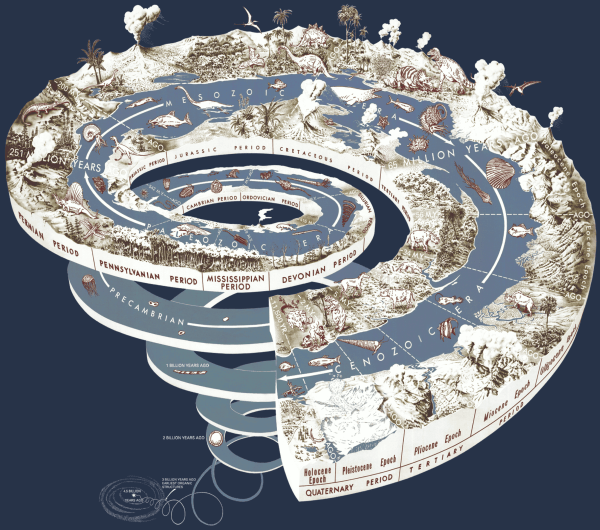
In a previous post, I analyzed the evolution debate between militant atheist Aron Ra and Christian creationist Kent Hovind. In short, I thought it was very unproductive, so I wanted to write a follow-up post describing how these debates could be done better. Plenty of “evolutionists” have written refutations of creationist arguments…but in a sense, that’s exactly the problem. Despite all these refutations, the same arguments keep coming up again and again.
Evolutionists call these PRATTs—short for “Points Refuted A Thousand Times.” PRATTs are statements that are easily proved to be fallacious and sometimes even factually false, and yet are still used over and over again in debates about creationism. “There are no transitional fossils” seems to be the most common example. Evolutionists consider these points to be not worth bothering with and therefore put little effort in refuting them, which makes their arguments appear weaker. You also don’t really see people try to engage with creationists over why they continue to use these false statements or really pin them down and force them to address the inconsistencies in their arguments.
Based on the Ra-Hovind debate, I thought it would be possible to dig down and ask specific questions to try to pin down flaws in creationist arguments in a fair way that gives them a chance to defend against them, but also does not give them space to evade them. That’s what I initially wanted to do in this post, but after investigating carefully, I don’t think I had the right sense of it. When you really try to steelman creationist arguments—when you try to understand them and frame them in a fair and charitable way, creationists have answers to many of the questions that are raised. They’re not necessarily correct or even logically sound answers, but they do have them.
So I think I’m going to take a different tack and try to address why PRATTs are a thing. Why, in these debates, are the same points brought up over and over again, long after being debunked, making them never seem to go anywhere useful? Aron Ra insists this problem is simple dishonesty—even claims he has had creationists tell him to his face that they know they’re lying—but I choose to take them at their word that they believe what they say.
So…this is not the result I expected.

No, I didn’t get Bingo with the card I made. But this is a good opportunity to make a brief analysis of President Trump’s speech—not a political analysis, but an analysis as a writer.
There were two major points that really jumped out at me about this speech in terms of writing style. The first was that when I was watching it, Trump’s rhythm seemed off. In many places, it sounded like he kept wandering from topic to topic at random because he would suddenly start talking about a different subject with no warning. At the time, I thought the speech sounded poorly rehearsed, like he wasn’t reading the paragraph breaks correctly, but I now think I was wrong. Upon reading the speech as prepared for delivery, it looks like it was actually written that way, and in my opinion, it did not have enough transitions between subjects.
The second thing I noticed was the style itself, which is why I lost the game with my card. I forgot how formal Trump’s previous State of the Union speech was last year, and this year’s speech was similar in style. Despite some commentators calling the speech a campaign rally, my totally amateur word analysis says it was very different in tone (regardless of substance), so putting some of Trump’s slogans and catchphrases on the card was a bad move.
In fact, there were so many words that didn’t come up that I worried I might have missed one, but I checked the transcript, and I didn’t. Even some things I did expect in a formal speech didn’t show up. The President never used the word “shutdown,” which would have given me Bingo–and in retrospect may well have been a deliberate conciliatory move. He also didn’t use “many, many,” which seems like it would be common enough in general, but he always used actual numbers instead.
I will note that I was being strict about exact matches, so I didn’t count the phrase “disastrous Iran nuclear deal” for “disaster,” nor did I count “I ask you to choose greatness” for “Make America great again,” though neither of those were winners. I could have made Bingo if I had counted “justice,” even though it wasn’t for an actual judge and “Madam Speaker” for “Pelosi,” but it clearly didn’t come out the way I expected.
Finally, all of my foreign policy picks came up in the speech, as did others including Syria, Afghanistan, and Iran. Clearly, I should have focused on foreign policy topics for my card out of the listed suggestions, since those seem to be more predictable.
I don’t normally talk about politics on this blog, but since President Trump’s State of the Union address is tonight, I thought I’d make an exception. I encourage you to watch the speech, a little bit so you can keep up with current events and learn important(?) information for American citizens about the President’s policies, etc., etc…but mostly for this:
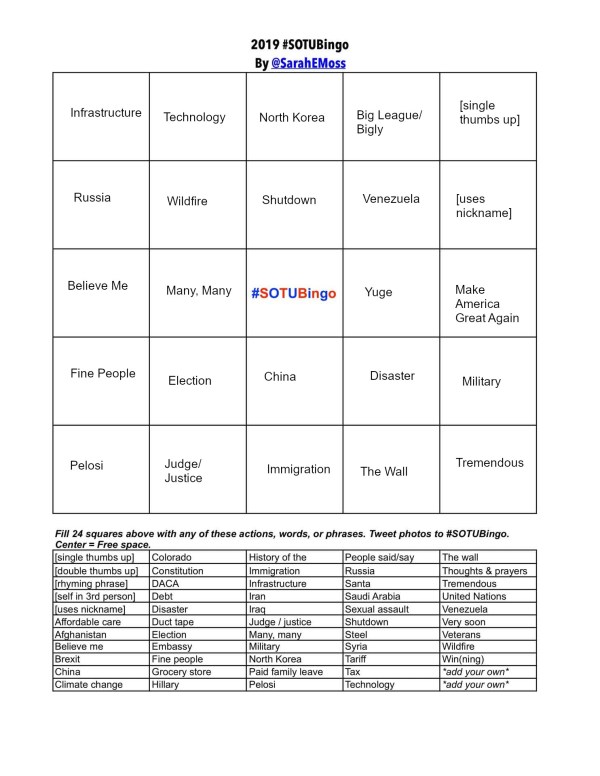
Here is my custom Bingo card for tonight’s speech, made from the Washington Post’s template. I wholeheartedly support this because it will inject some much needed fun into the mess that is American politics today, and it’s safer than trying to play the drinking game. (Don’t try that at home.)
I’ll post my results tomorrow, but I have a feeling it won’t be hard to get a Bingo or three.
This won’t be a big speech or anything. I’ve leave that to certain people who enjoy making speeches on Tuesday. I just wanted to make a quick note because I’ve discovered something interesting about this blog.
I’ve been maintaining this blog for about 6 years, which is kind of amazing. It doesn’t feel that long. And I haven’t always been consistent. There have been a few times when I’ve gone months without posting. However, I’m trying to get better about that. One of my New Year’s resolutions this year is to post at least once per week (where a week is measured Monday to Sunday). So far, I’ve kept that up, and I’m optimistic about the rest of the year.
I’ll talk more about my New Year’s resolutions later, possibly toward the end of the year when they’ll be more relevant to my average reader. However, I wanted to point out something else.
I’ve been wanting to archive my blog for a while, just in case WordPress goes under or something, but I’ve been bad about not keeping an offline copy of my posts, and there’s not really an easy way to download an entire blog–not without upgrading to WordPress’s business plan, anyway.
So today, I decided to buckle down and manually archive my entire blog into Scrivener. All 298 posts. It took a couple hours, but it wasn’t too hard with copy-and-paste. I didn’t try to preserve the format or the images or even the tags because that would have taken ten times longer, but all I really needed was the text.
The interesting thing happened when I had Scrivener compute the total word count. Not counting this post, I have written 164,387 words on this blog! That’s equal to a book, or even two books, and that’s without even trying.
I’m writing this to encourage any fellow writers who might be reading. I wasn’t pushing for word count; I wrote as the fancy took me; I was too busy half the time, and I was unreliable about it…and I still wrote enough for two books in six years. Writing a book isn’t as insurmountable as it first appears, so if you have an idea for one, go for it.

Aron Ra (left) and Kent Hovind (right).
Over the past several months, Christian creationist Kent Hovind and militant atheist Aron Ra held an extended YouTube debate about the evidence for evolution. (You can see Hovind’s challenge here and the first video of the debate, by Aron Ra, here.) Since I wrote before about the (in-person) evolution debate between Bill Nye and Ken Ham in 2014, I wanted to analyze this one too.
So, I won a nice astronomical camera in a raffle at the recent AAS conference, and since there was a lunar eclipse last night, I wanted to try it out with my telescope to get pictures.
This didn’t go as well as I’d hoped.
I had several problems getting my telescope set up properly. A broken tripod I could work around. A bad connection to the controls? I could still get it pointed. But here’s the thing, up here in Ann Arbor, it was the coldest night of the year. By midnight, it was hovering around zero Fahrenheit (-18 degrees Celsius). I was bundled up enough myself, but it was so cold that frost was forming on my computer screen in 20 minutes.
And the cold proved to be my downfall. It turns out, I can’t autofocus the camera unless I can point it at a star to resolve it as a point. But I couldn’t point it at a star and get it to stay put without turning on the electronic tracking. And it was so cold that the electronic tracking was malfunctioning. That meant I had to focus blind by taking a photo and adjusting the focus knob on the telescope itself.
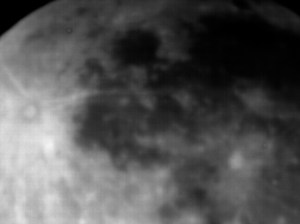
This is the first photo I took. It’s about the best focus I could get doing it blind, and the resolution was smaller than I’d hoped. (And obviously, the field of view is smaller than the Moon.) This is a raw image, which means I haven’t done any processing to clean it up like you usually see in astronomical photos. I couldn’t stay out very long because of the cold, so I didn’t have time explore all of the camera’s options. I think there’s a higher-resolution mode available, but I’m not sure how to use it.
The bright white crater in the above image is Tycho, which is at the south end of the Moon’s face, and the dark area at the upper left is the largest of the Moon’s “seas,” Oceanus Procellarum (The Ocean of Storms).

Here is an area slightly north of the first photo showing Oceanus Procellarum with a lighter auto-adjusted brightness. (I told you they were raw images.) I took these two photos at the very beginning of the eclipse. If you look carefully, you will see a darkened region at the top of the Moon’s disk, which is where it’s starting to enter Earth’s outer shadow.

I took this image about an hour into the eclipse, when the Moon was halfway into Earth’s inner shadow, the umbra–the part that looks red when the Moon is fully covered. The orientation of the camera is different here, so the features you can see on the light part of the Moon are in the northeast: the Sea of Tranquility (where Neil Armstrong and Buzz Aldrin landed) and the Sea of Serenity.

Here’s a picture of the southern part of the eclipse boundary. On the light part of the Moon, you can just make out the Sea of Fertility and the Sea of Nectar.

Back to the northern part again, maybe a little bit better focus.
I wanted to get photos of totality, when the Moon is fully covered and turns blood red. However, here I ran into another problem. I live in an area with a lot of exterior lights, and with the Moon being so much dimmer then, the glare from the lights reflected inside the telescope was too much to see it clearly. Even looking with my eyes, the glare was so bad that when I first spotted the Moon, I thought it had gone behind a cloud, so it was pretty much hopeless.
So, my process needs some work. I’m going to see if I can come up with something better and in a better location when the weather warms up.

 Science Meets Fiction