
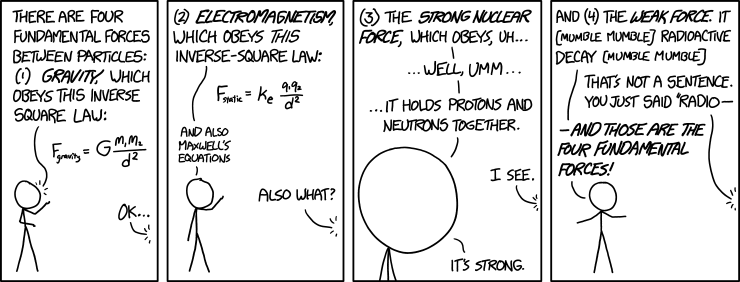
Previously, I described how the weak nuclear force really is a force even though it’s almost never described as one. Instead of a simple inverse square law like gravity and electromagnetism, it decays exponentially so that it weakens over a very short distance.
But there’s one more piece to this puzzle. At the popular science level, no one ever explains what the equation for the strong nuclear force is, either. It does have one, and it’s simple enough to explain, but no one ever mentions it, which is a shame because it’s actually kind of cool.
This equation is called the “Cornell potential” or the “funnel potential”:

Here, α and σ are constants associated with the strong force. The main function of the strong force is that it holds the quarks inside a proton or neutron together. It holds atomic nuclei together, too, but that’s a side effect. The Cornell potential tells us how this works when we take a derivative to convert it to a force:

The first part of this is an inverse square law. In other words, inside a proton or neutron meson, quarks actually undergo a gluon-mediated scattering interaction governed by an inverse square law just like Coulomb’s law. The difference is that there’s a second term in the equation, and it’s a constant. Regardless of the distance between them, two “unpaired” quarks will be attracted to each other with a constant force on top of the inverse square law of about 10,000 newtons[1] (which is a weirdly normal-sounding number equal to about one ton of force).




 Science Meets Fiction