Nomads of the galaxy

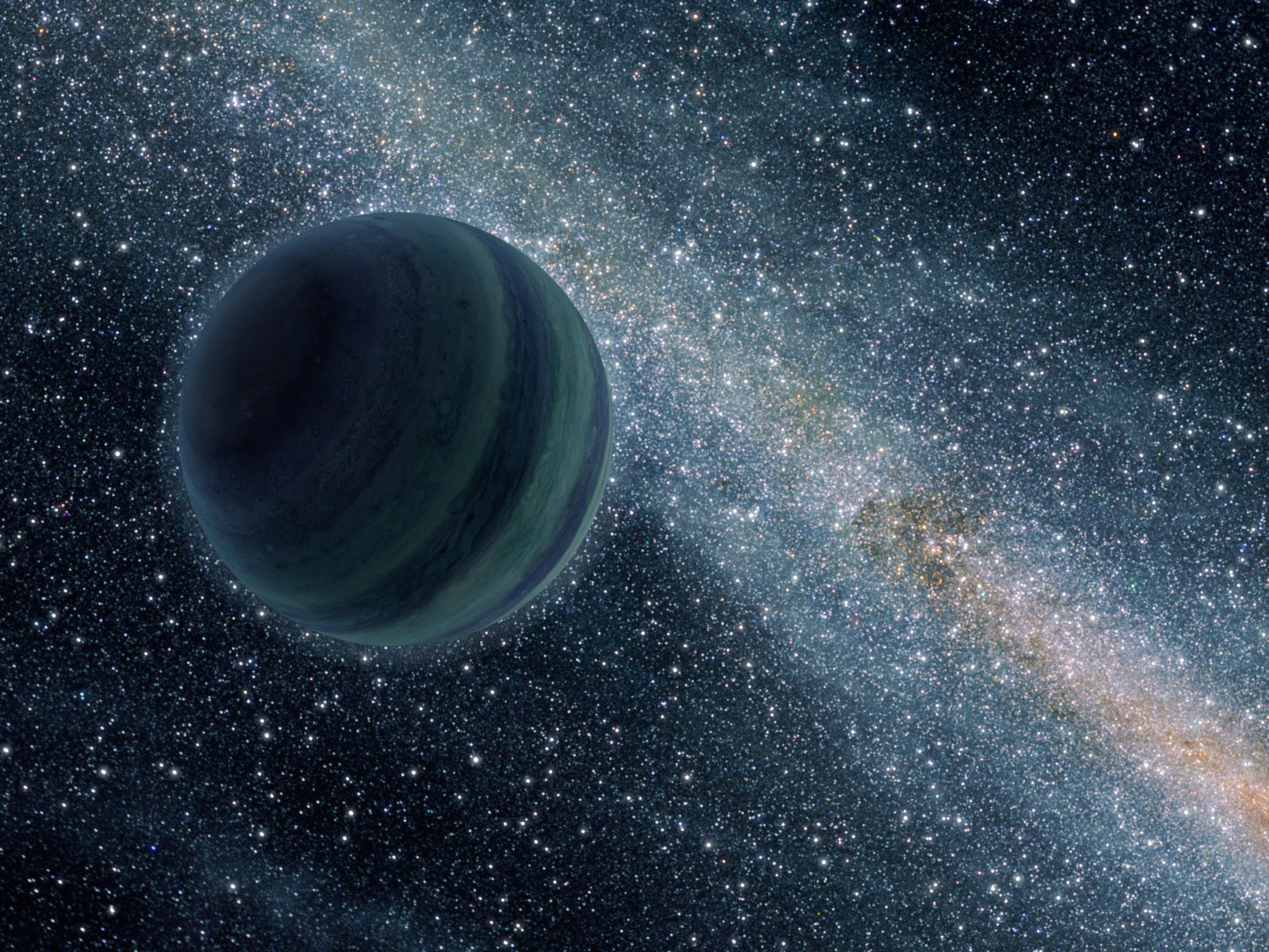
Artist’s rendition of a nomad planet. Credit: NASA

Far from the warmth and light of any star, there are still planets…depending on what you call them. There is no doubt that objects the size of planets have been found floating in space by themselves. There are several in the Sigma Orionis Cluster. They are only a few times the mass of Jupiter, too small to be stars or even brown dwarfs, but what to call them?

Science fiction writers have long called these objects “rogue planets”, but many astronomers don’t like to call them planets because they aren’t orbiting a star. The International Astronomical Union (IAU), of “Dwarf Planet Pluto” fame, would prefer to call them “sub-brown dwarfs”. Other astronomers use “planemo”, short for “planetary mass object”. Around 2001, “planetar”, for “planet+star”, was in vogue, but that one has fallen by the wayside.

Meanwhile, there are astronomers who don’t mind using the word planet, but they like to throw in some adjectives, so you might have “rogue planets”, “interstellar planets”, “free-floating planets”, or “orphan planets”. But “nomad planets” seems to be the fad now, so let’s go with that.

Nomad planets may have formed orbiting a star, but they were kicked out of their solar system by the gravity of the other planets. Or they might have collapsed from clouds of gas, like stars do. Either way, there a lot of them. Several studies, like this one, say that there are twice as many nomad planets in our galaxy as stars, and at least one estimates that there are far, far more.

The surprising thing is that, even though nomad planets have no sun, they need not be frozen solid. With no sun to strip it away, even an Earth-sized nomad planet could hold on to a thick hydrogen atmosphere that would trap its internal heat and keep its interior warm. Some planetary scientists even speculate that a nomad planet could have a layer of liquid water deep within some part of its structure. It’s not likely, but it is possible, and that is something pretty amazing in itself.
Posted in Planets | Comments Off on Nomads of the galaxy

In the sky: the Double Cluster

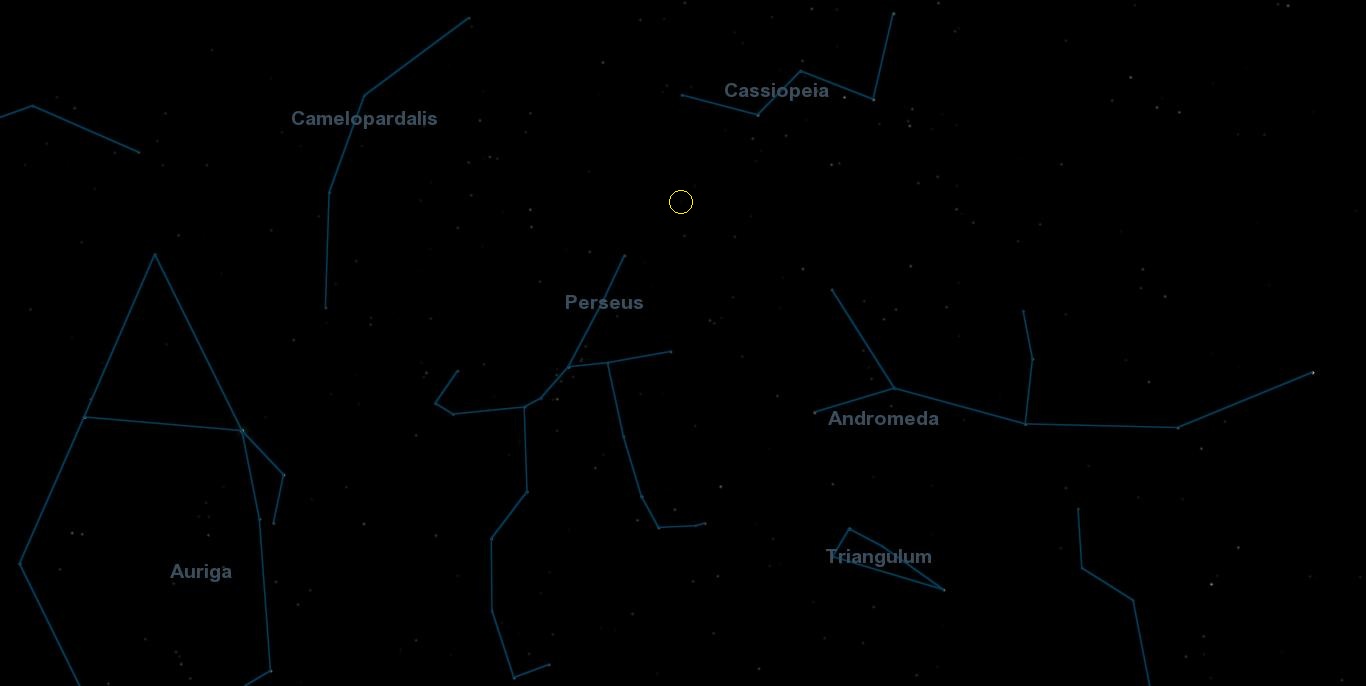
If you’re in the Northern Hemisphere, as most of you are, then late autumn and early winter is a great time to see some of the most famous objects in the night sky, like the Pleiades, the Andromeda Galaxy, and one of my favorite objects: the Double Cluster. To find the Double Cluster, go outside after sunset and look to the northeast. You should see something like this:

The northeastern autumn sky from the Northern Hemisphere. Image generated by Celestia.

Take note of the yellow circle beneath the well known W-shape of Cassiopeia. You can find the spot in the real sky by following the line of the second and third stars of Cassiopeia. Look there from a dark place, and you can see there are two fuzzy spots side by side. If you look through binoculars, you can see that the spots are made of stars, something like this:

Credit: Chuck Jopson/The Etna Astros

The two spots are really two separate open star clusters together known as the Double Cluster. Open clusters are groups of young stars that formed together. These two clusters are among the youngest in the sky, so almost all of their stars are bright and blue. While they look like they’re close together, one is hundreds of light-years farther away than the other, and they formed about 2 million years apart in time.

The Double Cluster is one of those rare objects that looks good at almost any magnification. Through binoculars, it looks neat because you can see two clusters close together. If you look through a small telescope, it’s even better:

Credit: Andrew Cooper

But if you’re lucky enough to have access to a big telescope of 12 inches’ diameter or more (college astronomy departments and local astronomy clubs are a great place to ask), then the Double Cluster is absolutely stunning.

Okay, so you won’t see quite that many stars using your eyes instead of a camera, but that doesn’t diminish the experience. It’s still one of the most beautiful objects in the sky. Grab the viewing instrument of your choice, and go take a look.

Posted in Stargazing | Comments Off on In the sky: the Double Cluster

Intro to Celestia

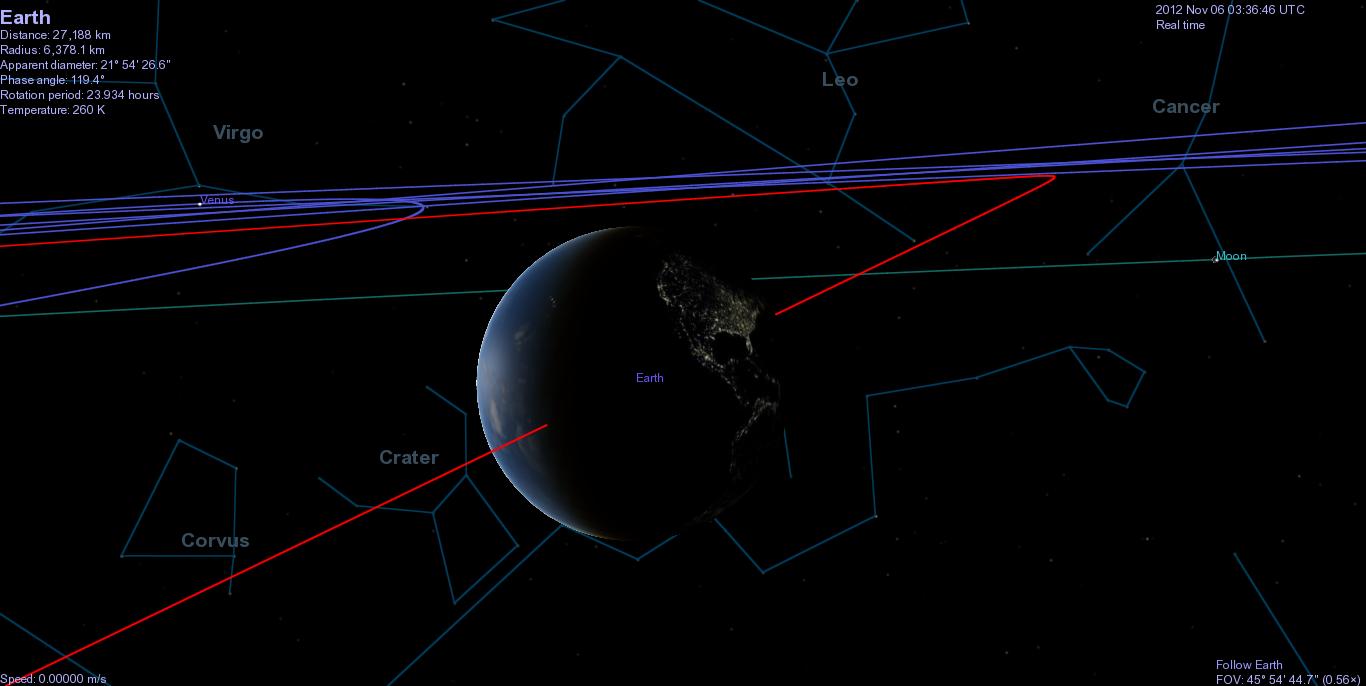
Earth, the Moon, and Venus as simulated by Celestia.

Have you ever wondered what the night sky looks like on Mars? Or Pluto? Or Alpha Centauri? How about finding out the relative positions of the planets on March 28, 2073 (as a science fiction writer might want to do)? For simple Earth-based stargazing, you would want some kind of planetarium software. There are a lot of great resources out there for that, some free and some not.

However, if you want to really explore the universe from the comfort of your desk, Celestia is the way to go. Celestia is a free, open-source simulation program that creates a 4D map of planets, stars, galaxies, and more, computed in real time. It even includes spacecraft like the International Space Station. It’s a little harder to get up against Earth’s surface and look out, but it gives you a lot more freedom to fly around the Solar System and even the galaxy, to see what the constellations look like from light-years away, or to speed up or reverse time. That’s why a friend of mine has dubbed it, “Google Earth for the universe”.

Better yet, because Celestia is open-source, anyone can create addons with objects that aren’t in the regular database. These can be other spacecraft, asteroids, stars, or galaxies, better maps of planets, or even entirely fictional objects. Many popular addons are available here, and it’s pretty easy to write your own, too. So whether you want to see how other solar systems work or you want to create your own star charts, Celestia is worth a look.

Posted in Stargazing | Comments Off on Intro to Celestia

The “puffy planets”

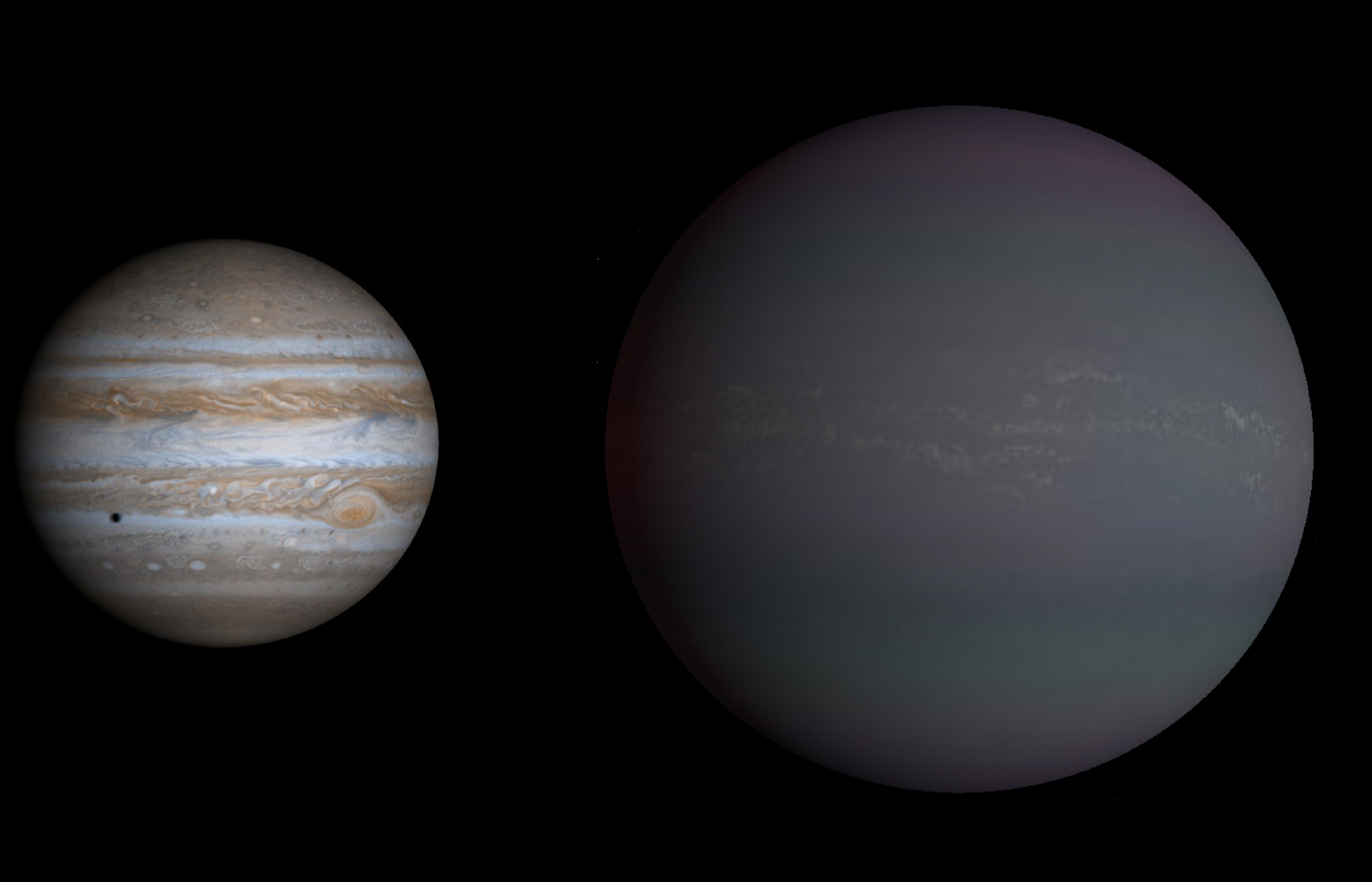
Size comparison of Jupiter and WASP-17b.

Under extremely high pressures, matter stops behaving normally. The atoms get squashed in weird ways and turn into a state called degenerate matter. Planets about as massive as Jupiter and larger are big enough to contain degenerate matter. This leads to the interesting property that planets lighter than Jupiter are smaller than Jupiter, but planets heavier than Jupiter are actually about the same size as Jupiter…or so we thought.

Then HAT-P-1b was discovered.

The first planet discovered by the HATNet Project in 2006, HAT-P-1b is only about half the mass of Jupiter, but its diameter is 22% larger. We know that because it passes in front its sun and blocks some of the starlight. Since we have a good estimate of how big the star is, we can also estimate how big the planet is.

HAT-P-1b is only about a quarter as dense as water. For comparison, the least dense planet in our Solar System, Saturn, is two-thirds as dense as water. There’s no known reason for a planet to have that low a density. Even though it’s a hot Jupiter orbiting very close to it’s sun, normal models of planetary atmospheres say it should not be that fluffy.

And HAT-P-1b isn’t even the least dense planet. That honor goes to WASP-17b (compared with Jupiter in the artist’s rendition above), which is only one seventh the density of water, or about the density of balsa wood. In all, we’ve discovered as many as a few dozen of these “puffy planets”, but how they got so puffed up is not clear. Our best guess is that it’s caused by a combination of tidal heating and electromagnetic heating effects. As we discover more planets and put together a more continuous landscape of their properties, we may be able to learn more.

Posted in Planets | Comments Off on The “puffy planets”

November is National Novel Writing Month

Every November, hundreds of thousands of people around the country and around the world join in the challenge of National Novel Writing Month, where the goal is to write a 50,000-word novel (about 175 pages) in just one month. It sounds crazy, but it’s not as hard as you might think. After all, it’s only 1,667 words per day.

National Novel Writing Month, or NaNoWriMo, was started in 1999 by freelance writer Chris Baty. The first year, it was a local event in the San Francisco area, with just 21 writers participating, but it grew quickly. Participation grew to 140 writers in 2000, over 5,000 in 2001, and nearly 14,000 in 2002, and the numbers have continued to grow through last year, when over 250,000 people signed up through the website, writing a combined total of over 3 billion words. Meanwhile, the new Young Writers Program went into 2,000 classrooms and enlisted 50,000 kids to start writing.

50,000 words is pretty short for a novel. In fact, these days, 70,000 is preferred even for a breezy romance, but 50,000 is the equal of The Great Gatsby, Brave New World, and The Hitchhiker’s Guide to the Galaxy. At the same time, it sounds like a lot of writing in one month, and it is hard work. The most I’ve ever written in one month was 28,000 words, and that was in July, when I didn’t have classes; but 1 in 7 people who sign up for NaNoWriMo succeed in finishing 50,000 words, and more than a few have been published. Probably the most famous book to come out of NaNoWriMo was Sara Gruen’s Water for Elephants.

If you’ve ever wanted to be a writer, this is good time to do it, because you can find lots of support from other writers both online and offline. Even if you don’t think you can hit 50,000 words, you can set your own lower, unofficial goal and work toward that (which I’ve done a couple times). Or you can set a higher goal if you want. I know at least one person who has written 100,000 words in a month. The important thing is to start writing and keep writing. In this case, quantity is more important than quality. Quality is important, of course, but it does you no good until you actually put the words on the page.

So will I be going for 50,000 words this November? Not exactly. Unfortunately, I’ve gotten myself into a position where I have a backlog of editing to do–two novels and several short stories. So my goal this November is to edit 50,000 words. Check back in a month to see how it goes, and in the meantime, think about setting a goal of your own.

Posted in NaNoWriMo, Writing | Comments Off on November is National Novel Writing Month

Book review: Redshirts by John Scalzi

On the original Star Trek television show, any time Captain Kirk beamed down to an uncharted planet, he would take along a couple of nameless ensigns clad in bright red for security. Inevitably somebody on the away mission would die, and it certainly wasn’t going to be Captain Kirk. In Redshirts, John Scalzi, author of Old Man’s War, asks why.

The Starship Intrepid seems at first to be a parody of the Starship Enterprise, except that, seen through the eyes of the “redshirts”, all of those nameless ensigns do have names and lives, and they quickly notice that they’re keep dying in statistically absurd numbers whenever the senior officers are around. The newest batch of crew members don’t want to believe it at first, but after seeing one nonsensical–and deadly–event after another, they are forced to conclude that something is very wrong aboard the Intrepid. Soon, Ensign Andrew Dahl and his friends begin constructing ever-more-elaborate plans to protect themselves and, just maybe, save all the redshirts on the ship.

Scalzi presents Redshirts with a unique format; the novel itself is followed by three “codas”, which might have been called epilogs, except that they are really short stories in their own right. These three codas wrap up some loose ends and fill in the stories of three important secondary characters who don’t get as much exposure in the main story as they deserve.

Redshirts is good quick read for sci-fi fans and great fun for Star Trek fans because Scalzi so effectively lampoons all of the absurd tropes and inconsistencies of the original television show that so many people love to point out. The book’s biggest shortcoming is that it is too, well, short. It comes out at only about 75,000 words, even with the three codas, leaving a lot of the characters’ stories underdeveloped. (For comparison, a typical sci-fi novel is at least 90,000 words.) Still, for all its brevity and even some occasional genre-savvy preachiness, I liked the book as a reader, found it useful as a writer, and enjoyed its fresh perspective on the eponymous characters.

My rating: 4 out of 5.

Posted in Book reviews | Comments Off on Book review: Redshirts by John Scalzi

Italian scientists found guilty of manslaughter for failing to predict deadly earthquake

Damage from the 2009 L’Aquila earthquake.
Credit: Paolo di Tommaso

Today, an Italian court convicted six seismologists and one government official of manslaughter for failing to predict a magnitude-6.3 earthquake that struck the city of L’Aquila on April 6, 2009, killing 309 people. They have been sentenced to six years in jail and fined nine million euros, although they are currently free, pending appeal. On its face, this appears to be an egregious move against science and scientists, holding them liable for failing to predict the unpredictable. The actual truth is more complicated, but I think the result is still very troubling.

Continue reading

Posted in Current events, Geology | Comments Off on Italian scientists found guilty of manslaughter for failing to predict deadly earthquake

Yes, there is a planet at Alpha Centauri!

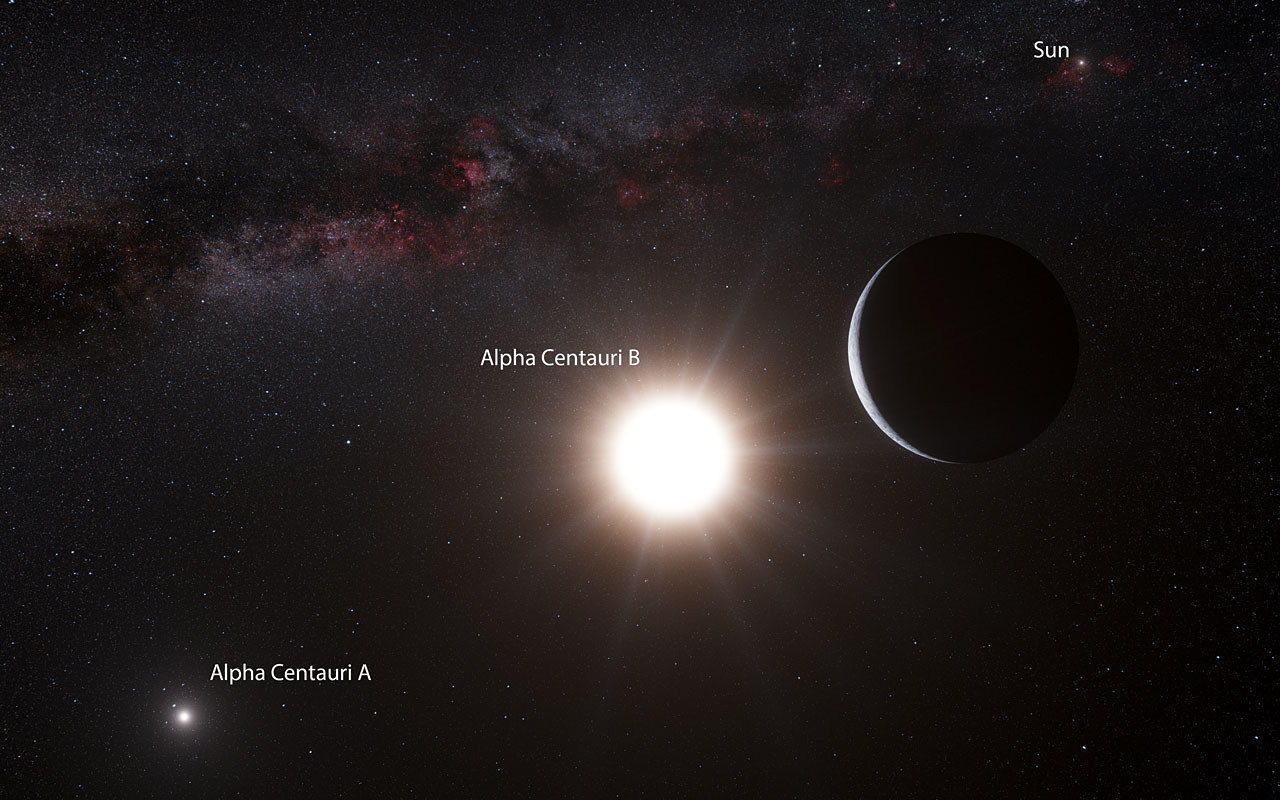
An artist’s conception of the Alpha Centauri System. Credit: ESO/L. Calçada/N. Risinger (skysurvey.org)

Science fiction fans the world over are vindicated as astronomers at the European Southern Observatory (ESO) have discovered a super-heated planet in the Alpha Centauri system. Better yet, it’s almost the same size as Earth!

Alpha Centauri is a triple star system just 4.3 light-years away, literally just next door in astronomical terms, since they are the closest stars to Earth besides the Sun. Two bright stars, Alpha Centauri A and B, orbit each other at about the distance between the Sun and Uranus, while the tiny red dwarf Proxima Centauri orbits them at a great distance. Now, ESO’s HARPS project has discovered a planet orbiting one of the stars, Alpha Centauri B.

The planet itself is known as Alpha Centauri Bb, and it may have a mass as small as 1.13 times Earth’s mass (and probably not much more). It is the smallest planet ever detected by radial velocity measurements and a very important step toward eventually discovering truly Earth-like planets. Finding small planets is hard, and this is the first time we’ve been able to make accurate measurements of a planet that is basically the same size as Earth.

But this planet is not Earth-like. It zips around Alpha Centauri B every 3.2 days, and it’s surface is so hot that it is probably made of molten rock obscured by a thick layer of dust. Finding slower-moving planets like our own is about five times as hard–but we’re getting there.

For now we can enjoy the fact that once we do have some way to travel interstellar distances (and there’s a half-decent chance we will by the end of this century), we’ll have someplace close by to go; and, if planets are as common as they appear, the nearest Earth-like planet might not be too far away, either. The fact that Alpha Centauri’s closeness makes it a favorite setting for science fiction, including, most recently, Avatar, makes it twice as fun. True, Alpha Centauri Bb isn’t quite Pandora, but it takes us one step closer.

Posted in Current events, Planets | Comments Off on Yes, there is a planet at Alpha Centauri!

Felix Baumgartner’s World Record Skydive

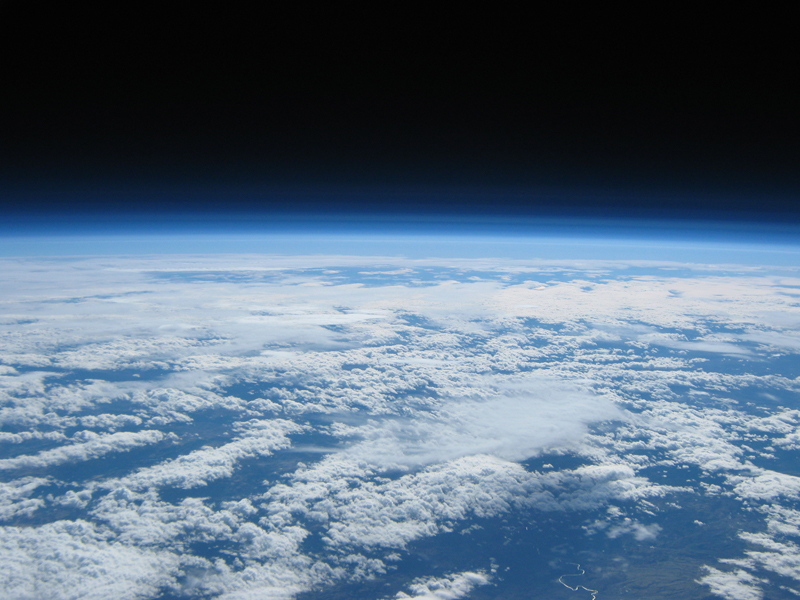
An image taken from an altitude of 30,000 meters (100,000 feet). Felix Baumgartner jumped from the height of Mount Everest higher than this.

On Sunday, Austrian daredevil Felix Baumgartner made a parachute jump from a high altitude balloon and became the first human to break the sound barrier unassisted as part of the Red Bull Stratos mission.

Breaking the sound barrier isn’t that hard under certain circumstances. You can it do at home just by whipping a towel, but for a person to break the sound barrier in the air requires some drastic steps, like jumping out of a capsule at 39,000 meters (128,000 feet), where there’s almost no air resistance.

This jump came on the 65th anniversary of Chuck Yeager’s first supersonic flight and broke five world records: largest manned balloon (1,000,000 cubic meters), highest manned balloon flight and highest parachute jump (39,000 meters), fastest free-fall (373 meters per second, or 834 miles per hour), and farthest free-fall (36,500 meters, or 119,800 feet). Baumgartner fell 16 seconds short of a sixth record: longest free fall, which still stands at 4:36, partly because he fell faster than expected.

But one of the coolest parts of this mission was that Felix Baumgartner’s ground controller was none other than Colonel Joe Kittinger, who set two of the records that Baumgartner broke and still holds the longest free-fall record that he set back in 1960. At a press conference, Baumgartner said that, instead of topping his own feat, his hope for the future is to someday help someone from the next generation to break his records.

Baumgartner’s jump was not really from the “edge of space”, as was advertised. That line is much higher, at 100,000 meters (328,000 feet). Yet, it was far more than just a publicity stunt for Red Bull. The jump provided valuable information about the effects of high speeds and altitudes on the human body, which will be used to design next generation pressure suits and safety systems for astronauts–the same reason Kittinger made his jump 52 years ago. With all the private rockets and space planes that are now in development, they’ll certainly be able to use it.

Posted in Current events, Space exploration | Comments Off on Felix Baumgartner’s World Record Skydive

SpaceX makes first contracted delivery to the International Space Station

Space Exploration Technologies, better known as SpaceX, has successfully launched its Dragon space capsule to the International Space Station (ISS), completing the first of 12 resupply missions under its $1.6 billion contract with NASA. Dragon delivered replacement parts for the space station, dozens of scientific experiments, and chocolate ice cream to the astronauts;it and  will remain berthed at the ISS until October 28, when it returns more hardware and experiments back to Earth.

Dragon launched on Sunday aboard a SpaceX Falcon 9 rocket, along with a communications satellite. The launch did not go quite as planned, with two engine malfunctions, one in the first stage and one in the second stage; but the rocket’s computer was able to correct for the problem by shutting down the malfunctioning engines and computing a new flight path in real time. This allowed Dragon to reach the ISS, and the communications satellite should be able to reach its object with some additional boosting. All in all, it’s not a huge problem; even the Saturn V’s experienced similar engine failures on two launches.

This is an important milestone for both NASA and the private space industry. Having the Falcon 9/Dragon launch capability goes a long way toward America’s ability to keep the ISS supplied and toward closing the gap in our launch capabilities. If all continues to go well, SpaceX may be able to launch the crewed version of Dragon, DragonRider, as soon as 2015, allowing the United States to begin sending humans into space again. Better yet, DragonRider will be able to carry more astronauts at a lower cost than a Russian Soyuz launch.

For all the logistical and funding difficulties NASA has had lately, I think things will begin to look very different in just a few years. Welcome to the Future.

Posted in Current events, Space exploration | Comments Off on SpaceX makes first contracted delivery to the International Space Station