Boston, Reddit, and the problem of quality control

The immediate aftermath of the bombings. Credit: Aaron Tang.

The immediate aftermath of the bombings. Credit: Aaron Tang.

By now, you probably know all about the bombings at the Boston Marathon last week that left 3 people dead and 176 injured. It has its own Wikipedia page now, if you’re not up to speed. In the ensuing investigation, authorities were led to Tamerlan and Dzhokhar Tsarnaev, who are also believed to have killed a police officer on Thursday night. After two shootouts with the police and an exhaustive manhunt that locked down the whole city of Boston, Tamerlan would up dead and Dzhokhar is now in the hospital and in custody.

The ordeal may not be over yet, as there are reports—from the British papers, oddly enough—that a larger “sleeper cell” may be involved. Still, we can be cautiously optimistic that any further attacks have been thwarted, so the city of Boston and the country can breathe easier moving forward. Certainly our prayers are with the victims of these horrific crimes as the investigation continues.

The “witch-hunt”

But there is one aspect of the aftermath of the bombings that is of technological interest. In the days following the attack, Internet forums such as Reddit began combing over thousands of photos taken by spectators at the marathon, looking for anyone who looked suspicious. They singled out about a half dozen people carrying bags large enough to hold the bombs…and then the pictures went viral.

Continue reading

Posted in Current events, Technology | Tagged , , , | Comments Off on Boston, Reddit, and the problem of quality control

Fun with word counts

Quick, which one of these books has more words in it?

Have a guess? The book on the left has 516 pages, which at about 330 words per page means it probably has about 170,000 words, give or take. That’s long for an industry that doesn’t like to go too much over 100,000.

But the book on the right is a New Testament, and while translations vary, the New Testament has about 180,000 words, more than the big novel. In this case, those 180,000 words are squeezed onto 384 pages less than a quarter the size.

How do publishers fit so many words in such a small space? Everything about it is compressed: thinner paper, much smaller print (appears to be 6-point), less space between lines, and smaller margins. The same thing happens to a lesser degree with paperback novels. The hardcover and paperback editions of the same novel will be very different in size, but will often have the same number of pages (and of course words).

If you want to be mindful of publishing while you’re writing (but don’t let it distract you!), word counts are important to pay attention to for pacing. After all, if your novel has 300,000 words, it’ll be hard to get it published as anything but a trilogy. Looking at the word counts for your favorite novels is a good point of reference, but you have to do a little more homework than just looking at the size of the book or the number of pages.

For most novels, 330 words per page is a pretty good estimate, since the formatting is pretty standard across publishers. There are exceptions, though. For example, US editions of the Harry Potter books average about 260 words per page. You can kind of tell by looking if the formatting is standard or not, but if you’re not sure, try counting the words on an average page and multiplying by the number of pages.

Of course, the important thing is to write the story you want to tell first…even if your 30,000 word novella awkwardly morphs into a 70,000 word novel. You can always clean it up on the second draft.

Posted in Writing | Tagged , , | Comments Off on Fun with word counts

Red suns

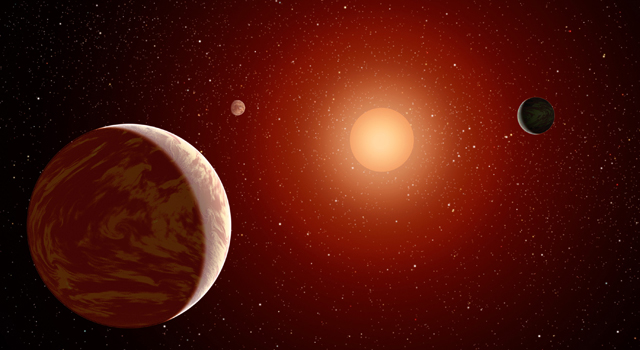
Artist's conception of planets orbiting a red dwarf. Credit: NASA/JPL-Caltech.

Artist’s conception of planets orbiting a red dwarf. Credit: NASA/JPL-Caltech.

The most common type of stars in the universe are Type-M dwarfs, better known as red dwarfs. These are stars that are less than about half the mass of our Sun, less than a tenth as bright, and much cooler, hence the reddish color. Red dwarfs make up about two thirds of the stars in our galaxy.

Red dwarfs aren’t really red. They put out most of their light in the red part of the spectrum, but they also make some green and blue light. To the eye, they would look either pale orange, like the picture, or perhaps even pink. But the important thing is that red dwarfs are so faint that planets have to orbit very close to them to keep warm.

Could a red dwarf have an Earth-like planet? For a while, astronomers said probably not, but now we’re starting to change our minds.

The first reason to worry about red dwarfs having Earth-like planets is that they’re little. It’s a good guess that little stars have little planets, and for once, that turned out to be right! There are very few big, Jupiter-sized planets orbiting red dwarf stars. At first, we guessed that there wouldn’t be many Earth-sized planets either, be once we started looking, we found that there might actually be more of them than around Sun-like stars.

The second problem is that young red dwarf stars are very fussy. Red dwarfs have solar flares, just like the Sun, and these flares are just as big, even though the stars are much smaller. That’s bad news for a planet orbiting close by. Red dwarfs tend to settle down when they mature, but unlike Sun-like stars, which take 100 million years to do so, the longer-lived red dwarfs take over a billion years. If there was an Earth-like planet nearby, the flares could have burned off its atmosphere by then.

Or maybe not. Atmospheric loss is still poorly understood, and it’s entirely possible that a planet could hold on to its atmosphere against these giant flares. But there’s another problem: a planet orbiting a star that close would become tidally locked, always keeping one side facing its star, like the Moon does toward Earth. On that kind of planet, one side would always be boiling hot, while the other would be freezing cold, and the expected weather patterns would end up with all the water frozen solid on the night side.

Or maybe not. Atmospheric circulation is even more poorly understood that atmospheric loss. After all, we can’t even predict the weather on Earth more than a few days out. With a thick enough atmosphere, even a tidally-locked planet could be warm all the way around.

Noted physicist Freeman Dyson says that we should look for life where it’s easy to look, not where it’s likely to live, an idea her expresses in this TED talk. This makes sense because even if life is not likely to be there, we’re much more likely to actually find it. In many cases, red dwarfs are easy places to look: they produce less light, so planets don’t get quite as lost in the glare. Hence the great scrutiny given to the red dwarf planet GJ 1214b. If Earth-like planets are as common around red dwarfs as we’re starting to think, this is good news for planet hunters.

Posted in Planets | Tagged , , , | Comments Off on Red suns

De-extinction: not to be or to be?

Martha, the last passenger pigeon. The species was hunted from several billion to zero in about a century.

Martha, the last passenger pigeon. The species was hunted from several billion to zero in about a century.

The latest word in environmentalism is “de-extinction”: resurrecting species that have gone extinct by cloning them (or occasionally by selective breeding, such as recreating the wild aurochs from domestic cattle).

While there are a handful of species we might actually want to get rid of, like Anopheles gambiae, the malaria-carrying mosquito, we generally don’t like it when species go extinct, especially when it was due to irresponsible practices like over-hunting that are now frowned upon. So why not clone some of these extinct animals if we have their DNA and bring them back from the dead?

Actually, this has already been done. The Pyrenean ibex, which went extinct in 2000, was successfully cloned in 2009. Unfortunately, the single newborn ibex kid died shortly after birth due to lung defects. Cloning still has a long way to go before it can work on the species scale.

But that isn’t stopping some geneticists who have already started projects to resurrect the passenger pigeon and the gastric-brooding frog. Plenty of other species are being investigated, too, some of which were hunted to extinction by humans, while others, like the wooly mammoth, were only maybe wiped out by humans.

Of course, the idea of de-extinction is not without its detractors. This article, for example, points out a number of concerns. These concerns are real and merit serious consideration, but I don’t believe they should deter us from a responsible pursuit of de-extinction.

The de-extinction movement, the claim goes, ignores the largest driver of extinctions today, which is habitat loss. It won’t do much good to recreate extinct animals and not have anywhere to put them. Worse, it could distract from conservation efforts aimed at preventing extinction in the first place. Land use is a complicated economic issue that is beyond the scope of this post, but trying to prevent future mistakes should not stop us from doing what we can to fix the mistakes of the past, or vice versa. We would do best to address both problems.

The other area of concern is for the welfare of the animals themselves. Cloning is expensive, difficult, and has a low success rate. And even if cloning is perfected, we would likely be able to clone only a few individuals of any given species, resulting in a dangerously low level of genetic diversity. Yet these ethical concerns are not new. Cloning has these problems whether the cloned species is extinct or not, and we do it anywau. And as for genetic diversity, the California Condor is being repopulated from a low point of just 22 birds. Some may decry the high cost-benefit ratios of these efforts, or the high valuation of the more photogenic animals, but clearly, we are not shy about protecting the species we care about.

It all sounds very Jurassic Park, but I think that de-extinction is really leading us someplace far more profound. Where is that? Well…

We have the Neanderthal genome. All it needs is a reliable human cloning technique, and that is almost certainly coming. It may be in 5 years, or it may be in 50, but it is coming. That will bring a whole new raft of ethical problems, but none, I suspect, are insurmountable. After all, most of us are 3% Neanderthal ourselves, so it wouldn’t be anything entirely new. We may see our ancient cousins walking the Earth again sooner than you think.


Posted in Biology, Genetics | Tagged , , , , | 4 Comments

How to take a picture of the universe

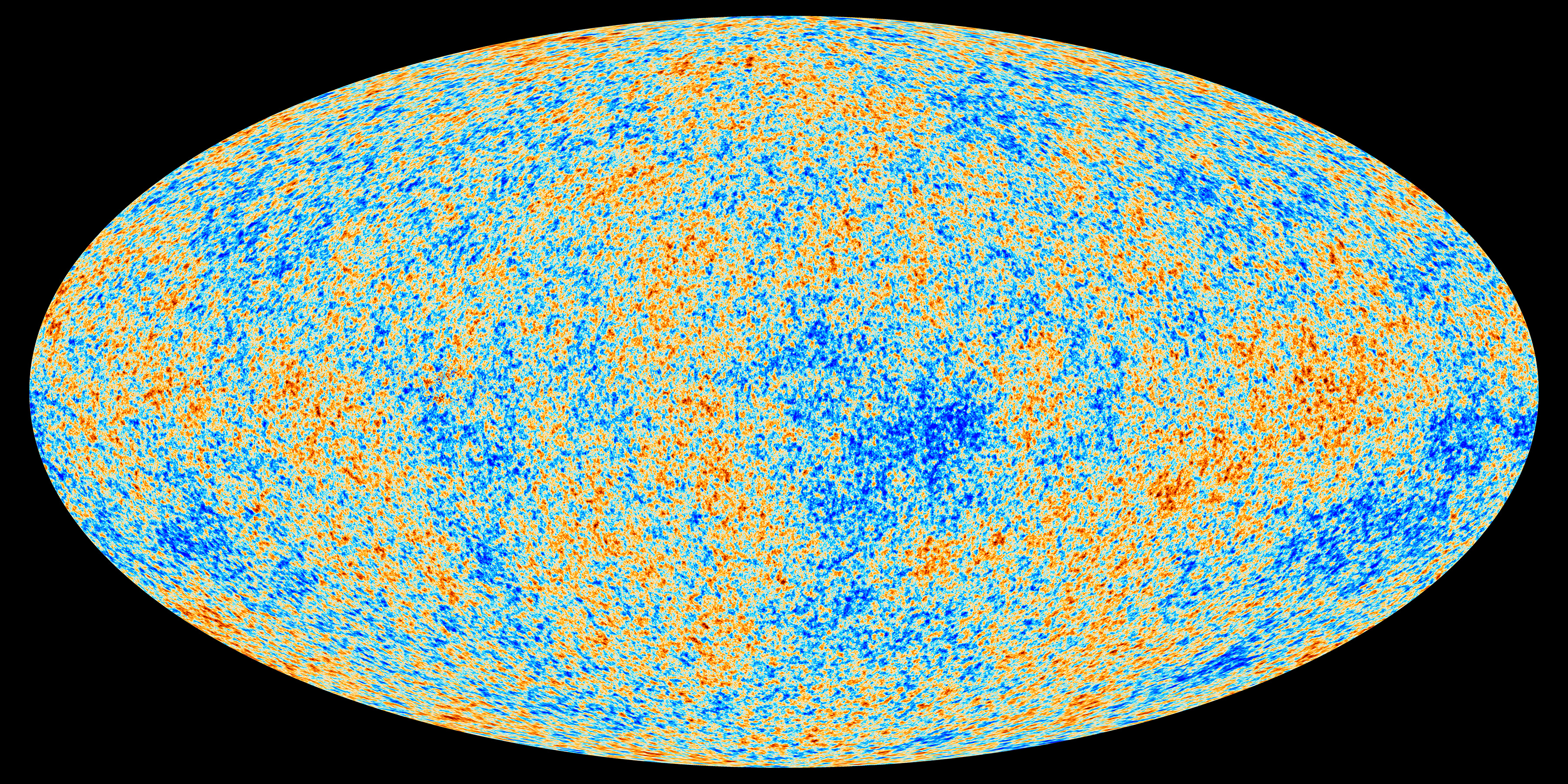
The universe as seen by Planck. Click to expand and see it in all its glory. Credit: ESA and the Planck Collaboration.

The universe as seen by Planck. Click to expand and see it in all its glory. Credit: ESA and the Planck Collaboration.

Astronomers take pictures of stuff in the universe all the time, but it’s not every day that we get to take a picture of the universe. Today was one of those days, and this is the picture.

This is a map of the cosmic microwave background, or CMB–the fading glow of the Big Bang itself. By today, the expansion of the universe has cooled it down so much that it’s only 3 degrees above absolute zero, but it’s not quite uniform. The red spots are very, very slightly hotter than the rest, and the blue spots are a tiny bit cooler. Over time, those small fluctuations grew into the clusters of galaxies we all know and love.

Here’s how they did it. The European Space Agency’s Planck spacecraft has been watching the sky since 2009, sweeping over it again and again, taking many pictures of each part. Planck sees in the far infrared, terahertz, a microwave portions of the spectrum, where mostly only very cold things shine. To see things that cold, the camera also has to be that cold, so Planck used liquid helium to cool its camera to a fraction of a degree above absolute zero. After a year of watching, all the pictures were edited together to form this image:

Planck's unfiltered view of the sky. Credit: ESA and the Planck Collaboration.

Planck’s unfiltered view of the sky. Credit: ESA and the Planck Collaboration.

In this picture, the bright white stripe down the middle is our own Milky Way Galaxy, especially the dusty star-forming regions. The blue cloudy stuff is called infrared cirrus and is made of diffuse dust scattered above and below the plane of the galaxy. The grainy stuff in the background comes from other galaxies, and most importantly, the CMB. If you look carefully, you can see some similarities between the grainy background here and the CMB map in the first image.

This picture took one year to make, but it took nearly three years to filter out the light from our own Galaxy and from other galaxies to make the image at the top of the post. This was done by, among other things, comparing different wavelengths of light to figure out what each thing in the picture is made of and what its temperature is. Do it just right, and you can see what the universe looked like when it was just 370,000 years old.

Astronomers can learn a lot from pictures like this. For example, the universe is about 100 million years older than we thought, and it has a little less dark energy than we thought. See here for a good overview of the science or here for the original press release. We can learn so much from Planck because it has a much better telescope and camera than its predecessor, NASA’s WMAP. Here’s a comparison I made of the same part of the sky as seen by WMAP and by Planck:

Comparison of the same part of the sky as seen by WMAP (left) and Planck (right). Credit: NASA/WMAP Team, ESA/Planck Collaboration, and own work.

Comparison of the same part of the sky at the same scale as seen by WMAP (left) and Planck (right). Credit: NASA/WMAP Team, ESA/Planck Collaboration, and own work.

Try to match up the red spots and convince yourself that you really are looking at the same part of the sky. In WMAP, you see a bunch of blobs that look that could just be noise, but when you look at the Planck image, you can see that the blobs are real, and they have little details inside them. That’s because the fluctuations in the temperature of the CMB are strongest when they’re about the size of those blobs–a few times the size of the full moon–but there are some that are larger and smaller.

So there it is: the best picture ever taken of the early universe, and it only took 4 years and 700 million euros to make. Now the cosmologists can get to the really hard part: interpreting it.

Posted in Space | Tagged , , | Comments Off on How to take a picture of the universe

New title

I decided I needed something snazzier than just putting my name across the top of the page, especially since it’s already in the side bar and the address bar. After Googling a few phrases to see if they were taken, I decided on “Science Meets Fiction”. It pretty much describes what I’ve been doing: talking about the interesting science (especially astronomy) that’s going on in the world alongside my thoughts about reading and writing. The change feels like a timely one, too, since I’m coming up on sixth months of blogging. (Wow, has it been that long?) Here’s hoping the new name will serve well for a long time to come.

Thanks to all my followers and regular readers who have joined me in these past six months, and now, welcome to Science Meets Fiction.

Posted in General | Comments Off on New title

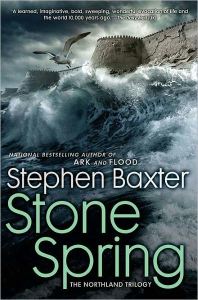
Book review: Stone Spring by Stephen Baxter

Stephen Baxter is one of the most versatile speculative fiction authors writing today, with works ranging from near future to far future to parallel universes to the distant past. He won fame for his award-winning Vacuum Diagrams and his bestselling Flood and Ark. In Stone Spring, he explores another corner of the speculative fiction universe: alternate prehistory.

In 7300 BC, much of the North Sea is dry land, a fertile plain on which stands the village of Etxelur, known throughout northern Europe for the high quality of its flint. However, this “Northland” is being flooded as the Ice Age ends and the great glaciers to the north melt. In a millennium or so, the sea will rise several hundred feet.

Fourteen-year-old Ana of Etxelur is confronted with this reality amidst all of the other hardships of the Mesolithic era. After one too many disasters in her life, from the loss of her home to the waves to the splintering of her own family, she decides to fight back. Novu, a wandering trader from a town called Jericho has recently arrived in Etxelur, and while Ana initially laughs at his strange words like “bricks” and “walls”, when he explains what they are for, she starts to get ideas.

Stone Spring is an eerily plausible story of how people might have lived at a time when they were just figuring out agriculture, and about what could have been with a little nudge in the right direction. Baxter also includes a number of subtle nods our archaeological knowledge of the period. Ana speaks a distant ancestor of the Basque language. The newcomer Ice Dreamer is the last of the dying Clovis People, having survived a harrowing journey across the Atlantic. And while he doesn’t get everything right (for example, it wasn’t that uncommon for people to live to age 40 in the Mesolithic, as Baxter suggests), the backdrop of the story is well-researched and vividly described.

Stone Spring is broad in its scope, exploring such diverse topics as the sophisticated lifestyle and international politics of prehistoric Europe and the psychology of people who are seeing large-scale construction for the first time. Yet through all this, the story of Ana, her family, and the fate of her village shines clearly. The ever-present danger of the Mesolithic is keenly felt, and fortunes can turn on the life or death of a single character, making it a compelling read as well as a thought-provoking one.

My rating: 4.5 out of 5.

Posted in Book reviews | Tagged , | 1 Comment

The Sun plays nice…for now

The Sun as seen by the Solar Dynamics Observatory. Credit: NASA/LMSAL.

The Sun as seen by the Solar Dynamics Observatory. Credit: NASA/LMSAL.

The Sun has been acting kind of weird for close to five years now. The good news is that it’s been oddly quiet. The less good news is that we don’t really know why.

The Sun undergoes an 11-year magnetic cycle. In the Solar Minimum, it’s very calm, with few or even no sunspots, and very little other activity. It just shines. Over time, though its magnetic field gets tangled up, and it starts to get cranky. First, there are sunspots, and then all manner of other phenomena: solar flares, solar prominences, and the ominous coronal mass ejections, or CMEs. This is called the Solar Maximum. After a while of this, the whole magnetic field flips over, and things quiet down again.

It’s those CMEs you have to worry about. CMEs are giant clouds of protons that are blasted into space at high speeds. If they head toward Earth, they get funneled toward the poles by our own magnetic field, where they create the auroras. But if they get too big, the results could be catastrophic.

But there is some good news. Check out this graph of sunspot numbers since 2000:

High numbers mean a lot of Solar activity, and a high risk of big solar storms. In 2000-2002, we had a big, double-peaked Solar Maximum, and then, a few years later, things started to get weird. The Solar Minimum of 2008-2010 lasted a year longer than expected. Now, the new Solar Maximum is only half as strong as the last one–much weaker than the predictions.

Why is this happening? We don’t really know, but it’s good for us because it gives us more time to harder our power grid against disruption. And it looks like it’s half over already…but we’re not out of the woods yet. The biggest solar storms in recent memory were the Halloween Storms of 2003, which came long after the Solar Maximum and at a time when the Sun was about as active as it is now.

So here’s hoping the Sun keeps playing nice until at least the next Solar cycle.

Posted in Sun | Tagged , , , , | Comments Off on The Sun plays nice…for now

250 words per day: the dark side

I wrote before about the Magic Spreadsheet, which is the only thing that has ever really gotten me to write daily. I’m happy to report that I am at 51 days and counting, but it’s been getting harder, and the reason is time.

As is typical in my field, academia keeps me very busy. I do have some free time–a fair bit of it on a good day, which is one of the reasons I’ve been able to keep up with it. But what I do not have is large blocks of free time. And I find that when I have to write for a long time without that flexibility, I’m more and more likely to get stuck.

I’m the type of writer who always has several projects going at once. I realize that this is violating one of the rules guidelines of writing: “Don’t cheat on your writing with your other writing.” (I thought I had heard this from I Should Be Writing, but I can’t find it now.) It sounds like good advice, but it doesn’t work for me most of the time, so I keep a shortlist of active projects instead. Unfortunately, my shortlist looks like this:

1. A short story that requires significant research about the War of 1812 to write coherently.

2. Starting a novel that is pretty well outlined, except I never thought of a good opening scene.

3. Some pop-science material that I’m not sure how to explain at the correct technical level.

4. Editing a different short story–more on this in another post.

All of these projects are at a critical point: I need time to give them some serious thought to organize them and knit together the little snippets of material I have for them. Too often, I don’t have time to do that, or (more insidiously) I don’t feel like I have the time. So I usually end up choosing option 5: some cool scenes from other projects that are a long way from being seriously worked on. I still get my writing in, but it’s not as productive. Or I might pick option 6: some legitimately useful outlining and/or background material.

With spring break coming up, this might change, but with general exams also coming up, it might not. So, to all you writers out there, any advice on how to get a project unstuck? Leave a comment below, and, until next time, keep writing.

Posted in Writing | Tagged , , , , | Comments Off on 250 words per day: the dark side

In the sky: Comet PanSTARRS is here

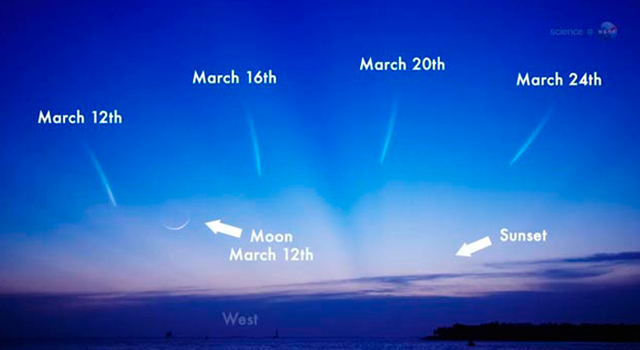
Simulation of Comet PanSTARRS as seen in the northern United States. Credit: NASA.

Simulation of Comet PanSTARRS as seen in the United States. Credit: NASA.

The first bright comet of 2013 is entering the northern skies this weekend. Comet C/2011 L4 (PanSTARRS) will be brightest for the next three days or so, rivaling the stars of the Big Dipper. The exact position in the sky will vary with time and with your latitude. Here is a good guide to finding it.

To spot this comet, first find an unobstructed view of the western horizon. (For many people living in populated areas, this may be the hard part.) Then, wait until about half an hour after sunset. Finally, look just a little to the left and above where the Sun went down–this close to the equinox, that will be almost due west. If you have clear skies and good eye, you should be able to see it. Good luck!

Posted in Comets, Stargazing | Tagged , | Comments Off on In the sky: Comet PanSTARRS is here