Children’s Fantasy Review Part 3

The original trio: Alice’s Adventures in Wonderland, Peter Pan, and The Wonderful Wizard of Oz

See Part 2 of this series here.

Okay, so they’re not the original children’s novels. Even if you toss out the fairy tales as a different genre, the tradition of books written specifically for children goes back to John Newbery’s A Pretty Little Pocket-Book (1744). The earliest children’s book that remains well-known today is probably Johann David Wyss’s The Swiss Family Robinson (1812).

However, something happened in 1865 when Charles Lutwidge Dodgson, better known as Lewis Carroll, published Alice’s Adventures in Wonderland. Up until this time, practically all of children’s literature, from the moralistic fairy-tales to Newbery’s alphabet book to Wyss’s educational literature was aimed at least in part at teaching children.

But children won’t learn much from Alice. Attentive adults may learn a fair amount about advanced mathematics and Dodgson’s low opinion thereof, but for children, it will go completely over their heads. Alice’s Adventures in Wonderland began a new trend of books whose primary appeal was to children’s imaginations, not their lessons.


Alice is also probably the wildest of children’s literature as well. In other books, strange things may happen at random, but Alice reads like a 100-page opium-fuelled dream sequence. Like a real dream sequence, utterly bizarre scenes involving the White Rabbit and the Queen of Hearts shift into one another with no rhyme nor reason, nor any significant resolution. It’s pretty much just meant to be funny, but by modern standards, it’s a bit difficult to read.

J. M. Barrie’s Peter Pan or Peter and Wendy is much more straightforward, though still quite fantastical. Here the eternally young and grown-up hating Peter whisks Wendy away to Neverland, a land of dreams, where she is to be a “mother” to the Lost Boys. While Neverland is very much written as a real place, a number of whimsical elements, like the ticking crocodile, and even dream-like ones, like Wendy wearing a kiss on a chain around her neck, pepper the novel, which seems to be a reflection of Peter’s conceited and rather scatterbrained mind.

L. Frank Baum’s The Wonderful Wizard of Oz rounds out the classic trio of female protagonists of Alice, Wendy, and Dorothy, and it probably has the most coherent plot of these three early children’s novels, though it is still very episodic, and, in violation of good literary practice, the resolution is scattered across half the book. Nonetheless, it is a good story: Dorothy is picked up with her family’s farmhouse in a “cyclone” (tornado) and deposited in the magical land of Oz. There she meets, bizarre companions, defeats the Wicked Witch of the West, and unmasks the fraudulent Wizard on her journey to get back home to Kansas. The plot of the film here is actually only the first two thirds of the book, as an extra quest is needed to discover the secret of the silver (not ruby) slippers.

I will note that in the latter half of the twentieth century, various theories of an allegorical meaning to The Wonderful Wizard of Oz were proposed, the most popular being a very amusing comparison with the “Free Silver” Populist political movement of the 1890s. However, this allegorical theory was only first proposed in 1964 and is now generally discounted.

One particularly important aspect of children’s literature that I noticed from reading these books is pacing. Most children’s literature has a certain economy of words, in which the same thing is said faster and more simply than it would be in an adult novel. The exceptions are the longer books that are as long as adult novels. To see what I mean, compare the writing style of the first Harry Potter book with any of the large later ones.

However, there can be a huge variation from book to book. Peter Pan is close to 50,000 words, while The Wonderful Wizard of Oz is about 40,000. However, The Wonderful Wizard of Oz has a far more complex plot (in that a lot more things happen), resulting in its language being much snappier. Scenes shift rapidly, major problems are introduced and solved in just a few pages, or sometimes just a few lines, and description is quite light.

This stands in stark contrast to Peter Pan, which takes its time drinking in the flavor of Neverland and indulges in long descriptions of the life of the Lost Boys. It’s not boring, by any means, but its slow, grand, sweeping style is nonetheless extremely different.

Neither of these approaches are wrong by any means, although I prefer the more measured style that, if not overdoing it on the descriptive details, certainly doesn’t shy away from them. What is more important is to be aware of and consistent in your style, and to keep your style to the reading level of your audience.

Next time, we explore the animal world with The Tale of Despereaux and the Rats of NIMH trilogy.
Posted in Book reviews, Reading | Tagged , , , , , | 1 Comment

Cosmos follow-up: Hypatia and the Library of Alexandria

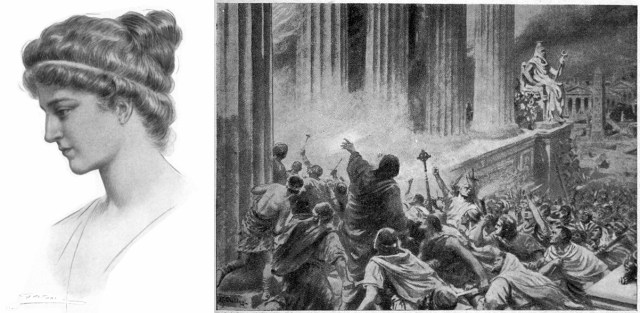
Left: portrait of Hypatia. Right: illustration of the burning of the Library of Alexandria in 391.

Left: portrait of Hypatia. Right: illustration of the burning of the Library of Alexandria in 391.

The recent Cosmos series has been a tour-de-force for science education and popularization, equal to the original. However, there is one aspect of both series that I have to take issue with, and that is the holding up of the murder of the philosopher Hypatia and the burning of the Great Library at Alexandria as examples of the decline of intellectualism in the early Christian era.

Hypatia was a neo-Platonist philosopher living in Alexandria, and probably the most famous female scholar of antiquity. It is agreed by all accounts that she was murdered by a Christian mob, specifically, followers of the Bishop, Cyril of Alexandria, in the year 415, as Dr. Sagan and Dr. Tyson both say. However, the account closest to her death says that she was not murdered for being a non-Christian (indeed she was held up by some Christians as a symbol of virtue), but for being an adviser to the Christian governor, Orestes, whom Cyril opposed. (Orestes was more secular than Cyril, opposing the growth of ecclesiastical power and making overtures to Jews and Pagans in Alexandria.)

Cosmos does not make Hypatia’s death so much a religious issue as an anti-intellectual on, but the truth is that it was actually a political one. A second problem comes when Dr. Sagan links her death to the destruction of the Great Library. In fact, in the final episode of the original Cosmos, “Who Speaks for Earth”, Carl Sagan says, “The last remains of the library were destroyed within a year of Hypatia’s death.”

The problem with this is that the last remnant of the Library of Alexandria were almost certainly destroyed in 391, 24 years before Hypatia’s death, and most of the library was likely destroyed, by accident, centuries earlier.

It sounds strange, but we actually don’t have a very good idea of when the Library of Alexandria was destroyed. As best we can tell, much of it was burned unintentionally when a fire spread through the city during Julius Caesar’s invasion in 48 BC. While the majority of the library may have survived that war, it was almost certainly destroyed in the war between Emperor Aurelian and Queen Zenobia of Palmyra in the 270s AD. This also appears to have been unintentional, as a large part of the city was burned.

What little was left of the library was deliberately destroyed in 391, when Emperor Theodosius I banned Paganism. The remaining repository of books in Alexandria was destroyed along with the Pagan temple it was stored in.

I admire most of Dr. Sagan’s and Dr. Tyson work, but when they characterize Hypatia’s death and the burning of the Great Library as the deliberate (and linked) actions of an anti-intellectual mob, they are simply misrepresenting the history.

Posted in History, TV Reviews | Tagged , , , , | 3 Comments

Children’s Fantasy Review Part 2

Divine intervention: The Horse and His Boy and A Wrinkle in Time

See part 1 of this series here.

The Horse and His Boy is my favorite book of the Chronicles of Narnia by C. S. Lewis, a series now considered one of the staples of children’s literature. Perhaps as famous as the Narnia series itself is the fact that it was written with very prominent Christian themes. (Aslan is not just an allegory for Jesus, in-story, he is Jesus.) Meanwhile A Wrinkle in Time by Madeleine L’Engle, is a rare beast: an instance of Christian science fiction. These are few, and ones that are well known are fewer. A Wrinkle in Time is probably the most widely-read, but being Christian, it is really better characterized as science fantasy. Madeleine L’Engle was strongly influenced in her writing by C. S. Lewis, though she definitely has her own style.

Continue reading

Posted in Book reviews, Reading | Tagged , , , , , , | 1 Comment

Cosmos side by side: part 3

Cosmos: A Spacetime Odyssey has wrapped up, with the final episode airing last Sunday. Here I am reviewing Episodes 10-13 of the series. See also my reviews of Episodes 1-4 and Episodes 5-9. Continue reading

Posted in Science, TV Reviews | Tagged , , | Comments Off on Cosmos side by side: part 3

Children’s Fantasy Review Part 1

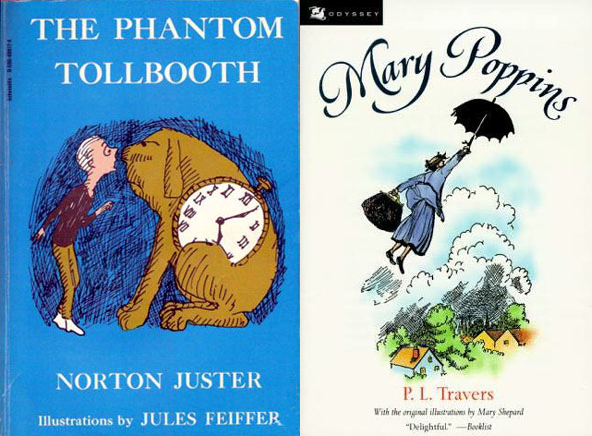
Things happen at random: The Phantom Tollbooth and Mary Poppins

The Phantom Tollbooth by Norman Juster and Mary Poppins by P. L. Travers are two of the classics of children’s fantasy literature. Like much children’s fantasy, both books tell the stories of an ordinary child or group of children who are suddenly thrown into a world of magic and adventure. The circumstances are different, but several common patterns quickly emerge.

In The Phantom Tollbooth, a very bored boy named Milo is transported to a land of pure metaphor where he must travel through the Kingdom of Words and the Kingdom of Numbers, Fight the Demons of Ignorance, rescue the princesses, Rhyme and Reason; and in doing so, he learns to appreciate his life. In Mary Poppins, the Banks children (there are four of them in the book) go on adventures with their new nanny, who seems to cause the most ordinary day to become magical.

One of the staples of children’s books, especially fantasy, is that the children are usually isolated from their parents and other authority figures. This requires somewhat more suspension of disbelief than you might find in adult literature, since in the real world, responsible adults wouldn’t let children wander around on their own that much at all, let alone in dangerous situations. Mary Poppins is actually unusual in this regard, since Jane and Michael stay with their nanny, who is a responsible adult, but just so happens to be magical. The Phantom Tollbooth is more standard: Milo drives through a cardboard turnpike tollbooth that is mysteriously delivered to his room in a toy car.

Another feature that appears in some children’s books, but not others, is that they can be very episodic. After all, with children’s short attention spans, there is not all that much need for a plot. The epitomes of this trope are definitely Alice’s Adventures in Wonderland and Through the Looking Glass, and What Alice Found There by Lewis Carroll, which both read like 100-page opium-fueled dream sequences. Personally, I dislike this style. I think that children’s books are more fulfilling when they have a strong, overarching plot, and the ones that do will do a better job of appealing to both children and adults.

Both of these books follow the episodic pattern. The Phantom Tollbooth does have a plot, and a pretty clever one, the way little things from earlier keep coming back, and the wordplay was also excellent, like Alice in Wonderland, but with more plot and less opium. However, I was still put off by how much the action kept jumping around.

Mary Poppins, on the other hand, I was very surprised to learn has basically no plot at all. The children just go on a number of small adventures with Mary Poppins with no real pattern to them. In this case I think I was spoiled by having seen the movie first. Mary Poppins is one of the rare cases where I think the movie is much better than the book, which is ironic because P. L. Travers actually hated the movie. The movie actually does follow the book loosely, but the subplot of Mr. Banks learning to be a real father to his children, which I feel is the best part, doesn’t appear in the book at all.

Unfortunately, I can’t give very high recommendations for these books. Classics they may be, but I have to say that, at best, they’re not my style.

In Part 2, I will be examining two classics of Christian-influenced fantasy-adventure: The Horse and His Boy from the Narnia series, and A Wrinkle in Time.

Posted in Book reviews, Reading | Tagged , , , | 1 Comment

Children’s fantasy literature review: Introduction

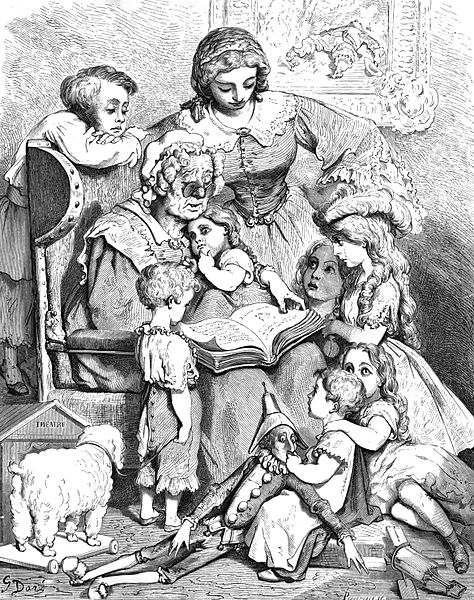
Mother Goose reading fairy tales. Illustration by Gustave Doré (1866).

Mother Goose reading fairy tales. Illustration by Gustave Doré (1866).

Children’s books are very much a genre of their own–or rather multiple genres, since they can be realist or literary fiction, mysteries, fantasy, history, or (almost) any other adult genre, plus the different age groups: chapter books (ages 6-10), middle grade (ages 8-12), upper middle grade (ages 10-14), and young adult (ages 12-18).

The literary conventions in children’s literature are very different in many ways from adult fiction, both because of the younger audience (which requires simpler language and shorter lengths), and because the marketing is more geared to parents and schools, with their distinct views of literature.

I’ve been taking a closer look at children’s literature because I’m planning to write a middle grade fantasy novel for Camp NaNoWriMo in July (more on that later). In preparation for this, I’m reading through a number of classic children’s fantasy novels, some of which I’ve read, and some I haven’t, in order to get a feel for the genre. I will post my observations from these books as I read them in the coming weeks.

Posted in Reading, Writing | Tagged , , , | 1 Comment

Book review: Scoundrels by Timothy Zahn

I usually shy away from the Star Wars Expanded Universe. I’ve read about what kinds of things have got into the shared timeline from places like Wookieepedia, and I feel like large swaths of it are ridiculously over the top. The comics are the biggest culprits in this, but since everything in Star Wars is canon (considered to be part of the official storyline), we’re stuck with them. As for the books, I’ve not heard great things about a lot of them, either.

However, I make a point of reading all of the Star Wars books written by Timothy Zahn. Years before the prequel trilogy of films, Timothy Zahn wrote the Thrawn Trilogy, which wonderfully fleshed out the political and military aftermath of Return of the Jedi, showing that things weren’t quite so simple for the Rebellion taking over from the Empire. Since then, I’ve found Zahn’s books to be well-written and well thought out in the Star Wars universe.

Zahn’s most recent Star Wars novel, Scoundrels, is no exception. This story takes a different route from his Rebellion-centered stories, instead focusing on one of Han Solo’s personal misadventures–a heist story modeled on Ocean’s Eleven.

Recruited by the son of a murdered entrepreneur, Han’s team of, yes, eleven smugglers, gamblers, thieves, and all-around scoundrels are tasked with getting the hapless victim’s money back from a local crime lord. The trouble is, this crime lord isn’t exactly local, and he’s got a lot more than money to protect in the galaxy’s most impenetrable safe. Oh, and they only have a week to do it in.

This book was a lot of fun. While not perfect, the caper was well-designed, with just enough things going wrong to keep it interesting. The characters were believable, including the ones we already know and love. The biggest problem was keeping all eleven scoundrels plus a few antagonists straight. However, while the plethora of characters weighed it down a bit, the way the plan came together in the end, despite being half-improvised on the fly did make it work. Add in a hilarious Easter egg for Harrison Ford fans and a last-minute twist ending, and you have a recipe for a pretty good read.

My rating: 4.5 out of 5.

Posted in Book reviews | Tagged , , | Comments Off on Book review: Scoundrels by Timothy Zahn

The Sun’s big brother found

How to find HD 162826 in the sky. Credit: Ivan Ramirez/Tim Jones/McDonald Observatory.

How to find HD 162826 in the sky. Bring a telescope. Credit: Ivan Ramirez/Tim Jones/McDonald Observatory.

The Sun was born 4.57 billion years ago from a giant molecular cloud, as one of probably hundreds or even thousands of members of a freshly-minted open star cluster. So where are all these brothers and sisters of the Sun? Well, stars in an open cluster scatter across the galaxy over billions of years, so they’re probably all thousands of light-years away where we wouldn’t notice them.

Or are they?

Astronomers at UT Austin’s MacDonald Observatory have announced that they have found a star that they believe was born in the same cluster as our Sun. This star is called HD 162826, and it’s only 110 light-years away in the constellation Hercules. You can read the details of their discovery in the scientific paper here.

I’ll admit, when I first saw this story, I was very skeptical. After all, stars in open clusters scatter into the galaxy as something like a few percent of their orbital speed around the galactic center. (This behavior varies with distance and is describe by something called the Oort constants.) Since the Sun has made about 20 orbits around the galaxy since its birth, its had time to drift to the far side of the galaxy from the place of its birth.

On the other hand, it is possible for star clusters to hang together for a long time. For example, M67 is an open cluster that it estimated to be about 4 billion years old, nearly as old as the Sun, and it still has well over 500 stars. Moreover, the way the gravitational interactions work, small stars get thrown out of clusters fastest and farthest, while big stars huddle closer together for longer. Since the Sun is bigger than 85% of the other stars in the galaxy, it might have been drifting away much more slowly.

So which is it? Did the Sun wind up on the far side of the galaxy from its birthplace, or did it stay closer to home? It would appear that the answer is the second one. The astronomers at MacDonald observatory looked at two crucial properties of the stars around us to see if any of them could be the Sun’s long-lost siblings. First, they had to be on a reasonably similar orbit, not some weird elliptical one where it couldn’t have come from anywhere near here. Second, it they had to have the same chemical composition. Every giant molecular cloud has a different chemical signature–more of one element and less of another–so only stars with almost exactly the same chemical abundances as the Sun could possibly be siblings.

For the star HD 162826, only one element, Samarium, was out of place, and that is strong evidence that it really did come from the same stellar nursery!

HD 162826 is 15% more massive than the Sun and slightly hotter and brighter. Since bigger stars usually form before smaller ones, it is the Sun’s big brother in both senses of the term. Finding a solar sibling has some astronomers excited, since their proximity in their youth means that there is a greater possibility that life could have been carried between one solar system to another by asteroids and comets. Personally, i don’t put much stock in these panspermia-type theories, but seeing what kinds of planets might be around stars similar to the Sun does tell us about how they form and how many there might be out there. Sadly, HD 162826 doesn’t have any planets that we can see yet, but so far, we’ve only ruled out the biggest and hottest ones.

Posted in Science, Space, Sun | Tagged , , , , | Comments Off on The Sun’s big brother found

Cosmos side by side: part 2

This is my review of Episodes 5-9 of the new Cosmos series, hosted by Neil deGrasse Tyson. See my review of Episodes 1-4 here.

The middle third of the new Cosmos series branches out more from the original, tackling many new topics, although it still hearkens back to earlier concepts like the Cosmic Calendar and the Tree of Life.

Episode 5, “Hiding in the Light,” is an all new story describing the nature of light, the history of cameras and optics, and the discovery of absorption lines in the spectrum of the Sun by Joseph von Fraunhofer. Thus, we explore a dimension of our knowledge of the universe that was skipped over in the original. The near-fairy tale story of Fraunhofer delightfully takes center stage, but his discovery will be very important in a few episodes.

Episode 6, “Deeper, Deeper, Deeper Still,” explores the world of molecules, atoms, and subatomic particles, from the atomic theory of Democritus to Wolfgang Pauli’s prediction of the existence of the neutrino–a whirlwind tour of the very small right up to the development of modern neutrino detectors. This episode draws a little on Episode 9 of the original series, “The Lives of Stars”.

Episode 7, “The Clean Room”, focuses in and tells the story of one man: Clair Patterson. Patterson’s many achievements include inventing the clean room, determining the age of the Earth, and, finally, his multi-year crusade against the powerful Ethyl Corporation to remove lead from gasoline. Patterson’s story is compelling and highlights the best of Dr. Tyson and Co.’s storytelling skills.

Episodes 8, “Sisters of the Sun”, again draws upon “The Lives of Stars”–more thoroughly, in fact, than any of the episodes, describing the life cycles of stars in detail, but it also particular tells the story of the women pioneers of modern astronomy: Annie Jump Cannon, Henrietta Swan Leavitt, and Cecilia Payne-Gaposchkin, who developed the science of stellar classification, a way to measure the distances to distant stars and galaxies, and discovered the mostly-hydrogen composition of the stars, respectively. Once again, the stories are told well, and as an astrophysicist, I definitely appreciate the mainstream attention these women are getting.

Episode 9, “The Lost Worlds of Planet Earth”, tells of Earth’s geological history from the Carboniferous Period to the present. The formation of fossil fuels, continental drift, mass extinctions, the evolution of mammals, and ice ages are explored. Personally, I felt that the focus on climate change toward the end was a bit heavy handed, but no more so than the anti-nuclear stance of the original.

Overall, while I felt that the first few episodes had some weak spots, once the show gave itself room to strike out on its own, the content has been very good, and I think it does hold up to the original Cosmos. I am excited to see what the final four episodes have in store.

Posted in Science, TV Reviews | Tagged , , | Comments Off on Cosmos side by side: part 2

Bible reading redux

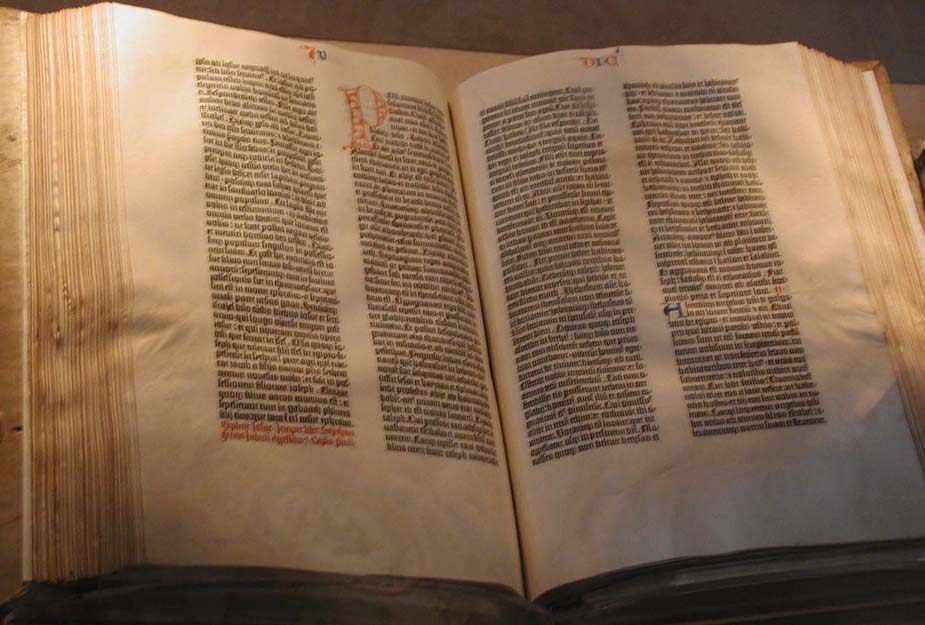
A Gutenberg Bible. Probably not the most practical version for reading. Credit: Mark Pellegrini.

A Gutenberg Bible. Probably not the most practical version for reading. Credit: Mark Pellegrini.

At the beginning of the year, I posted my plan to read the Bible cover to cover this year. I felt unsatisfied with the various Bible in a year plans that can be found on the Internet, so I designed this plan myself by trying to balance two conflicting goals: one, to make each reading close to the same length, and two, to keep the natural narrative units of the text intact.

But you know what they say about the best laid plans. In the intervening four months I have found two distinct problems in my plan.

It took me until the beginning of February to notice the first problem. I had simply made a few mistakes in diving up the text, a product of only skimming the text before cutting it. But there are a number of places where it’s hard to figure out where the most natural breaks in the text are without reading it through.

I first noticed this in the beginning of Leviticus, where my first two readings were Leviticus 1:1-5:13 and 5:14-7:38. I chose this break because it was the most convenient-looking place where the text was divided in the New International Version. It was only on the actual read-through that I realized that this naturally breaks down into three sections. The first, covering 1:1-3:17, deals with regulations on one broad category of offerings: when someone brings an offering to God freely. The second section, 4:1-6:7, covers a different category of offerings: those brought in repayment for sins. The third section, 6:8-7:38, starts over and says how the priests are supposed to handle both types of offerings. The points may be subtle, but the “narrative” flows much better when it’s divided this way.

The second problem with my plan was that I didn’t do as good a job as I thought at dividing the Bible into equal sections. Granted, it’s better than most other plans that I’ve seen, which usually just order three or four chapters per day, even though the chapters can be very different lengths. However, I fell into this same trap when I based my plan on the word count for each book. It turns out that the word counts of individual chapters can vary so much in the same book, that I still wound up with some readings that were much longer than others.

The average daily reading length to read the Bible in a year is 2,143 words in the King James Version, or 2,026 words in the NIV translation, which is about 40,000 words shorter. I first noticed the inconsistency of my plan with Exodus 25-31, describing the design of the Tabernacle, which clocks in at 5,252 words, but I didn’t realize how far it went until I got into the history books, Samuel and Kings, where several readings turned out to be over 4,000 words. When I saw that, I finally broke down and took a word count of every reading via copy and paste. From this, I learned that Exodus 25-31 is the second-longest reading in my plan. The longest is Jeremiah 48-52, Jeremiah’s prophecies of judgment against the nations, which measures a whopping 6,734 words (despite being two fewer chapters).

So…if you’re following my plan, you might want to set aside some extra time on August 28. I apologize for the inconvenience. I will post a revised version of my plan at the end of the year to fix these errors.

Posted in Reading, Religion | Tagged , , , | Comments Off on Bible reading redux