The Great Silent Treatment

A Short Story

Author’s Note: For the first time, I am publishing a piece of my original fiction on this blog. I’ve previously been looking at trying to break into traditional publishing, but the online medium is becoming moreand more the way to do it, so I’ve decided to get on the bandwagon. There will be a permanent link to this story on the Short Stories page in the header.

The trouble first started when the observatories tasked with tracking potentially-hazardous asteroids reported several objects headed towards Earth on similar trajectories and at very high speeds—much too fast to originate from within the Solar system. On paper it looked like a mistake, not even worth reporting, but astronomers’ attempts to find the error only served to produce more asteroids. The find was sent up the telescope pecking order until it got to us at Keck, and we turned the huge mirrors on the peak of Mauna Kea to take a look. Continue reading

Posted in Fiction | Tagged , | Comments Off on The Great Silent Treatment

Fan Fiction Review: Harry Potter and the Methods of Rationality

Fan-made cover art for HPMOR. Credit: Zerinity (DeviantArt).

Fan-made cover art for HPMOR. Credit: Zerinity (DeviantArt).

A very well-written and scientifically-minded retelling of Harry Potter has just been completed: Harry Potter and the Methods of Rationality.

Fan fiction is in the news lately. This genre, in which fans of books, movies, or television shows like Star Trek, Star Wars, and Harry Potter write their own versions of their beloved stories began with the Star Trek fanzines of the 1960s and 1970s, but has come into its own in the Internet era, with major repository websites like fanfiction.net hosting literally millions of stories.

Continue reading

Posted in Book reviews | Tagged , , , | 1 Comment

Movie Review: Chappie

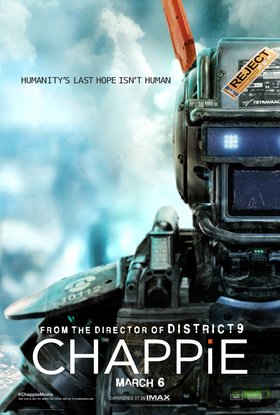
Chappie is the story of a robot brought to life by one kidnapped scientist and three brutal gangsters. Given an upbringing like that, he turns out better than you’d think.

In 2016, the police force of Johannesburg, South Africa deploys robotic officers to turn the mounting tide of crime. One robot, Scout 22, is hit with a grenade and is no longer fit for service, but the robots’ creator, Deon Wilson, steals it for his personal artificial intelligence project. Unfortunately, Deon is kidnapped by a trio of gangsters (two of whom seem to be South African rappers playing versions of themselves) who want him to shut down the robots (which is not possible). With no other options to save his life or his creation, Deon uploads his artificial intelligence program into Scout 22, which immediately takes on a conscious, but infantile demeanor.

Named Chappie by one of the gangsters, the robot say his first words within minutes, learns to swear overnight, and (through the forceful encouragement of the gang leader) how to handle guns and knives the next day. But Deon stays in the picture, doing his best to teach Chappie about the finer things, like reading, painting, and morality. Soon, though, Chappie is surrounded by danger on all sides, between his own defective battery, the gangsters, and Deon’s ruthless rival, Vincent, who will stop at nothing to get his own super-robot up and running. Chappie must grow up fast to save himself and his dysfunctional family.

Usually, I find myself agreeing with the critics on the quality of movies, but this film is an exception. I consider Chappie to be Neill Blomkamp’s best work, better than both District 9 and Elysium. Maybe it’s because I’m a big fan of the Short Circuit films, which I also consider to be underrated. (I definitely see parallels between Chappie and both Short Circuit films, but nothing that smacks of a complete ripoff.) Maybe it’s because I have a particular affinity for robot/AI-centered movies. Whatever the reason, I thought it was very well done, far better than most of the critics’ assessments. In particular, I thought that Chappie’s progression from infant to young child, older child, teenager, and finally adult, and his ensuing interactions with his human “Mommy”, “Daddy”, and “Maker”, were brilliantly executed, making him seem so human while still keeping him clearly a super-intelligent robot at the same time. I wouldn’t quite put him on the level of Johnny 5, but Chappie is still an instant classic of the robot world.

My rating: 4 out of 5.

As an afterthought, I will add that I’m a little perplexed by the film’s tagline: “Humanity’s last hope isn’t human.” Humanity is never in danger in this movie. The robot police are never even hinted at being oppressive by anyone except the gangsters they’re hunting down. However, there may be another side to it. If you think about the implications of the end of the film, I think it may be Fridge Brilliance.

Posted in Movie Reviews | Tagged , , | Comments Off on Movie Review: Chappie

What If? Rejects #4.1: Volcanoes

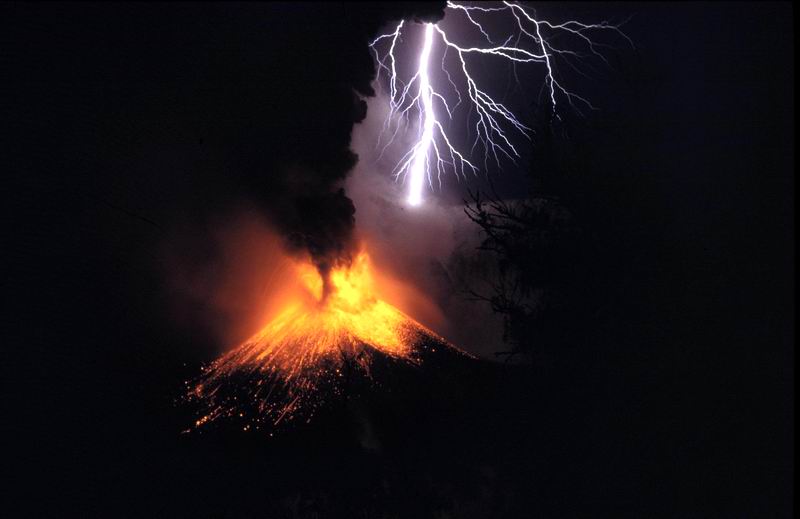
Eruption of Mount Rinjani in Indonesia in 1994. Credit: Oliver Spalt.

Well, it’s been a while, but it’s finally time I got back to my What If? Rejects series, where I answer the questions that Randall Munroe declined to answer in his book, What If?

Previous post in this series: Umm…?

Next post in this series: In Space, No One Can Hear You Scream

Q: Would it be possible to stop a volcano eruption by placing a bomb (thermobaric or nuclear) underneath the surface?

Randall’s response: A volcano erupts an ash cloud in the shape of the word “NO”. A guy standing on the volcano says, “Why did you do that?!”

My response: No. Dropping a thermobaric bomb on a volcano would do very little. Dropping a nuclear bomb on a volcano would get you…a radioactive volcano.

A thermobaric weapon is a type of explosive powered partially by oxygen from the air. For example, a fuel-air bomb creates an aerosol of gasoline that burns explosively in the air. This is in contrast to most types of explosives, like gunpowder, in with the oxidizer is the saltpeter in the powder. Thermobaric weapons do not need to carry oxidizer, which saves weight and makes them more powerful per unit weight.

Thermobaric weapons are also particularly destructive and deadly because they burn very hot, and the subsequent cooling of gases causes a partial vacuum, which causes negative pressure winds towards ground zero, and can damage lungs. The largest thermobaric weapon in the world is the Russian Aviation Thermobaric Bomb of Increased Power, or “Father of all Bombs“, which has a yield of 0.044 kilotons of TNT.

A nuclear bomb, obviously, uses a chain reaction of radioactive decay or nuclear fusion to create a much larger explosion. The Little Boy bomb dropped on Hiroshima had a yield of 15 kilotons. The largest nuclear weapon ever tested, the Russian Tsar Bomba, was over 3,000 times more powerful, with a yield of 50 megatons.

A large volcanic eruption is as powerful and explosive as a large nuclear bomb. For example, the 1980 eruption of Mount St. Helens released about 24 megatons of energy, blasted down millions of trees, caused massive mudslides, superheated rock-filled blast waves, and other mayhem. I fail to see how nuking it could make that better in any respect.

Posted in Geology, What If? Rejects | Tagged , , | Comments Off on What If? Rejects #4.1: Volcanoes

Book Review: The Martian by Andy Weir

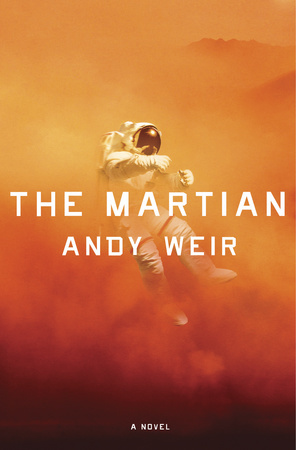
Astronaut Mark Whatney got the chance of a lifetime when he was picked to join the third manned mission to Mars. But after they landed, things went wrong. A freak dust storm far beyond anything the crew anticipated nearly destroyed the landing site. The crew was forced to leave the planet, but Mark was cut off. Now, he is stranded on the surface of Mars with no means of communication, no help scheduled to come for three Earth years, and only his wits to survive.

So we meet Mark at the beginning of Andy Weir’s novel, The Martian. Weir, a computer programmer turned author, first self-published The Martian online in 2011 and was then given a contract in 2014, to much acclaim. A movie is set to premier in November, starring Matt Damon at Mark Whatney. (Not exactly how I pictured him, but I’ll reserve judgment. Interestingly, both Matt Damon and female lead Jessica Chastain starred in Interstellar.)

For some reason, I’ve always found Mars-based fiction to be a bit dry. I’m not sure why; maybe it’s just bad luck. But The Martian was a refreshing change. Mark Whatney is relatable and funny with his frequent wisecracks and gallows humor. He’s a genius at innovating his way out of problems, but he can and does make mistakes that nearly cost him his life.

Andy Weir worked hard to make sure that the challenges Mark faces are all plausible and not contrived, though often resulting from unintended consequences of his own actions. I thought this was pulled off brilliantly, and I understood the science behind each problem well. The only serious mistake I noticed was that Mr. Weir forgets that plants actually have a lower tolerance for high carbon dioxide* levels than humans do, and Mark, as a botanist, should have known this, which would have complicated one of his projects. Other than that, I didn’t see anything I absolutely couldn’t believe.

I was surprised how long it was possible to survive on Mars with limited resources and damaged equipment, but the science works, and so does the science of how to avoid certain death again and again. The constant twists and setbacks made the book exciting to the very finish and still left me wanting to see what happened next. The Martian is possibly the best example of strict hard science fiction I’ve ever read.

My rating: 5 out of 5.

*The reason for this seems to be that the plant doesn’t need to keep the cellular structure of its leaves as open to the air with higher carbon dioxide concentrations. This reduces the evaporation rate of water, which lowers the rate at which water is brought up from the roots, and (the real killer) the plant gets fewer dissolved nutrients from the soil. Mark Whatney should have maintained his habitat at about 1200 ppm (about three times the current level in Earth’s atmosphere) for maximum plant growth.

Posted in Book reviews | Tagged , , , | 1 Comment

See Comet Lovejoy While You Can

Close-up astrophotograph of Comet Lovejoy. Credit: Paul Stewart.

Close-up astrophotograph of Comet Lovejoy. Credit: Paul Stewart.

This is Comet C/2014 Q2 (Lovejoy). Like many comets, it has a bright green color due to the fluorescence of diatomic carbon molecules in its tail, broken off from its surface. And most notably, Comet Lovejoy is visible to the naked eye in the northern hemisphere.

Northern hemisphere skywatchers have had bad luck with comets. There hasn’t really been a good comet to see here since Comet Hale-Bopp in 1996, while the southern hemisphere has had several. In fact, I don’t remember any other easy-to-see (far from the horizon) naked-eye comets here in the United States except for Comet Holmes in 2007.

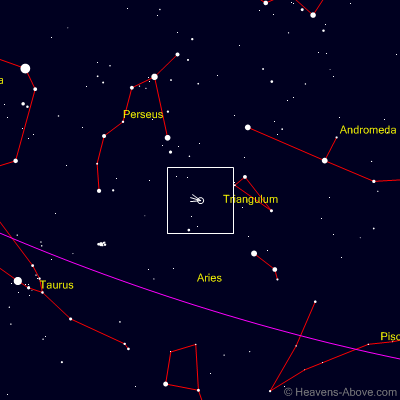
Comet Lovejoy is actually one of five (and counting) comets discovered by Australian astronomer Terry Lovejoy, all of which, by convention, bear his name. This comet lovejoy, is not a particularly impressive sight, but it’s magnitude is 4.5, bright enough to see from a typical suburban site it you know where to look. And where do you look? Right here:

Chart created by Heavens Above.

Chart created by Heavens Above.

To the left of the image is Taurus. Look to the right of Orion, and you’ll see the bright orange star Aldebaran in Taurus. Follow that line further and a little bit up, and you’ll see a tight cluster of several stars: the Pleiades. And keep following that line further, as far again from the Pleiades as the Pleiades are from Aldebaran, and you’ll see Comet Lovejoy–at least for tonight. It’s moving fast. Look for the little green dot. Stars are never green, so if you find a green one, you’ll know you have it.

Naked-eye comets are rare, and this one will be here only a little while longer, so go out and see it while you can.

Posted in Comets, Stargazing | Tagged , , | Comments Off on See Comet Lovejoy While You Can

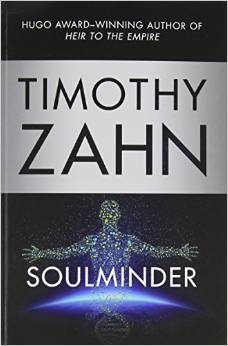
Book Review: Soulminder by Timothy Zahn

I’m a big fan of Timonthy Zahn’s Star Wars novels, but Soulminder is the first non-Star Wars offering of his that I’ve read. I was happy to find it was up to his usual high standards.

After losing his young son in a car accident, Dr. Adrian Sommer dedicates his life to finding a way to save people at the moment of death. After years of work, he not only discovers the existence of the soul, but also finds a way to trap the soul in a machine outside the body to keep it from “moving on” while the body can be repaired.

Inside the machine, Soulminder, is like being stuck in the tunnel with the bright light, unable to move on or go back. When Sommer himself finds himself in the tunnel, he finds it peaceful, but not everyone else does, and back in the land of the living, a lot of people have their own ideas for Soulminder.

Over the ensuing years, Soulminder becomes used for all sorts of things that Dr. Sommer never intended: body theft, body swapping, slavery, political imprisonment, murder victims testifying against their killers, and more. As the limits are pushed further and further, Sommer must find a way to stop his creation from being corrupted from a medical miracle to an instrument of horror.

I’m not usually a fan of books that skip in time with each chapter separated by months or years, but this one actually worked. A big part of what brought it together was Sommer’s character arc, which runs throughout the book, and his ultimate solution to his mounting problems was brilliantly written.

In short, Soulminder raises a lot of interesting moral and ethical questions about its eponymous technology and the real-world problems and politics that play into them, framed excellently in a compelling human drama.

My rating: 5 out of 5.

Posted in Book reviews | Tagged , | Comments Off on Book Review: Soulminder by Timothy Zahn

Bible Reading Revised

One year ago I started on a plan to read the Bible cover to cover in, well, one year. I wrote my own reading plan to do this because I was dissatisfied with the various other plans I could find. I had two general principles in writing this plan: first, that particular stories should not be broken up in the middle, and second, that the readings should be roughly a similar length.

However, I later realized that I had made some mistakes in writing my plan. Some of the readings were too long, and some of them started or ended in the middle of a story. Therefore, I have now revised my plan to fix these problems by logging all the times when I thought the readings didn’t quite line up with the narratives and also getting a word count for each reading and splitting up the longest ones.

Click here to see my revised reading plan.

I definitely recommend trying to read through the Bible in a year, as it gives a very different perspective on many of the stories than breaking them down and only reading them one chapter at a time.

Posted in Reading, Religion | Tagged , , | Comments Off on Bible Reading Revised

Movie Review: Exodus: Gods and Kings

I reviewed Noah last spring with a follow-up post on the finer points of the film’s theology. I thought that film was pretty good, but you had to be willing to think deeply about its message and not just watch it casually. I finally got around to watching Exodus: Gods and Kings, and I’m sorry to say that it lacks both the quality and the depth of Noah.

Exodus is another epic Biblical film starring Christian Bale as Moses, which could have been very good, bu the execution was poor throughout. The first half hour was actually pretty good, but had nothing to do with the Biblical story of Moses. It shows Moses as a general in Pharaoh’s army, fighting the Hittites and generally being a better leader than his adoptive cousin, Ramesses. It’s a nice sequence, but the Biblical Moses probably wasn’t that smart, nor that good of a public speaker, and his intelligence had very little bearing on the rest of the movie, ultimately proving ineffective, after which God’s intervention begins.

Another point that never seems to come up in any adaptation: Moses almost certainly knew he was a Hebrew from his youth. I think it would be interesting to see his story told from that angle, but Ridley Scott chose not to do it.

From there the movie goes into a poor attempt at making the Biblical story more interesting, mainly by playing fast and loose with it. Moses is exiled by Ramesses because his Hebrew heritage is discovered, more so than because of his murder of an Egyptian guard. Later, when God calls him back to Egypt, he leaves his wife and son behind at Mount Sinai instead of taking them with them. He doesn’t use a staff to call down the plagues; rather, he is told by God to sit back and watch Him do everything. And even if you don’t mind playing fast and loose with the story, the screenplay was not all that good and dragged a lot.

The movie’s real redeeming part was the Red Sea sequence. I thought that was both visually and narratively very well done. Instead of the Red Sea parting instantly into walls of water, a storm and a strong current cause the water to flow away overnight. This is the only time I’ve seen Exodus 14:21 depicted in an adaptation: “Then Moses stretched out his hand over the sea, and all that night the Lord drove the sea back with a strong east wind and turned it into dry land. The waters were divided” (NIV). This sequence was really enjoyable, but sadly not enough to salvage the rest of the film.

My rating: 2.5 out of 5.

Posted in Movie Reviews, Religion | Tagged , , , , , | Comments Off on Movie Review: Exodus: Gods and Kings

What If? Rejects #3.3: Umm…?

Randall Munroe’s What If?

Previous post in this series: Planet of the Apes

Next post in this series: Volcanoes

Q: If people had wheels and could fly, how would we differentiate them from airplanes?

Randall’s response: No response.

My response: Umm…let’s ask the Internet. Here are some samples from the first page of Google results.

“If people had wheels and could fly, why would we even have airplanes?

“Because the pilots inside them would be really weirded out.”

Okay, let’s take a closer look at that first one. Why do we have airplanes? It’s because people can’t fly, but it’s also because people can’t move at 600 miles per hour under their own power. Even if people had wheels and could fly, they probably couldn’t do that easily, much less for an extended period. We would want a machine that people could ride in that could transport them faster and more comfortably than they could go under their own power.

Wow, that sounds an awful lot like an airplane. So in this philosophical experiment, we would distinguish people from airplanes because airplanes would be things people ride in. Although since we never would have bothered with land vehicles in this scenario, we might just call them “cars”.

Posted in Philosophy, What If? Rejects | Tagged , , , | Comments Off on What If? Rejects #3.3: Umm…?