
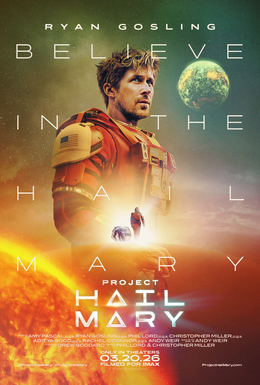
It’s finally here. Andy Weir’s Project Hail Mary has gotten its big screen debut.
I reviewed Project Hail Mary when the book came out in 2021, and I also wrote a follow-up post analyzing some of the science in it. Weir, of course, originally became famous for The Martian, and in Project Hail Mary, he put together an even bigger space survival story, this time going interstellar.
And…this was a very good movie. I think it is better than book, in fact. But even more than that, the Project Hail Mary movie is also an uncommonly good adaptation of the book.
Great music, too. Granted, it was definitely trying to evoke Interstellar, but this movie was way better than Interstellar. Sorry, not sorry.
My rating: 4.5 out of 5.
Spoilers below.
In Project Hail Mary, the Sun is dying, or more accurately, it’s being colonized by alien microorganisms called Astrophage that are absorbing the sunlight, bringing about a new ice age. Dr. Ryland Grace wakes up on an interstellar spaceship, the Hail Mary, which humanity has sent to investigate Tau Ceti, the only nearby star not affected by the Astrophage.
The trouble is, he’s lost his memory. And his crewmates are dead. And there’s an alien spaceship sitting outside the window.
That is how Grace meets Rocky, a very excitable a starfish-like alien from 40 Eridani, who is trying to save his star from the Astrophage. Together, they go through a series of death-defying scientific stunts in order to save both of their worlds.
My one really big criticism of the book (other than a few scientific errors) was the pacing. It felt like too many problems were piled up at the end. Grace just couldn’t catch a break, and the ending was weirdly rushed and a slog at the same time because of it. The movie significantly improves that pacing. I still felt like things piled up too much at the end, which is why I didn’t give it a perfect rating, but it’s not nearly as bad as the book.
Also, it was a very interesting move to have Grace do the entire “evolving taumoeba” part in a montage sequence while Rocky was recovering. It definitely helped collapse some of the timeline in what was already a long movie. But I also think it worked in context. The way the emotional arc was laid out, it fit in perfectly.
So, let’s not beat around it anymore. I think the movie did a really good job (better than the book) of portraying the emotional arcs of two of the three main characters: Ryland Grace and Eva Stratt.
Eva Stratt is the head of Project Hail Mary, appointed by the world’s collective governments to procure anything and everything they need for the project. But the book actually portrayed her as a sort of antagonist to Grace. She felt like a jerk who was walking all over everyone like she ran the world (which she kind of did)—a hardass who would use any dirty trick to do what she felt needed to be done.
The movie humanized Stratt to a degree that I would not have believed going in. Or at least, I wouldn’t have believed it could be done without watering down her character until it wasn’t really her anymore. Honestly, maybe it was just the delivery in the audiobook, but with the movie version, I could see her really feeling the weight of agonizing over what to do, not just parroting the “cold equations” and giving orders expecting them to be followed. She felt more like a real person.
The scene of Stratt singing karaoke, which was cooked up specifically for the movie, typifies this change, but it’s not the main part. The main part is, naturally, her relationship with Grace. With the movie version, I actually believed she regretted “betraying” Grace. Seeing her express confidence in Grace even while having him forcibly strapped to a gurney didn’t remove her “do what needs to be done” attitude, but it no longer felt like…I’m not even sure how to describe what the book felt like. Heavy-handed government oppression? That’s what it most literally is from Grace’s perspective, I suppose.
That would have been an improvement already, but what really tied it together was the conclusion to Grace’s emotional arc. Late in the story, Grace finally remembers how he wound up on the ship: he’s a self-described coward who had to be tied to a gurney to make him go on a suicide mission. But he eventually does what Stratt herself suggested and finds a reason to be brave, someone he’s willing to give his life for: Rocky. But the movie completes the thought where the book more or less trails off: Grace makes his peace with Stratt and admits she was right about him. Yes, he got to basically same place in the book, but he wasn’t as self-aware about it, and the pieces felt like they fit together a lot better here. And the scene of an older Stratt watching his video message, while not strictly necessary, really helped to bring it full circle.
The other reason I liked this change was that it brings the story more in line with The Martian. A key point of The Martian is that there are no villains. There are competing interests, certainly, but everyone is honestly trying to do the right thing. Obviously, that’s true of Stratt, too. In fact, Grace’s selfish and cowardly refusal of the call makes him the closest thing to a villain in the story. But from Grace’s and therefore the reader’s perspective, Stratt always looked a little bit villainous. The movie softens her just enough to make her feel more like a good person forced into a difficult situation without fundamentally changing her character.
Now, one other thing I liked about the movie was that, even though it had to make some concessions, it did a good job of adjusting things in the book that wouldn’t translate so well to the screen.
For one, it greatly simplified the problems of Grace and Rocky coexisting. In the book, Rocky’s atmosphere is too hot and too high pressure for him to be rolling around the ship in a hamster ball, and especially too hot for Grace to hug the hamster ball. The movie mentions this initially, but then proceeds to mostly ignore it. But those changes worked in a movie that was less technical and more emotional compared with the book. Giving Grace the ability to hug Rocky shortcuts a lot of their relationship in the book, which was based on a lot more talking.
Likewise, giving Rocky a speech synthesizer instead of Grace learning his language…well, the book rendered Rocky’s speech in English anyway, so that’s not any more a concession than the book made. But it definitely helped Rocky’s emotiveness.
And it’s a minor point, but I also liked how the movie made Rocky’s echolocation more believable. And it wasn’t really by describing it any differently than the book did, but being able to see it (ironically) sold it. I still think it’s improbable that an intelligent lifeform would evolve with echolocation instead of sight, but showing how he can use it to “see” through walls and even watch Grace on the outside of the ship when they’re in Adrian’s atmosphere actually makes clear how it could be an advantage.
So, yes, this was a very good movie. If you didn’t read the book, I’d still recommend it. And if you did read the book, you might find you enjoy the movie even more.


 Science Meets Fiction