Trading stars

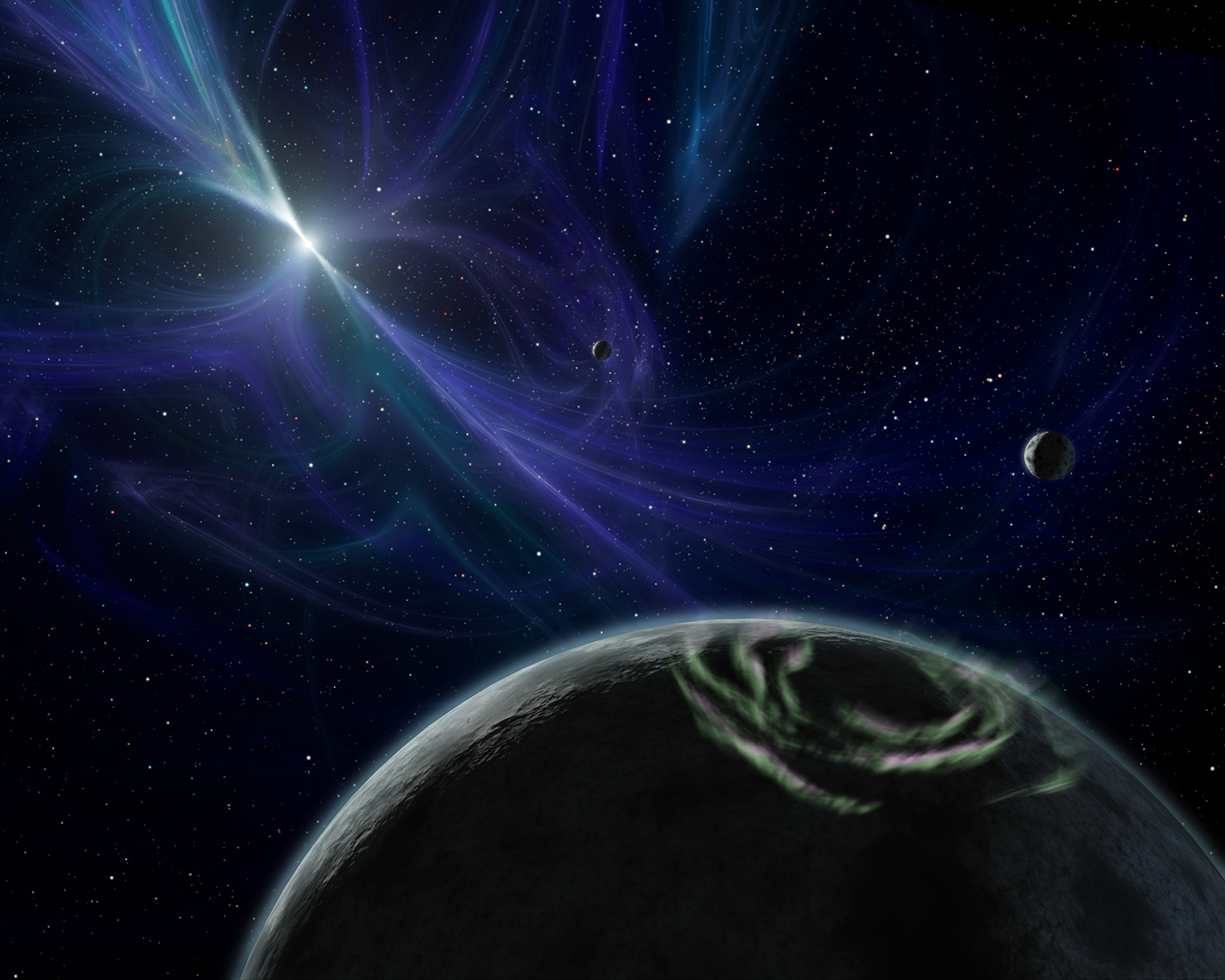
Astronomers have discovered a handful of planets orbiting the collapsed stars known as pulsars. Almost all of these confirmed or purported pulsar planets are small, only a few times the mass of Earth, and are thought to have formed out of the gas and dust left over from the supernova explosion that created the pulsar. However, PSR B1620-26 b, discovered in 1993, did not fit that pattern.

PSR B1620-26 b was several times as massive as Jupiter, and that was not the weirdest thing about it. It was the first planet discovered orbiting a binary star: a pulsar and a white dwarf, it has a very wide orbit that lasts 100 years, and, strangest of all, it resides in the globular cluster M4, yet another place where planets were not expected.

A globular cluster can have over a million stars in a space less than 100 light-years across. With that many stars buzzing around, one would expect that their gravity would knock any planets out of orbit. In fact, we think that is what happened here.

Astronomers believe that PSR B1620-26 b first formed around a solitary normal star at the same time that the cluster formed–12 billion years ago–which also makes it the oldest known planet. Millions of years later, its original sun passed close to a binary star: the pulsar we now see and another normal star now lost to history. Through a complex gravitational interaction, the pulsar’s original partner was kicked out, and the planet’s original sun replaced it, bringing the planet with it. Eventually, that sun aged and died, becoming the white dwarf we now observe.

Meanwhile, the planet lives on. Not having been present for the supernova that created the pulsar, it still retains its thick atmosphere, and, if it avoids the dense center of the star cluster, it may continue circling its old sun and its newer companion for billions of years to come.


Posted in Planets | Comments Off on Trading stars

Planets on the move

It was easy to detect planets around pulsars because of their incredibly steady rotation period, but that didn’t work for normal stars, like the Sun, and the astrometric method of watching a star’s position on the sky was not sensitive enough for planet-hunting. Was there another way? In the late 1980s, a few astronomers thought there was.

As a planet orbits a star, the star moves in a smaller circle to counterbalance it. So while the planet is moving toward Earth, the star is moving away, and vice versa. But the star is giving off light, and a moving light source undergoes a Doppler shift.

Various atoms in a star’s atmosphere absorb light at very specific wavelengths. If the star moves, those wavelengths shift a little bit, much like the pitch of a siren changes depending on whether it’s moving toward or away from you. The shift in wavelength is very small. For a planet like Earth, it’s too small to see even with today’s telescopes, but for a big planet like Jupiter, it’s easy to spot.

That was the theory, anyway. This way of looking for planets is called the radial velocity method. For a while, it didn’t turn up anything, until 1995, when astronomers Michel Mayor and Didier Querloz looked at small yellow star called 51 Pegasi.

On paper, 51 Pegasi was a great place to look for planets. It’s about the same size, brightness, and age as the Sun. If solar systems like our own were common in the universe, there was a good chance of finding a planet around 51 Pegasi, and, when Mayor and Querloz looked, they did find a planet–the first ever found around a normal star. Except that, once again, it was in a place where no planet had any business being.

Mercury, the innermost planet of our Solar System, orbits 60 million kilometers from the Sun. This new planet, called 51 Pegasi b, orbits less than 8 million kilometers from its star. Mercury orbits in 88 days. 51 Pegasi b orbits in 4 days. Mercury is as hot as an oven. 51 Pegasi b is as hot as an open flame.

Finally, 51 Pegasi b isn’t a little rocky planet, like Mercury; it’s half the size of Jupiter–a gas giant made mostly of hydrogen. Shouldn’t the intense heat and solar wind have blown away it’s atmosphere long ago? Even if it didn’t, any reasonable theory of planet formation says that the heat would have evaporated the gas and dust that close to the star long before any planets could form there. It was a planet that shouldn’t exist.

Today, we know of many planets like 51 Pegasi b, which we call “hot Jupiters”. Even though they aren’t as common as we once thought, they’re still the easiest to find. The closer a planet is to its star, the faster it moves (and the less time it takes to see it move); and the heavier it is, the more the star will move in response. So it was natural big planets orbiting very close to their parent stars were found first.

51 Pegasi b taught astronomers two things. First, it really was worth it to look for planets. Soon, other astronomers got in the game, and dozens more planets were found, and, today, there are hundreds. Second, not only were planets common in the galaxy, but they were also on the move. 51 Pegasi could never have formed where it is now. They realized that it must have formed farther from its sun and migrated inward. This gave us some clues about the formation of our own Solar System, but that’s another story.

Posted in Planets | Comments Off on Planets on the move

Book review: Existence by David Brin

Science fiction author David Brin, perhaps best known for his novels, Startide Rising, and The Postman, delivers a cornucopia of big ideas in his latest epic, Existence, published by Tor Books. The story begins sometime around 2050, when astronaut Gerald Livingstone, tasked with cleaning up a century’s worth of space junk, snags something that just might be an alien artifact. From there, Brin throws the reader into the deep end as the world reacts to the news. It is a world already haunted by nuclear terrorism, environmental disaster, plague, class conflict, anti-technology religious movements, the balkanization of America, and the creep of artificial intelligence–and all that is just in the first few chapters.

Despite the best efforts of national governments, it soon proves impossible to keep the Livingstone Artifact a secret in a world that has twenty-three Internets and where most people are constantly online through their eyewear–or AIwear. The very existence of the alien artifact threatens to reopen dangerous societal fault lines, which only grow worse when the digitized aliens inside start talking.

Soon, a whole host of characters are swept up in the chaos, from Pen Xiang Bin, a poor Chinese man unwillingly thrust into the spotlight, to Tor Povlov, an ace reporter promoted from social media, to the trillionaire neo-aristocrat, Lacey Donaldson-Sander, and many more. With the danger growing, the world must come together to answer the ultimate question: the future existence of human civilization.

Existence is a slow read, and that’s a good thing. Brin’s multifaceted perspective on the future of life on Earth is filled with so many big ideas that you’ll want to take the time to savor and ponder them in detail. For all this, the novel continues to entertain throughout its 560 pages. The fact that Brin combines the big ideas and good storytelling so well is what makes Existence both a top-notch work of science fiction and an eerily plausible vision of our own future.

My rating: 5 out of 5.

Posted in Book reviews | Comments Off on Book review: Existence by David Brin

Comet watch

Image

This is Comet C/2012 S1 (ISON), currently out past the orbit of Jupiter. Believe it or not, all of those letters and numbers actually mean something. The C/ means that it is a long-period comet, originating in the very distant Oort Cloud rather than the less distant Kuiper Belt just past the orbit of Neptune. Long-period comets return only after thousands or even millions of years, and if they get too close to Jupiter, they can be kicked out of the Solar System entirely.

2012 is the years that the comet was discovered. The S1 means that it was the first comet discovered in period S, which is the second half of September. Finally, ISON is the discoverer: the International Scientific Optical Network, based near Kislovodsk, Russia.

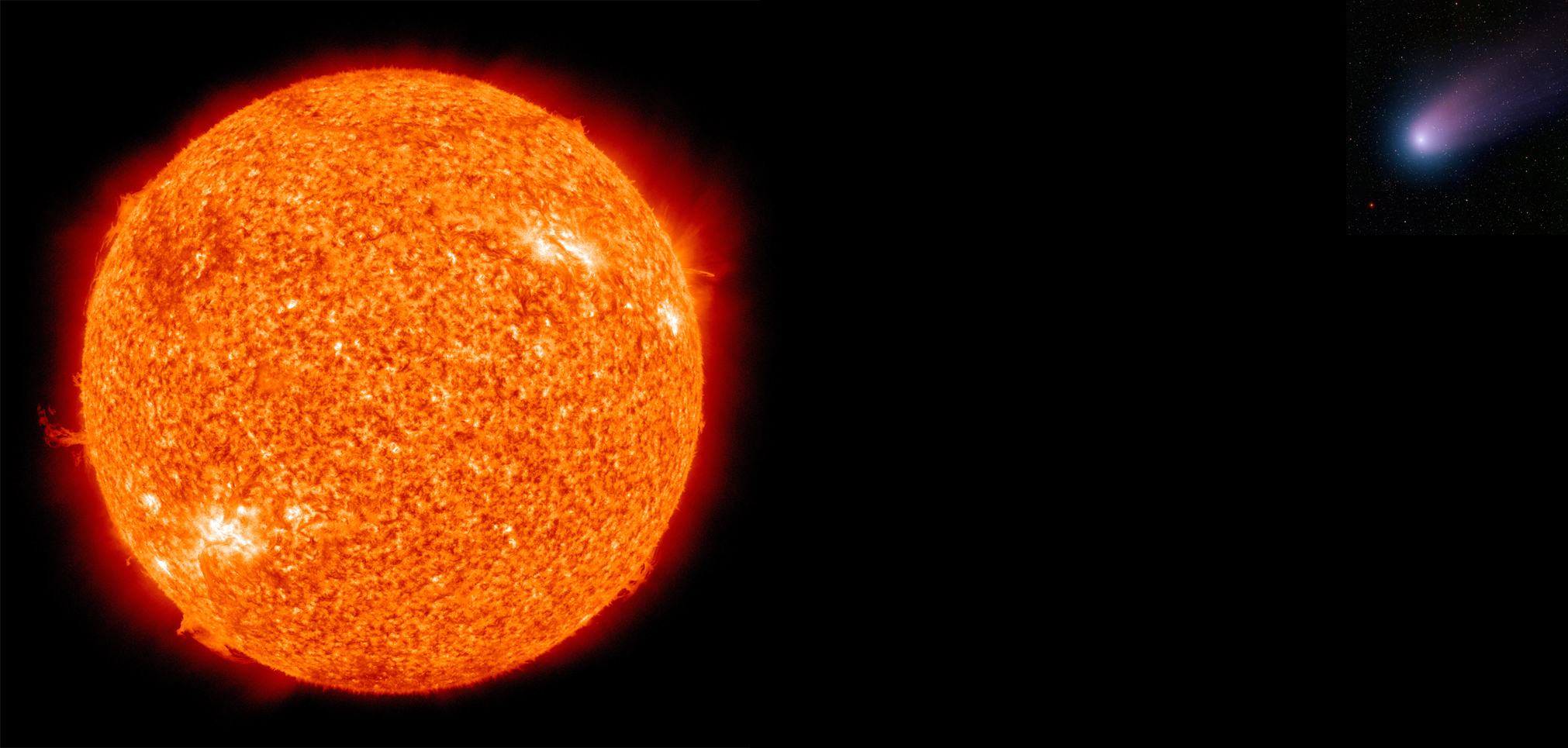
The cool part is that next fall (November 29, 2013, to be precise), Comet ISON will come very close to the Sun. How close? This close:

This cartoony image is, in fact, to scale. That’s not comet ISON, of course–it’s Comet NEAT from 2004–but a comet’s coma (the bright, but diffuse cloud that surrounds the tiny nucleus) really can grow larger than Jupiter, and comets really can survive passing that close to the Sun, even though they’re made of ice.

Comet ISON is making headlines because astronomers predict that it could become very bright. There’s a chance–but only a chance–that around Christmas next year, Comet ISON will light up brighter than the full Moon, making it the brightest comet ever seen since accurate records have been kept. Of course, there’s also a chance that it could remain invisible to the naked eye, like Comet Elenin in 2011. Comets are notoriously fickle, and predictions have been known to be way off.

Even so, I think that Comet ISON is well worth watching over the next year. The last two really bright comets, Comet Lovejoy in 2011 and Comet McNaught in 2007, were mostly visible only in the southern hemisphere, but Comet ISON will be visible in the northern sky in the hours before sunrise, so North America will get a front row seat.

There will be one other chance to see a comet next year. During next March and April, Comet C/2011 L4 (PANSTARRS) may be visible throughout much of the world shortly after sunset. It’s not likely to be super-bright, but it could become the equal of Comet Hyakutake in 1996 and Comet Hale-Bopp in 1997, both of which were pretty cool. I highly recommend Space Weather to keep up with news about comets, meteor showers, auroras, and anything else that’s going on in the sky.

And keep looking up. There’s plenty to see whenever the sky is clear.

Posted in Comets, Stargazing | Comments Off on Comet watch

The weirdest planets

At this writing, 838 planets outside our Solar System—exoplanets—have been discovered, with thousands more possible planets waiting to be investigated. Yet the study of exoplanets is one of the youngest fields in astronomy and in all of science. In fact, just over 20 years ago, the number of known exoplanets was zero, and it was considered a little silly even to look for them.

Why? In the 1980s we learned that some young stars, like Beta Pictoris, probably were forming planets when huge disks of gas and dust were found to be orbiting them. Over millions of years, the gas and dust would condense into planets, but those planets, it was thought, would be invisible. Our own Sun is a billion times brighter than the planets that orbit it. From interstellar distances, any planets should be invisible in the glare of their parent star.

So by the early 1990s, very few serious astronomers were looking for exoplanets because even if planets were common in the galaxy, there should be no way to see them. Worse, the scientific landscape was littered with dozens of false alarms all the way back to 1855. Every time some reported finding an exoplanet, it was soon discredited or at least strongly questioned.

Still, a few brave souls kept looking. One idea was not to look for the planets directly, but instead to look for its effect on its parent star. As the planet orbited in a large circle, the star would also move in a small circle, like a counterweight, and it might be possible to observe the changing position of the star on the sky. This method worked great for binary stars, but it didn’t turn up any planets. Then, in 1992, a pair of planets did appear, in a place even the planet hunters did not expect.

PSR B1257+12 is a millisecond pulsar—a collapsed star that underwent a supernova at the end of its life. A pulsar packs more mass than the Sun into a space the size of Los Angeles and emits intense beams of radio wave and x-rays. A millisecond pulsar in particular spins incredibly fast at a nearly constant rate. Astronomers found that PSR B1257+12 was spinning at over 9,000 rpm, and its rate of spin was so steady that they could measure it to one part in a trillion.

Except it wasn’t quite steady: sometimes the pulses of radio waves would reach Earth a little earlier, meaning that it was closer to Earth, and sometimes a little later, meaning that it was farther away. That meant the pulsar was moving in circles, tugged by the masses of two unseen companion. Many pulsars have companion stars that are not detectable with visible light, but when astronomers Aleksander Wolszczan and Dale Frail calculated the masses of these companions they found that they were much too small to be stars. They were planets—the first ever discovered outside our Solar System!

Not only were they exoplanets, but they were tiny, only a few times the mass of Earth. Two years later, a third planet was discovered orbiting the pulsar, which is only the size of our Moon and is still the smallest confirmed exoplanet ever found.

But these planets were weird. It’s weird enough that they’re orbiting a dead star and are being constantly roasted by x-rays, but they shouldn’t have existed at all. The supernova explosion that created the pulsar should have disintegrated any planets it had to start with. So how did they get there? We now believe that these three planets formed after the supernova, condensing out of the debris that was left over.

So the field of planet hunting was partially vindicated in 1992, but these weren’t normal planets. They were weird, and they didn’t form like normal planets. It would be three more years before astronomers discovered a planet orbiting a star like our Sun, which I’ll talk about in a future post, but even then, the weirdness continued. It continues still to this day, so that now we’re starting to wonder…if maybe we’re the weird ones.

Posted in Planets | Comments Off on The weirdest planets

Welcome to my world

I’m a full-time astrophysics graduate student, a part-time science fiction writer, and now a blogger. In my day job, I study everything from planets to clusters of galaxies, but when I’m not probing the mysteries of the cosmos or imagining strange new worlds, I might be here, writing about science, fiction, and other things of interest. There will be real content very soon, so stick around, and thanks for reading.

Posted in General | Comments Off on Welcome to my world