The planet that thinks it’s a comet

Artist's rendition of HD 80606b compared with Jupiter. Credit: Aldaron (Wikipedia).

Artist’s rendition of HD 80606b compared with Jupiter. Credit: Aldaron (Wikipedia).

With all the talk of comets lately, let’s take a look at what happens when planets start acting like them. But surely, no planet could have a crazy, elongated orbit like a comet, right? They’re too big to get kicked around in those weird paths. Well, that’s probably how most astronomers would have reacted up until the mid 1990s. If you’ve been reading this blog for a while, now, you probably know what happened next.

Enter HD 80606b, the planet with the most eccentric orbit known. Eccentricity is a measure of how elongated and oval-shaped a planet’s orbit is. Zero is a perfect circle. One means it’s not coming back. Halley’s Comet, on its long orbit, has an eccentricity of 0.967. HD 80606b can’t quite match Halley’s Comet, but it does have an eccentricity of 0.9336. That means its orbit looks like this:
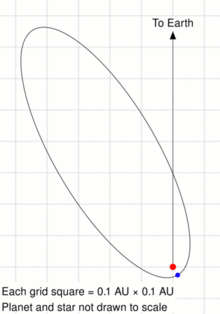
Schematic of HD 80606b's orbit. The longest distance is still smaller than Earth's orbit.

Schematic of HD 80606b’s orbit. The longest distance is still smaller than Earth’s orbit.

HD 80606b has an orbit that takes it almost as far as Earth is from the Sun, then plunges in to a twentieth of that distance. That means that for just a few hours of its four-month orbit, it turns into a hot jupiter. It could even have a tail, like a comet. The rest of the time, it’s just a warm jupiter.

But how did it get into such a strange orbit? It couldn’t have formed that way. Many exoplanets have somewhat eccentric orbits, but what we know about how planets form says that they have to be a lot closer to circles than this. Small planets can get kicked around by bigger ones, but HD 80606b is four times as massive as Jupiter, so there’s probably not a bigger planet around.

One theory of planetary migration is that planets start in circular orbits, then fall into elongated orbits because of interactions with debris around their stars. These planets later get pulled back into much smaller circular orbits as hot jupiters because of tidal forces caused by interactions with the star itself.

This would work as an explanation for weird orbits for some young planets, but the star HD 80606 is 3 billion years older than our Sun, so it doesn’t work here. Instead, we think the answer is something called the Kozai mechanism. It happens because HD 80606 isn’t alone. There’s another star called HD 80607 nearby. It’s much farther than Neptune is from the Sun, but the two stars still orbit each other. The planet’s orbit is tilted relative to the two stars, and over time, the complex interaction of the three bodies causes the planet’s orbit to take on this comet-like structure.

Posted in Planets | Tagged , , , , | Comments Off on The planet that thinks it’s a comet

First look at Comet PanSTARRS

2013 could be a banner year for comets, with not one, not two, but three of them being visible to the naked eye. Two are already visible in the Southern Hemisphere, as seen in the video, and they’ll be coming up north in the next few weeks.

Comet PanSTARRS is currently shining at magnitude +4.2, equivalent to a faint star, but getting brighter. Here’s a graph of its progress:

Brightness graph for Comet PANSTARRS. Credit: David Dickinson.

Brightness graph for Comet PanSTARRS. Credit: David Dickinson.

The blue line shows the brightness of the comet, compared with predictions; it started out fainter than expected, but has started shooting up, so it’s still on track to match the brightest stars in the sky, if we’re lucky.

The best show for stargazers in the Northern Hemisphere should come just after Comet PanSTARRS swings around the Sun on March 10–probably on March 12, just after sunset, before the Moon starts to wash out the sky. If you can find a clear view of the western horizon that week, I encourage you to take a look. You can check out the guide at Universe Today for more details.

One naked-eye comet would be worth a headline by itself, but now we have the surprise newcomer, Comet Lemmon. It’s not quite as bright as Comet PanSTARRS, but it’s just barely visible to the naked eye and is likely to get almost as bright. There’s a good chance that Comet Lemmon with be visible in the Northern Hemisphere come April.

You’ll notice from the video that PanSTARRS is a traditional white comet, which Lemmon is bright green, more like Comet Holmes in 2007. The green color comes from a higher concentration of cyanogen and diatomic carbon gases in the comet’s ices.

I’ll post more about Comets PanSTARRS and Lemmon as they come closer, and, of course, we have Comet ISON to look forward to in the fall. Just remember, as David Levy say, “Comets are like cats; they have tails, and they do precisely what they want.”

Posted in Comets, Stargazing | Tagged , , | Comments Off on First look at Comet PanSTARRS

The Magic Spreadsheet, or, Self-discipline = 250 words per day

Photo Credit: Antonio Litterio.

Photo Credit: Antonio Litterio.

One of the hardest parts of being a writer is finding enough time to write. Writers are busy people, with any number of things like day jobs, classes, families, and always being within arm’s reach of the Internet on their plates (although it’s usually that Internet part that causes most of the trouble).

A deadline imposed by someone other than yourself is great. If you have a class paper due, your boss wants that big report, or you need to get your next draft to your editor, you’ll probably get it done. Even maintaining a blog requires some self-discipline. But unless your lucky enough to find a critique group that meets every week, there’s probably no one but you putting deadlines on your creative writing. I’ve tried things like self-imposed deadlines and marking off the days when I write on a calendar, but they only seemed to work halfway.

Then I found the Magic Spreadsheet.

The idea behind the Magic Spreadsheet is simple. If you write 250 words in a day, you get 1 point (you can get bonus points for writing more). If you also write 250 days tomorrow, you get 2 points tomorrow. The next day, you get 3 points. But if you skip a day, you go back to 1 point. In other words, the way to get big points is to write every single day. If you write 250 words per day for 30 days straight, you get 465 points. But if you write 500 words every other day, you only get 30 points. You can compete against other writers, or just compete against yourself.

250 words is just about the perfect number. It’s not much–just 1 double-spaced page in your favorite word processor. Most of the time, you can do it in about 15 minutes, which makes it really easy to squeeze in at the beginning or end of the day, or over lunch. But it’s still enough to be substantial: 250 x 365 = 91,250 words, and that’s a book. So even if you just write the minimum amount, you can write a book in a year.

And it works! I haven’t been keeping track of my points, myself, but just understanding the importance of the 250 word minimum has been enough for me to write for 36 consecutive days. Considering that I’d never done more than 19 consecutive days in the past 2 years, I think that’s pretty strong evidence. Give it a try!

Posted in Writing | Tagged , , , , | 1 Comment

Rise of the mini-planets

Artist's impression of a hot planet like Kepler-37b. Credit: ESO/L. Calçada.

Artist’s impression of a hot planet like Kepler-37b. Credit: ESO/L. Calçada.

I’ve said before that when looking for planets, we must expect the unexpected. NASA’s latest discovery, Kepler-37b, was not unexpected, but it raises interesting questions nonetheless.

Kepler-37b is a hot, rocky planet, but it’s not a super-Earth, because it’s smaller than Earth. If that was all it was, this wouldn’t be news–we’ve found exoplanets smaller than Earth before. The interesting thing is that it’s the smallest known planet…including the ones in our own Solar System. Check it out:

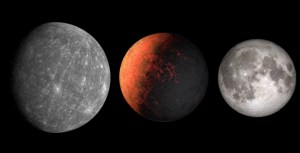
Size comparision of Mercury, Kepler-37b, and the Moon. Credit: NASA and Phil Plait.

Size comparison of Mercury, Kepler-37b, and the Moon. Credit: NASA and Phil Plait.

That’s Mercury on the left, the Moon on the right, and an artist’s impression of Kepler-37b in the middle. Kepler-37b is quite a bit smaller than Mercury, the smallest planet in our own Solar System (since Pluto is only a dwarf planet), and even smaller compared with all the other exoplanets we’ve found.

Okay, technically, the pulsar planet PSR 1247+12 A is almost certainly smaller than Kepler-37b, but pulsar planets are weird objects that don’t form in the same way and therefore don’t tell us a whole lot about regular planets. Kepler-37b is the smallest known planet orbiting a live star.

But if Kepler-37b is so small, are we sure its a planet at all? Well, yes and no. Yes, because we know enough about its properties to determine that it is definitely round, and it almost certainly exerts gravitational control over the area around its orbit (what the IAU definition of a planet clumsily refers to as “clearing the neighborhood”). We can rest assured that Kepler-37b meets all the qualifications to be a full-fledged planet.

Well…except for one. The IAU definition also requires a planet to be “in orbit around the Sun”. Our Sun. They never actually addressed the classification of exoplanets. This means that at some point in the future, the IAU will either have to revise the definition of a planet to include exoplanets, or drop the definition entirely and let astronomers get back to calling things whatever they feel is appropriate.

Most astronomers I know–and I suspect a large part of the IAU itself–would prefer the second option. That won’t solve the Pluto problem. In fact, if most astronomers had their way, whether or not Pluto is a planet would depend not only on who you asked, but on how you phrased the question. But that’s a discussion for another day.

Posted in Planets | Tagged , , , | Comments Off on Rise of the mini-planets

Improbable meteor causes chaos in Russia

Still frame from a dashcam video of the Russian meteor. Credit: Андрей Борисович Королев (YouTube)

Still frame from a dashcam video of the Russian meteor. Credit: Андрей Борисович Королев (YouTube).

If you had told me 24 hours ago that this would happen in my lifetime, I would have been skeptical–most of all that a meteoroid of this size could punch deep enough into the atmosphere to do any serious damage. If you had told me that it would happen on the same day as another major asteroid-related event, I would have done some quick mental math and promptly pronounced you insane.

And yet, there it is. At about 9:30 this morning, local time, a meteor exploded (or at least disintegrated) over the city of Chelyabinsk, Russia, population 1,100,000. The shock wave shattered hundreds of thousands of windows, set off every car alarm in the city, and, according to the latest reports, injured about 1,100 people. Thankfully, no one has been reported killed.

It’s hard to overstate how historic this is. It’s the largest meteor impact known on Earth since the Tunguska event in 1908, and, by a huge margin, it is the most damaging impact in history to human civilization. There have been a couple of confirmed reports of one or two people being injured by meteors, but never over a thousand.

(There are some records that suggest 10,000 people were killed by a meteor shower in China in 1490, but astronomers dispute this.)

So what happened here?

Continue reading

Posted in Current events, Meteors | Tagged , , , | Comments Off on Improbable meteor causes chaos in Russia

2012 DA14 will pass us by, but what is the risk from elsewhere?

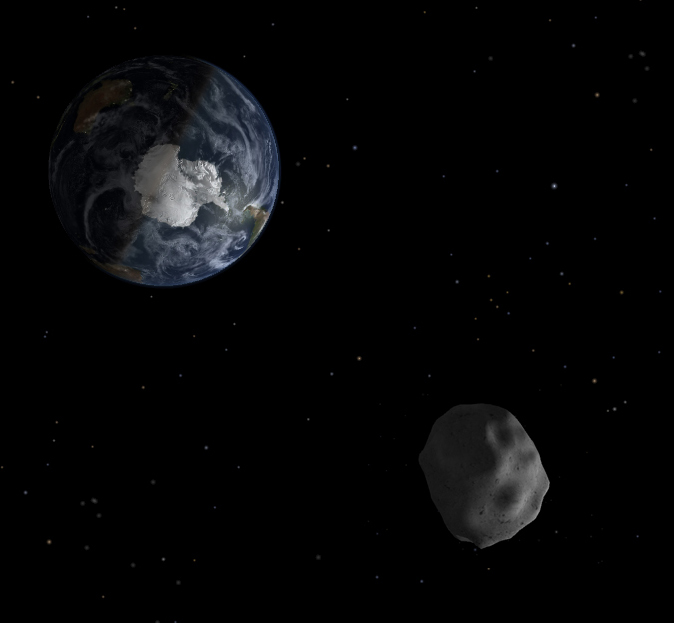
Artist's impression of 2012 DA14 approaching Earth. Credit: NASA/JPL.

Artist’s impression of 2012 DA14 approaching Earth. Credit: NASA/JPL.

You may have heard that an asteroid called 2012 DA14 will pass close by Earth this Friday, dipping below our ring of communications satellites at just 28,000 km (17,000 miles). At 50 meters wide (half the size of a football field), this is the largest asteroid ever recorded coming this close. However, the asteroid Apophis, which is about the size of a football stadium will come just as close on April 13, 2029.

How bad would it be if something like 2012 DA14 actually hit Earth? We’ll get ready, because I’m about to do some math here. A sphere of rock 50 meters in diameter weighs about 200,000 tons, and 2012 DA14 is moving at 12.7 kilometers per second. From this, you can calculate the kinetic energy–one half the mass times the square of the speed:

1/2 x (2 x 10^8 kg) x (12,700 m/s)^2 = 1.61×10^16 joules.

A megaton of TNT is about 4×10^15 joules, so 2012 DA14 packs a wallop of about 4 megatons. That would be a bad day if it happened to hit near populated area. Luckily, 2012 DA14 will stay safely out in space where it can’t hurt anyone, except in the extremely unlikely event that it takes out your satellite TV.

But there are a lot of other asteroids out there. How much risk do they pose? That gets a little complicated. NASA has been tracking potentially hazardous objects larger than 1 kilometer (0.6 miles) wide for some time. These are the asteroids in the “global catastrophe” category, though not in the “dinosaur killer” category. They’ve found 154 of them. They suspect that there are about 10 that we missed because they spend most of their time in the glare of the Sun. (Comets are a separate problem, but they’re quite a bit rarer.)

Astronomers estimate that about a third of these 154 asteroids will hit Earth in the next few tens of millions of years. The rest will either hit Venus or be kicked out of the Solar System. Maybe a few will hit Mercury or Mars. This means that one of these big asteroids hits Earth every 200,000 to 2,000,000 years–unfortunately, we can’t estimate much better than that. Chaos theory prevents us from predicting the appearance of the Solar System over longer time periods.

On the small end, we know things pretty well from radar and eyeball observations. Meteoroids of about 4 meters (13 feet) in size hit Earth about once a year, burning up as fireballs high in the atmosphere. In between is a big gap, where we don’t know how many asteroids there are. They don’t hit often enough to measure directly (which is a good thing!), and we can’t see them well enough to track them in space (which is not so good).

But we can estimate. If meteoroids 4 meters wide hit Earth once a year, then objects 250 times larger impact between 200,000 and 2,000,000 times more rarely. If this relation is governed by a simple equation called a power law, we can calculate how often we will be hit by asteroids of any size:

(average time between impacts) = (size of asteroid / 4 meters)^(log(200,000-2,000,000) / log(250))

You only get a range, but if you do the math, you find that asteroids the size of 2012 DA14 impact Earth between once every 250 years and once every 700 years, on average. The most recent such impact was Tunguska in 1908, but that doesn’t rule one out in this century.

The good news is that there seem to be fewer of these medium-sized asteroids than we expected, so the rate might be as low as once per 1,000 years. Even so, if you have to use the word “megatons” to describe them, you do have to wonder if maybe it’s worth more than the $5 million per year we’re spending to look for these things.

Posted in Current events, Meteors, Space | Tagged , , , | Comments Off on 2012 DA14 will pass us by, but what is the risk from elsewhere?

Astronaut records first song from space

Chris Hadfield, Commander of Expedition 34 on the International Space Station, joined Ed Robertson, lead singer of Barenaked Ladies, to perform the first song composed and recorded (partly) in space. The result: I.S.S. (Is Somebody Singing). Check it out.

This is pretty cool. It’s good to see well-known artists getting involved in space exploration like this. Here’s hoping for some more music from space in the future.

Posted in Music, Space exploration | Tagged , , , | Comments Off on Astronaut records first song from space

Carbon planets

Artist's rendition of a carbon planet.

Artist’s rendition of a carbon planet.

We may be carbon-based life forms, but carbon is actually pretty rare on Earth. If fact, only 0.03% of Earth’s crust is made of carbon, hundreds of times rarer than the foundations of the planet–silicon, aluminum, iron, and, oddly enough, oxygen. That carbon forms the building blocks of life instead of the much more common silicon says a lot about the probability of silicon-based life, but that’s another story.

Why is carbon so rare on Earth? You might guess that it’s because heavier elements like iron and silicon sank to the bottom of the Sun’s gravity well, where Earth is, while lighter elements like carbon stayed in the outer Solar System. That’s true of the very light elements, hydrogen and helium, but the most common element on Earth is oxygen, which is about the same weight as carbon. The real answer lies in chemistry.

The four most common elements in the universe, in order, are hydrogen, helium, oxygen, and carbon. Helium doesn’t react with anything, and most of the hydrogen stayed in the outer Solar System, but what’s left formed molecules when the Solar System formed. In Earth’s neighborhood, there was more oxygen than anything else, so it combined with both hydrogen and carbon to form water and carbon dioxide. It also combined with silicon to form silicate rocks, which form most of Earth.

As Earth formed, the intense light of the young Sun evaporated away most of the carbon dioxide and water, and any leftover oxygen, but not the silicates or elemental iron. That’s why Earth is made of iron, silicon, and oxygen.

We expect most rocky planets to be like Earth because there’s twice as much oxygen as carbon in most of the galaxy. But there are places–mostly regions with lots of old stars–where there is more carbon than oxygen, and that changes all of the chemistry.

With more carbon than oxygen, the atoms would combine into carbon-rich molecules like methane, oils, carbon monoxide, and silicon carbide. Carbon would also combine with titanium to form titanium carbide and with iron to form natural steel. Leftover carbon would turn into solid graphite.

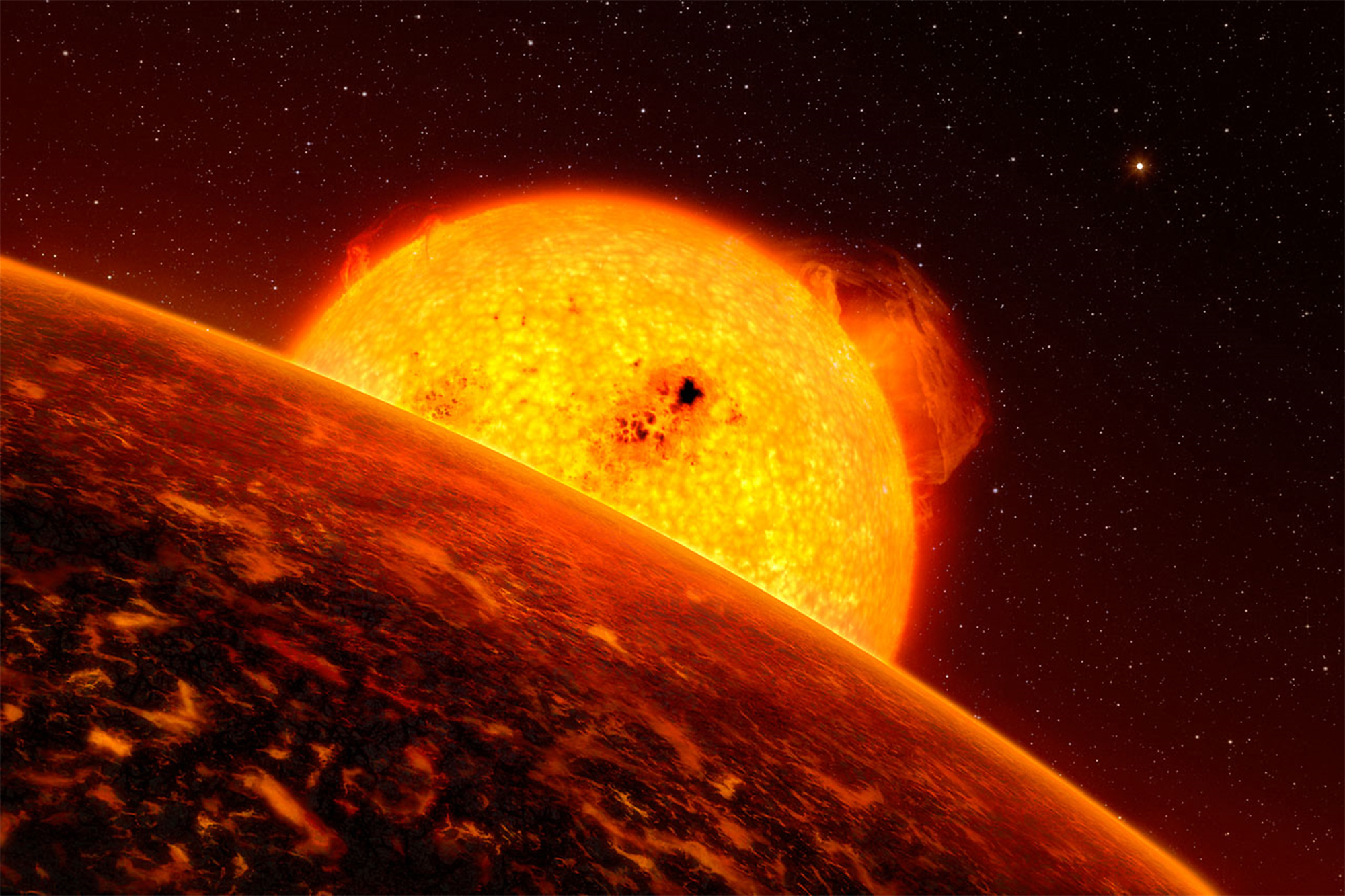
We call planets made out of these chemicals “carbon planets“. The surface of a carbon planet would be made out of graphite, tar, and, just maybe, diamonds. But you wouldn’t want to go there, because the atmosphere would be mostly methane and carbon monoxide.

Some parts of the galaxy have so much carbon that they have to have carbon planets, but we don’t know any for sure that are carbon planets. We know two planets that might be carbon planets: WASP-12b, a hot Jupiter, and 55 Cancri e, a super-Earth. There is another “planet” called PSR J1719-1438 b (the PSR means it’s a pulsar planet) that we’re pretty sure is made of carbon, maybe even diamond, but it’s actually a piece of a white dwarf–a dead star that has been eaten down to planet-size by the gravity of the pulsar.

Carbon planets are special, though. They are one of the few weird types of planets that we expected to find before they were discovered. The rest of the time when you’re looking for planets, you have to expect the unexpected.

Posted in Planets | Tagged , , | 1 Comment

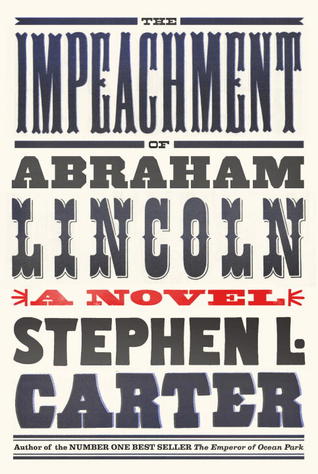
Book review: The Impeachment of Abraham Lincoln by Stephen L. Carter

Now for a little bit different kind of book: alternate history. Yale law professor Stephen L. Carter asks, what if Abraham Lincoln had survived being shot by John Wilkes Booth on the night of April 14, 1865? If he had, his legacy might have been very different. Lincoln could have won the Civil War only to be impeached by his own party for his alleged “high crimes and misdemeanors”.

This is hardly a crazy idea. After all, in 1866, the Supreme Court ruled in Ex parte Milligan that the imposition of military courts in the South was unconstitutional, and this was not Lincoln’s only questionably constitutional act during the Civil War. Moreover, Lincoln’s successor, Andrew Johnson, was impeached for (among other things) attempting to usurp the power of Congress, a charge that could just as well have been leveled at Lincoln, and Johnson escaped being thrown out of office by only one vote.

In his latest novel, The Impeachment of Abraham Lincoln, Stephen L. Carter plays with the historical events to push Lincoln down this path. While Lincoln survives the shooting, Booth’s conspirators succeed in killing Andrew Johnson. Meanwhile, Lincoln’s right-hand man, Secretary of State William Seward, who in real life recovered from being stabbed in the face and neck by Lewis Powell, here is rendered permanently bedridden by the ordeal. Finally, Mary Todd Lincoln dies in 1866, under mysterious circumstances. Thus isolated, President Lincoln is left with very little defense against the radical Republicans who think he is being too soft on the South, and will have no problem throwing him out of office to get their way.

Into this fray steps Abigail Canner, a young, northern black woman aiming to become the first female lawyer in America of any color. Fresh out of law school and eager to defy all expectations, Abigail takes a job as a clerk in the firm that will represent Lincoln in the impeachment trial. But then, Lincoln’s lead counsel is found brutally murdered. Sensing something suspicious about the killing, Abigail soon finds herself drawn ever-deeper into the world of conspiracies, lies, and intrigue lying just beneath the surface of Washington, as she fights to save the political career of the President she so admires.

In The Impeachment of Abraham Lincoln, Stephen L. Carter weaves together courtroom drama, political conspiracy, and Washington social life into a single, compelling story. The main characters are brilliantly written, and the many secondary characters drawn from the historical record–and their meticulously researched behavior–add an extra layer of richness for even a casual student of history. Carter also explores the political and legal questions surrounding the Civil War and Reconstruction in a very accessible, even personal way.

It is unfortunate that the ending of the story comes so abruptly, with the final reveal left feeling a little fuzzy, and the implications of what might have been not fully explored. Yet, for this unrealized potential, it more than carries its own weight. The drama remains to the end, and, like any good story of political intrigue, you’re never quite sure who you can trust.

My rating: 4.5 out of 5.

Posted in Book reviews | Tagged , , , | Comments Off on Book review: The Impeachment of Abraham Lincoln by Stephen L. Carter

Some advice about writing advice

Credit: Julian Rodriguez

How you should respond to most advice about writing. Credit: Julian Rodriguez

If you want to be a writer, you must write. But on everything else, it’s not so black and white. Whether around the Internet or in a real life writing group, writers will offer you plenty of advice, much of it very good. “Read as much as you can” is good advice. “Do your homework on the publishing industry” is good advice. “Revise your writing before trying to get it published” is very good advice.

But for almost every piece of advice out there, you can find an exception. Some authors get published at age 18. Some can give a book away for free and still sell it later. Some can sell re-purposed fan fiction and that very successfully. Of course, most people will never do any of these things, and if you think you will be the exception, you might want to reevaluate. Maybe you’ll get lucky, but probably not.

The point is that (except for the prescription that you must write) you should take every piece of advice about writing with a grain of salt–including mine. That goes even more for any tips a writer gives you about how they personally perform their craft. Every writer is different. For example, you may like to write by the seat of your pants, while I like to outline a story before I start. (Or, at least, I think I do. I’ve never quite done it properly.) And that’s only where the differences start.

Publishing is even more complicated. The Internet has made self-publishing so much easier that it’s upending the whole industry, yet the bestsellers still come out of the traditional publishing houses. I don’t think anyone really knows where publishing is going in the future.

So what should you do? Well, this is yet another piece of advice, but I recommend doing your homework. Read plenty of published fiction to figure out what makes some books (in your estimation) better than others. Look at advice from different sources; If you don’t agree with something, try to understand why it is recommended and why you disagree. Then figure out what works for you. It may take a while–I’m still learning, myself–but when you do, you’ll be in a pretty good position.

And, as always, keep writing.

Posted in Writing | Tagged , , | Comments Off on Some advice about writing advice