NASA finds an ice-cold planet right next door

Artist's conception of WISE J085510.83-071442.5. Credit: NASA.

Artist’s conception of WISE J085510.83-071442.5. Credit: NASA.

You may have heard about the recent discovery of an ice cold “brown dwarf” or “star” right next door in our Solar Neighborhood. The object, which goes by the telephone number* WISE J085510.83-071442.5, is only 7.2 light-years from our Solar System, making it closer than all but three other star systems, after Alpha Centauri, Barnard’s Star, and Luhman 16. See here for the original NASA story.

Both Luhman 16 and our new friend, which goes by WISE 0855-0714 for short, were discovered by NASA’s Wide-field Infrared Survey Explorer (WISE), which scanned the whole sky looking for cold objects that only shine in infrared light. WISE 0855-0714 is the coldest such object ever found at 225-260 K, or -54 to -9 degrees Fahrenheit–roughly the temperature of the North Pole. Unlike the picture about, it would be completely dark to the naked eye.

There’s just one problem. WISE 0855-07144 is not, as some news outlets have reported, a “cold star” (sorry, Doctor Who fans), and it is also not, as NASA’s own press release has reported and cold “brown dwarf”. A brown dwarf is in between a star and a planet, but WISE 0855-0714 has been estimated to be between 3 and 10 times the mass of Jupiter, too small to be a brown dwarf.

Ladies and gentlemen, this is a planet.

So why isn’t it being called a planet? Well, in my experience, it seems as if astronomers are a bit skittish about positively identifying objects like this based on their masses. This is understandable. After all, it’s hard to measure masses accurately in this range, especially for an isolated object like this one. Instead they seem to identify these objects based on what they look like. If they orbit a star, the look like planets, so they’re called planets, even if they’re probably too big. And if they’re free-floating, they look like brown dwarfs, so they’re called brown dwarfs, even if they’re probably too small. This also gets into the problem of how you define what a planet is, in particular regarding whether it’s orbiting a star or not. Hopefully, we can reach a clearer consensus in the coming years.

Posted in Current events, Planets | Tagged , , , , , | 1 Comment

Success for Kepler: an Earth-sized planet in the habitable (?) zone

Size comparison of Earth and Kepler-186f. Credit:  NASA Ames/SETI Institute/JPL-CalTech.

Size comparison of Earth and Kepler-186f. Credit: NASA Ames/SETI Institute/JPL-CalTech.

The Kepler Spacecraft’s primary planet hunting mission has ended, but the data it generated will keep astronomers busy for years to come.  Today, NASA announced that it has found in that mountain of data, Kepler’s first truly Earth-sized planet in the “habitable zone” of its star.

Kepler-186f is one of five planets in its solar system, all of which are pretty close to Earth-sized. Kepler-186f in particular is only 11% larger than Earth. Unfortunately, the red dwarf star it orbits is too dim to look at its spectrum to get a good mass measurement, but a planet that small is very probably rocky, at least according to current theories. Of course, our theories about exoplanets have historically been more wrong than right, so who knows.

But the real problem with Kepler-186f is that it only receives one third as much sunlight as Earth does–considerably less than Mars. Now, Mars is a lot smaller than Earth, so a bigger planet, able to hold on to a thicker atmosphere, having strong enough greenhouse effect might still be able to support life, but I am highly skeptical. Continue reading

Posted in Current events, Planets | Tagged , , , , | Comments Off on Success for Kepler: an Earth-sized planet in the habitable (?) zone

The subtle theology of Noah

In my review of the movie Noah, I said that I felt that the film was much deeper and richer in the theology of the Biblical text than it gets credit for. I wanted to take the time to show how many elements of the story, even some that have been criticized, are actually faithful to the Bible. All Bible quotes are from the New International Version.

Warning: spoilers below.

Continue reading

Posted in Movie Reviews, Religion | Tagged , , , , | 1 Comment

Movie review: Noah

The new Biblical epic, Noah, has generated a lot of controversy for its loose interpretation of the famous Bible story. (If you’re not familiar with it, you can go read Genesis 6-9 right here.) While the film has gotten good reviews over all (Rotten Tomatoes gives it 77% Fresh), many religious reviewers, especially conservative ones like this scathing critique from the conservative website Breitbart, have panned the film for deviating from the Bible and sending “wrong” messages. However, as a Christian myself, and one who leans conservative (in the theological sense of holding to the traditional creed), I think the truth is much more complicated.

The upshot: I think this film is quite a bit better than it gets credit for and is worth seeing. However, Christians and non-Christians alike should be cautious and well-prepared to think about the story it presents.

First, on the merits alone, this is a very good film. The story it tells is told very well. It really captures the anguish of a family going through basically the end of the world. The conflict is very real and very human, and a lot of it (though not all) is even to be expected in the behind the scenes of the Biblical text. In particular, the conflict between Noah and his wife beautifully captures the full measure of pain and outrage of their situation. It’s very rare that I have nothing I would add to such a deep personal conflict in books or movies, and this film meets that high bar.

On the merits alone, I give Noah a 4.5 out of 5.

However, I say again that things are not so simple. Noah is based on a Biblical story with a very carefully crafted narrative, and there are definitely major changes to that story here. In fact, director Darren Aronofsky has called Noahthe least biblical biblical film ever made“. Yet at the same time, Aronofsky, a self-professed atheist from a Jewish family, has spoken at length about how the film is steeped in theology, and, having seen it, I agree. I think the ultimately message of love and mercy is fundamentally a good and Christian-compatible one.

Some parts of the film may be jarring to some. Much has been made of the fact that the word “God” is never mentioned, but the “Creator” is mentioned over and over again, and it’s pretty clear who He is. Aronofsky has explicitly said that there is an environmental message in the film, which (whether you agree with it or not) doesn’t really figure in the Biblical text. However, I found that message to be downplayed, and the depravity of man certainly is not glossed over. And of course, there’s Noah’s uncompromising extremist attitude during most of the film, which drives much of the conflict.

I have two main complaints about this movie. The first is that the cast of the story has been changed. Only one of Noah’s three sons is married, and that fact drives the deep conflict of the third act. Objectively, this is not the biggest problem with the movie, but it’s a change takes me out of the story, and, as any writer knows, any story element that does that ought to be excised with extreme prejudice.

My second complain is a more fundamental and theological one. Noah is portray as receiving instructions from the Creator through vague visions, which he ultimately misinterprets. This goes directly against the Biblical text, where he receives clear spoken instructions that leave no ambiguity about what he is supposed to do. The change humanizes Noah, but it does not accurately portray the character of God.

That said, I found that there was actually a lot of depth and a lot of good theology in this film. Much of it is subtle and takes serious thought to really appreciate it. To discuss it in detail will take a whole other post, but it is one of the reasons why I do regard Noah as a reasonably good Biblical film.

The bottom line:

To non-Christians: be aware that the portrayal of Noah as receiving vague and easily-misinterpreted instructions from God is not Biblical. But also be open to the message of love and mercy that the film sends.

To Christians: be aware that this is not a movie for casual viewing. If you’re looking for a fun time watching a classic Bible story, especially with children, this is not it. In fact, I would even go so far as to recommend not seeing it without having a strong grip on the Biblical narrative and being prepared to think seriously about the theological subtleties in the film. If you do those things, though, I firmly believe that it can be a rewarding experience.

Posted in Movie Reviews, Religion | Tagged , , , , | 2 Comments

Book review: The Age Atomic by Adam Christopher

Dipping again into the world of the sci-fi/superhero/noir mash-up, Adam Christopher follows up his debut novel, Empire State, with The Age Atomic. A year after the dystopic parallel universe version of Manhattan, the Empire State, was saved by Rad Bradley and his companions, a new threat emerges. The Fissure, which keeps the Empire State connected to New York, has vanished, and without its energy, the Empire State is slowly descending into a deadly deep freeze. Meanwhile, an army of robots left over from the war appears to be assembling.

On the New York side of the fissure, things are also becoming troubled. Here, four years have passed, and the Fissure, while still there, is not safe. The mysterious government organization Atoms for Peace, led by a resurrected and super-powered Evelyn McHale, is scheming to take control.

Sadly, I can’t say that The Age Atomic comes out as a better novel than its predecessor. It’s not worse, which is uncommon for sequels, but it’s also not better. This story suffers from the same pitfalls as Empire State of a slow exposition and a confusing resolution. Granted, the ultimate conclusion was quite a bit clearer. I did understand what everyone was doing and why, at least in the immediate sense. However, this conclusion left several large plot threads dangling, as most of what was going on with the robots of the Empire State side was never explained, and even the open ending did little to satisfyingly solve this problem.
Unfortunately, The Age Atomic simply does not possess that breakout quality it needs to put it a cut above the rest.My rating: 3.5 out of 5.

Posted in Book reviews | Tagged , , | Comments Off on Book review: The Age Atomic by Adam Christopher

Cosmos side by side

Neil deGrasse Tyson’s Cosmos: A Spacetime Odyssey aired its fourth episode this week. The long-awaited follow-up to Carl Sagan’s Cosmos: A Personal Voyage may only be enjoying modest ratings in our modern 500-channels-with-DVR-and-Internet media, but it continues to keep pace with the original.

I recently started watching the original Cosmos for the first time, so that I could compare with the new series. Here is what I’ve found so far.

Tyson’s Cosmos actually follows Sagan’s pretty closely. Episode 1 of A Spacetime Odyssey draws heavily on Episode 1 of A Personal Voyage, showing our place in the universe. However, this episode seemed like a weak point of the new series for me, being too fast paced. And the controversial choice of Giordano Bruno for its historical narrative in contrast with Eratosthenes in the original was, admittedly, a questionable move.

Episode 2 followed the second episode of the original series very closely, talking about evolution and the history of life on Earth. And why not? The science on evolution hasn’t changed nearly as much as astronomy–at least not yet. The coming biotech wave is still in its infancy.

I’d like to note at this point that for all the hype about Neil deGrasse Tyson’s dismissal of Creationism in the new series, Carl Sagan was not a man to shy away from criticism of fundamentalist religion. After all, this was the man who wrote The Demon-Haunted World. And the man who spent quite a bit of screen time talk about the highly speculative (then and now) theories about the origin of life. Even Dr. Tyson’s most in-your-face assertion, that evolution is not a theory, but a fact, was taken straight from the original.

But, sadly, mentioning evolution at all draws heat from Creationists, as the latest round of criticism shows.

Episode 3 of the new series again draws heavily on the original, but here, Dr. Tyson actually backs off from Dr. Sagan’s confrontational script. Both episodes talk about how we came to understand the motions of the heavens, overcoming the mythology and superstition of the past, but while Dr. Sagan uses the opportunity to mount a full-frontal assault on astrology, Dr. Tyson talks about the old superstition of comets being harbingers of doom. I have absolutely no problem with this. Both are great stories, and I enjoyed Dr. Tyson’s account of Isaac Newton and Edmund Halley easily as much as Dr. Sagan’s story of Tycho Brahe and Johannes Kepler. In fact I would call this episode the best of the new series so far.

The most recent episode mixes things up and draws most heavily on Episode 8 of the original series, discussing the time it takes for light to travel around the universe, telescopes as time machines, and the Theory of Relativity, with black holes borrowed from Episode 9. This episode is a reminder, perhaps more so than the others, that CGI technology has come a long way since 1980. The episode is certainly visually impressive, although given the leaps that have been made in cosmology in the past 34 years, the science content was surprisingly similar to the original.

Overall, I’d say that the new Cosmos series continues to deliver. While it’s had its ups and downs, it has been a solid followup to the original. I do, however, have one consistent complaint about the new series: the music just isn’t as good. The original Cosmos had a theme song that really carried it well, and its soundtrack is laced with classics like Vivaldi, Mozart, Stravinsky, and, of course, Holst’s The Planets. Dr. Tyson’s Cosmos would have done well to have taken that page from its predecessor.

Posted in Current events, Science, TV Reviews | Tagged , , | Comments Off on Cosmos side by side

Dwarf planets and the problem of the IAU

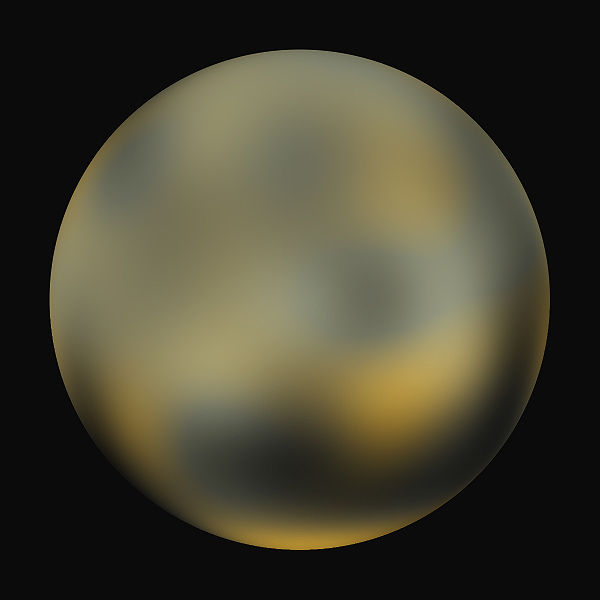
Pluto, a dwarf planet, as imaged by the Hubble Space Telescope. Expect better pictures next year.

Pluto, a dwarf planet, as imaged by the Hubble Space Telescope. Expect better pictures next year.

What is a dwarf planet? Under the definition accepted by the International Astronomical Union (IAU), a dwarf planet is any object orbiting the Sun that is large enough to become round under its own gravity, but is not large enough to have “cleared the neighborhood around its orbit” by its gravitational influence. A planet is an object that is round and has “cleared its neighborhood”.

You may remember when these definitions were accepted by the IAU back in 2006, resulting in Pluto being reclassified from a planet to a dwarf planet. The actual definition of the word “planet” is a can of worms that I will save for another time. For now, I will note only that I feel that the “clearing the neighborhood” business is scientifically sloppy, and there are better and more quantitative ways to measure the same thing.

What I want to discuss today is, at first glance, a simpler question: How many dwarf planets are there?

The answer turns out to be that we don’t know, even about the ones we’ve discovered. After all, how big does an object have to be to be round? We’re not sure, but we think the answer is about 300 kilometers. However, it might change based on how much rock is in an object, and we can’t measure it very accurately at the large distances where we find them, near Pluto or even beyond.

We can get a rough estimate, though we’ve discovered well over 100 objects larger than 300 kilometers in the outer reaches of the Solar System. Like it or not, you’re not going to be reciting them all in elementary school.

But there’s a problem. The IAU gives a different answer to this question. They are the ones who make it all official, and they say that the number of dwarf planets is 5. All of the others are just possible dwarf planets.

We can’t measure the actual sizes of things in the outer Solar System very well, and we certainly can’t measure roundness very well, so we really have to go based on brightness. But the IAU wants to be extra-extra-sure that an object is big enough to be round before they officially call it a dwarf planet. Because of this, they only call things dwarf planets that have an absolute magnitude of H < +1. An object this bright cannot possibly be smaller than 838 kilometers.

In other words, without pictures to prove that they’re round–pictures that won’t be possible until at least 2018 when the next generation of telescopes start to come online–the IAU will not consider an object to be a dwarf planet unless it is much larger than is necessary. Sadly, this leaves a lot of interesting objects like Sedna out in the cold–no pun intended.

Now, in some respect, this doesn’t matter. Scientists can do their own thing. Science is peer reviewed. If Mike Brown wants to call Sedna a dwarf planet, even in a formal publication, he’s free to do so as long as the other scientists agree with it. The problem with this (or maybe not a problem if you’re a fan of Pluto) is that this leaves the IAU behind. The IAU’s very conservative action on this issue causes its classification not to be followed as carefully and undermines the whole (admittedly questionable) idea of writing a definition in the first place.

Not to mention the fact that the IAU never even tried to classify exoplanets. I’m still waiting on them every three years to take that one up at their general assembly. The next one is in 2015, but I’m not holding my breath.

Disclosure: While I am an astrophysicist, I am not a member of the IAU.

Posted in Planets, Space | Tagged , , | 2 Comments

2012 VP113: a weird new “dwarf planet”

Artist's impression of a distant Kuiper Belt Object like 2012 VP113. Credit: NASA/JPL-Caltech.

Artist’s impression of a distant icy world like 2012 VP113. Credit: NASA/JPL-Caltech.

Astronomers Chad Trujillo and Scott Sheppard announced this week the discovery of a new icy world in the outer Solar System, named 2012 VP113. Trujillo is a colleague of Mike Brown, who discovered the dwarf planet Eris, which is larger than Pluto, among others. In a tradition of giving objects in the outer Solar System nicknames before they get real names, Trujillo has given 2012 VP113 the moniker “Biden” (because of the VP).

Now, 2012 VP113 is not very big. It’s believed to be about 500-600 kilometers across, only about a quarter the size of Pluto, but that’s not very well calculated yet. Historically, the sizes of objects in the outer Solar System tend to be overestimated at first, so it could be even smaller. But the interesting this is its orbit:

Orbits of Sedna and 2012 VP113 compared with the Kuiper Belt. Credit: Scott S. Sheppard/Carnegie Institution for Science.

Orbits of Sedna and 2012 VP113 compared with the Kuiper Belt. Credit: Scott S. Sheppard/Carnegie Institution for Science.

That’s 2012 VP113’s orbit in red. In orange is the orbit of Sedna, another, larger object in the outer reaches of the Solar System. The purple rings are the orbits of the planets, and the blue ring in the Kuiper belt, where most of these ice balls like to hang out. These things are very far away.

Now, any astrophysicist can tell you there’s a problem with this picture: the orbits of 2012 VP113 and Sedna never go near anything big. Our newest ice ball never comes closer than 80 AU from the Sun, nearly three times as far as Neptune. The law of gravity says that even if an object is thrown out into deep space by swinging too close to a planet, it eventually has to come back to where it started. And, in fact, we see some Kuiper belt objects thrown onto long, comet-like orbits that take them far from the Sun by the gravity of Neptune, but they all come back to near the orbit of Neptune.

Except these two oddballs.

These two objects never go anywhere near anything, and we really have no idea how to put them out there in the first place. And it gets worse. We discovered both of these objects near their closets points to the Sun, and things on elliptical orbits don’t spend much time there, just like comets only spend a few months of their long orbits near the Sun. We can’t see very far past these closest points, and if there are two of these ice balls this close, there are probably dozens or even hundreds farther away!

So how did they get there? One theory is that the gravity of the passing star messed up their orbits billions of years ago. Another, more intriguing theory is that their orbits are being influenced by another “planet”, maybe larger than Earth, maybe 10 times larger than Earth, hidden away somewhere in the large, blank areas of that figure. Such an object would be hard to find, but very interesting if we did–more on that later.

On a different note, you may notice that I’ve been dancing around the issue of what to call 2012 VP113, or Sedna for that matter. “Objects”, “ice balls”, “things”? Here’s the problem: we acutally don’t know what they are! They aren’t “Kuiper belt objects” because they’re not in the Kuiper belt. Astronomers come up with all kinds of names like “detached objects”, “inner Oort cloud objects”, and so on.

But what about “dwarf planets”? Isn’t that what everybody else is calling them? Well, not exactly. The headlines may say that, but more careful articles will note that 2012 VP113 is a “possible dwarf planet”. This is because, unlike most things in astronomy, the International Astronomical Union (IAU) is the gatekeeper of the dwarf planets. Officially, a dwarf planet is any object that is large enough to become round under the force of its own gravity, but in practice. This is certainly true of Sedna, and there’s really no good reason to think it’s not true for this new object. But in practice, an object is only a dwarf planet when IAU say it is, and the IAU refuses to classify any new dwarf planets without better data that only the next generation of telescopes can provide, even if what we have is easily enough to say they have to be round by a wide margin.

This, in my opinion, is the biggest downside of the whole “definition of a planet” debate, which I’ll talk about more in my next post. It’s even worse that the whole “is Pluto a planet or not” thing because it’s just now how science is done. With exoplanets, you can have papers going back and forth saying, “this is a planet” and “no it’s not”, sometimes for years, but when you insist on knowing for sure, like in our Solar System, everything winds up being a “possible dwarf planet”, full stop, even when there’s no real debate, and I think that detracts from the fascinating diversity of objects in the outer Solar System. For more on that, you might check out this post on Mike Brown’s blog and move out from there.

Posted in Current events, Science, Space | Tagged , , , , , , | Comments Off on 2012 VP113: a weird new “dwarf planet”

Math is hard

One of Einstein's mathematical mistakes. Credit: Albert Einstein Archives/Hebrew University of Jerusalem, Israel.

One of Einstein’s mathematical mistakes. Credit: Albert Einstein Archives/Hebrew University of Jerusalem, Israel.

Math is hard.

That may sound strange coming from an astrophysicist with a degree in math, but in some ways, it’s very true. Yes, it gets easier with practice, but only up to a point. I can attest from experience that some parts of calculus are still hard, even when you’re learning differential equations. Some parts of algebra are still hard, even when you’re learning calculus–indeed, it’s not uncommon for the algebra to be harder than the calculus.

And no matter how much math you know, one of the hardest parts is still keeping your plus and minus signs straight. Case in point: a recently-discovered document penned by Albert Einstein in 1931. The section above shows two equations that should be well-known to anyone who has studied cosmology, describing the shape and expansion of the universe. but in the top one, he initially wrote some number–it’s hard to tell which one, but it was a positive number–and had to write a -3 over top of it. And that’s not all. About 20% of Einstein’s papers include various mathematical mistakes. It turns out that even being Albert Einstein does not make you immune to the dangers of plus and minus signs.

The interesting thing is that Einstein’s entire idea behind this draft paper was wrong. By 1931, we already knew that the universe was expanding and therefore had a beginning. But Einstein didn’t like the idea of a beginning. He preferred the idea, which was current in his younger years, that the universe had always been here. He preferred this idea so much that when he realized his theory of general relativity predicted an expanding universe, he added a cosmological constant in 1917 to make his steady-state model work. He later called this move his “greatest blunder”, but, ironically, it turned out to be right for a different reason. We need the cosmological constant to explain why the universe is expanding faster than it should–you may also know of it as dark energy.

But in 1931, Einstein tried another approach to make the steady-state model work. He suggested that the universe was, indeed, expanding, but that new matter was always being created to fill in the space and keep everything from getting too spread out, the same idea that was proposed by astronomer Fred Hoyle, to much criticism, 20 years later. Einstein thought his equations could be made to work like this as is, but it turned out that they couldn’t. Amazingly, it was that same mistake with the minus sign that led him to realize that his idea didn’t fit his equations and wouldn’t work after all. The draft paper was abandoned long before it could get a chance to be published.

So I guess the moral is, don’t worry if the math is hard. Just remember to check your work.

Posted in Current events, Science | Tagged , , , , , | Comments Off on Math is hard

On Giordano Bruno

The earliest surviving depiction of Giordano Bruno, believed to be based on a contemporary portrait.

The earliest surviving depiction of Giordano Bruno, believed to be based on a contemporary portrait.

The new Cosmos TV series has drawn criticism for its depiction of Giordano Bruno, a Dominican Monk and philosopher who was burned at the stake for heresy in 1600. A lot has been said about this, including criticism of the segment coming from science-oriented sources, but I wanted to give my general impressions about the tone they set.

In Cosmos, Neil deGrasse Tyson presents Giordano Bruno as a philosopher with a radical view of the universe: not only was Copernicus’ idea of Earth orbiting the Sun correct, but all the other stars in the sky were other suns with other planets, perhaps hosting other forms of life. The universe was infinite and eternal. This startlingly modern idea went against the teachings of the Church, and he was therefore persecuted and eventually executed.

The martyr for science (or free thought, since Bruno, as Tyson admits, was no scientist) is a nice, Romantic notion, especially given his defiant pronouncement, “Perhaps you pronounce this sentence against me with greater fear than I receive it.” However, the truth is more complicated.

First of all, the relationship between Bruno’s vision of the universe and his trial for heresy is a complicated one. His vision of an infinite and eternal universe was against the teachings of the Catholic Church at the time, but this was not for its own sake, but because it admitted no Creation and no Final Judgment. Even worse (for Bruno), he denied the divinity of Christ, which is a big no-no for pretty much every branch of Christianity. We can rightly condemn the practice of burning people at the stake in general, but it wasn’t his views on science that did him in.

I won’t go into the historical details, as it seems like there are indeed some errors there, but, looking at the broad strokes, it’s hard to come down on a particular side. On the one hand, this is a science show, and the science-related part of the story took center stage. Moreover, Dr. Tyson did cover all the largest caveats. The story can hardly be called anti-Catholic when he points out how Bruno was rejected by Lutheran Germany, Calvinist Switzerland, and Anglican England. He correctly points out that Bruno was not a scientist and made a lucky guess. And the theological heresies that led to his condemnation are mentioned in the scene of his sentencing, as well as more subtly with his challenge to “question everything”.

My chief complaint is that this felt rather tacked on. It was there, but it wasn’t said up front. Yes, the story will have to be oversimplified to be told in ten minutes, but I would have been much happier if they could have spared just a couple of lines at the begin to say that Bruno’s theology was just as radical as his cosmology. Even with the segment’s other problems, I think this would have gone a long way toward making it more balanced.

And I wouldn’t even say this was intentional. Just like talking about our “cosmic address” without defining it, this seemed like just another manifestation of the slightly rushed format of the show. That said, I will be interested to see how these historical interludes will play out over the rest of the series.

Posted in History, Religion, Science | Tagged , , | 1 Comment