Planet 9 Follow-Up

Where it is, where it came from, and why there’s a chance it’s not there at all.
Planet 9 poster. Credit: @micquai (the Find Planet Nine blog).

Planet 9 poster. Credit: @micquai (the Find Planet Nine blog).

Last week, I wrote about the not-quite-discovery of a ninth planet in our Solar System (and I don’t mean Pluto), way, way beyond the orbit of Neptune. I wanted to follow up on this with a little more detail, mainly because Mike Brown and Konstantin Batygin put up a blog about their new discovery and the search for Planet 9.

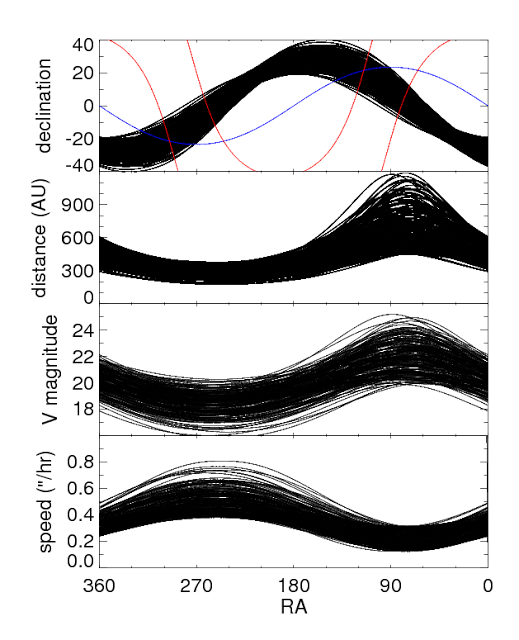
On the question of where Planet 9 might be found, Brown and Batygin put up a “treasure map” of the possible orbits their simulations allowed, which wasn’t in the main press release:
Credit: M. Brown & K. Batygin.

Credit: M. Brown & K. Batygin.

The top panel is an actual map of the sky. The red lines mark the Milky Way, and the blue line is the ecliptic. The second panel tells more about the possible orbits of Planet 9–specifically, its distance from the Sun. Although the media reported the minimum distance as 200 AU, the perihelion could actually be anywhere from 200 AU to 400 AU, and the aphelion anywhere from 500 AU to 1200 AU.

The third and fourth panels are about the telescope capabilities that are needed to find Planet 9 based on its brightness and speed of motion. And this leads to an interesting point: a lot of the places that Planet 9 could be have already been searched by various telescopic surveys without finding anything, specifically, the Catalina Sky Survey, Pan-STARRS, and WISE:

Credit: M. Brown & K. Batygin.

Credit: M. Brown & K. Batygin.

Almost the only place Planet 9 could have gone unnoticed is also the place where it is most of the time: far from the Sun, slow-moving, faint, and also probably in the dense star fields of the Milky Way. It won’t be easy to find there, but it’s definitely feasible within the next five years. And I wouldn’t be surprise if it turns up sooner–if someone goes through other sets of old images and finds it as a “precovery“. In fact, in the comment section of his own blog, another astronomer informed Dr. Brown of the Spacewatch archives, which could also be useful to search through.

So now that we have a better idea of where Planet 9 is, where did it come from? Well, basic planet formation theory says it had to have formed in the original protoplanetary disk that formed the other planets. Early in the Solar System’s history, it would have to have had a close encounter with another planet to be thrown out to a large distance. Now, normally, it would come back to where it started unless something else big bumped it into an orbit that always stays far from the Sun. That could have been another nearby star in the star cluster where the Sun formed.

This scenario is actually predicted by one of the theories of how the Solar System formed: the fifth giant planet hypothesis, postulated in 2011, which says there were originally five giant planets in our Solar System instead of four. If Planet 9 is found, it would lend a lot of support to this model.

Now, how sure are we really that Planet 9 exists? Well, Dr. Brown addressed that in more detail in this post. First off, while it appears that there is only a 0.007% chance of the curious alignment of outer Solar System objects happening by chance, there could always be other reasons for it that no one has thought of yet. The most obvious way it could happen is if there’s a planet out there, but it’s different from what Brown and Batygin think it is. They didn’t have time to simulate all the possibilities, after all.

But even before we find Planet 9, there is a way to strengthen the theory: just look for other objects out there. If Planet 9 is there, we should be able to find more objects on weird, but similar orbits like Sedna, and if we do find some, that would make it much more certain that Planet 9 is there, too.

Posted in Science, Space | Tagged , , , | Comments Off on Planet 9 Follow-Up

Planet 9: A New Planet in Our Solar System?

Artist's rendition of what the ninth planet might look like. Credit: (R. Hurt, Caltech).

Artist’s rendition of what the ninth planet might look like. Credit: (R. Hurt, Caltech).

“In my day, Pluto was a Planet!” said everyone over the age of…15 or so. Pluto was demoted from planet status ten years ago (a decision I do agree with–see here), and now we only have eight planets–or do we? Astronomers Konstantin Batygin and Mike Brown and announced yesterday that they have found evidence for a new ninth planet–one that’s about Neptune-size, but way beyond the orbit of Neptune. And unlike Pluto, this one would definitely be a planet.

Mike Brown was the first person to really do a dedicated search for what was then called the “tenth planet”. Ironically when he finally found his planet, Eris, he became one of the loudest voices to have both it and Pluto demoted to dwarf planet status. But he never gave up planet hunting, and now he’s found a new one, referred to only as Planet 9. You can read about his latest discovery in the scientific paper here, or the less scholarly article in Science here. But I wanted to give my own explanation and clear up a few things today.

So did they actually discover a new planet?

Continue reading

Posted in Planets, Science, Space | Tagged , , , , | 1 Comment

Book Review: The Windup Girl by Paolo Bacigalupi

Alright, so I was torn about reviewing The Windup Girl because I’m really not sure it’s fair to do so. I tried. I really did. But no matter what I did, I just couldn’t get into this book. For the first time in years, I couldn’t finish a book once I started it. I only got about a third of the way through it before I put it back on the shelf.

I want to say up front that this was not because Paolo Bacigalupi is a bad writer. He’s pretty good, and even though I didn’t like the book, I would go so far as to say there’s a good chance you would. It’s also not because I disagree with Mr. Bacigalupi’s (for lack of a better word) politics, even the more extreme parts like his portrayal of big businesses as bioterrorists. My disagreement was real, but that wouldn’t stop me from reading it. It wasn’t even because I found the premise to be patently unrealistic. I love a good fantasy or soft sci-fi novel.

The reason I couldn’t get into this book was because I found it to be patently unrealistic while trying to set itself up as realistic (granted, this was more marketing than Mr. Bacigalupi’s intent), and it just destroyed my suspension of disbelief. You may think that’s unfair, and you would have a point, so I’m going to try to make this review as balanced as possible, respecting the fact that I only have firsthand knowledge of the first third of the story.

Continue reading

Posted in Book reviews | Tagged , | Comments Off on Book Review: The Windup Girl by Paolo Bacigalupi

The Wild Chemistry, Geology, and Everything Else of Pluto

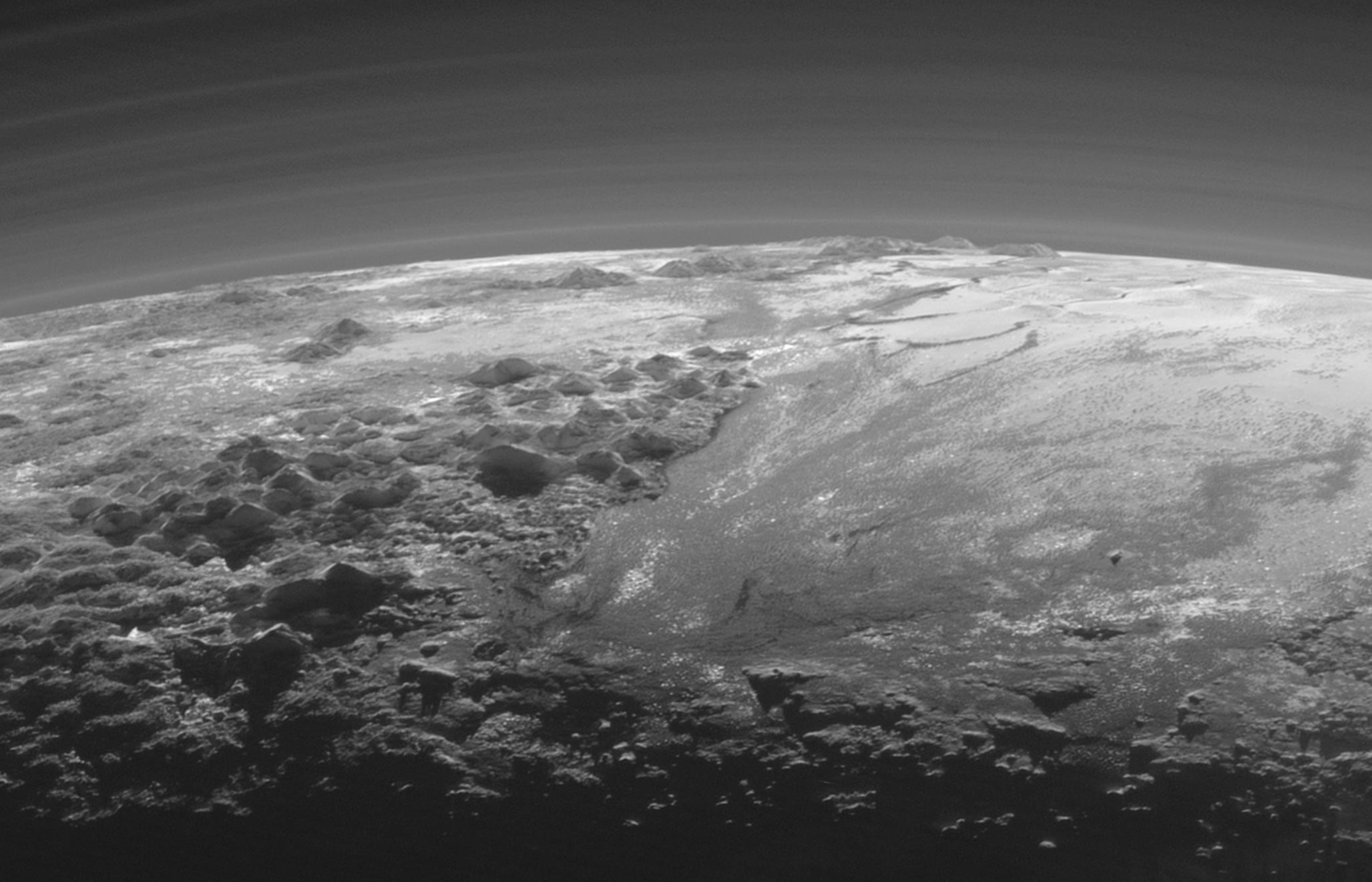
Horizon of Pluto with Norgay Montes (left) and Sputnik Planum (right). Credit: NASA/Johns Hopkins University/Southwest Research Institute.

Horizon of Pluto with Norgay Montes (left) and Sputnik Planum (right). Credit: NASA/Johns Hopkins University/Southwest Research Institute.

I just got back from the American Astronomical Society’s winter conference, and let me tell you, there was a lot of great science going on there, but I wanted to focus particularly on the latest findings about Pluto.

Pluto’s geology is more complicated than I ever could have expected, and New Horizons principle investigator Alan Stern said the same last week: “We expected a high school calculus-hard kind of planet, but instead we parachuted directly into graduate school.” It’s amazing that at 40 kelvins, Pluto can be anything but a solid ball of ice, but it’s actually more active than most of the warmer worlds in the Outer Solar System.

Pluto gets an advantage in the geology department because it’s colder than 63 kelvins–the temperature at which nitrogen freezes. Nitrogen ice is soft–“the consistency of toothpaste”, Dr. Stern said–meaning that it flows in glaciers and convection cells not seen on any of the moons of the gas giants. Interestingly, water ice, which forms the mountains of Pluto, floats in nitrogen ice. That means that what look like mountain ranges as high as the Rockies aren’t true mountains at all, but are enormous icebergs floating in a sea of nitrogen! Every time we turn around we see something new and strange on Pluto, from ice volcanoes to giant canyons to giant plains of constantly-resurfacing ice.

That we see so many unexpected things is all the more surprising because we can predict pretty well what chemicals we’ll find on Pluto, and there aren’t many of them. In fact, for Pluto, many other icy worlds, and even some exoplanets, we expect to see just a few major chemicals, and we can predict them pretty easily. Here’s how.

The six most common elements in the universe are hydrogen, helium, oxygen, carbon, nitrogen, and neon. The next few–magnesium, silicon, iron, and sulfur–are found in rock and so wouldn’t be found on an icy world like Pluto. Helium and neon don’t form chemical compounds, and even Pluto isn’t cold enough for them to freeze, so the vast majority of the molecules on Pluto’s surface will be made from hydrogen, oxygen, carbon, and nitrogen–and they’ll usually be simple molecules.

We can narrow down the list of molecules still further. Hydrogen by itself (H2) is too light and will evaporate into space. Oxygen by itself (O2) will react with other molecules and won’t stick around for long. And while there will occasionally be more complicated molecules with three elements, the most important being hydrogen cyanide (HCN), most of these molecules will be as simple as possible.

Within these rules, it turns out that almost all of Pluto’s surface and atmosphere are made of just six molecules: nitrogen (N2), water (H2O), carbon dioxide (CO2), carbon monoxide (CO), methane (CH4), and ammonia (NH3). And from the properties of these molecules, we can also figure out what roles they play.

Water ice is rock hard at 40 K, so it forms the main structural component of Pluto’s surface. Nitrogen is a soft, flowing ice that sublimes easily and forms the basis of the “hydrological” cycle. Ammonia and carbon dioxide don’t do much because they both freeze at much warmer temperatures, but carbon monoxide freezes at 68 K, much like nitrogen, so you might expect that it would form a major component of the soft ice, and it does, but only in a limited area. Besides a whiff of the stuff in the atmosphere, the carbon monoxide on Pluto is concentrated mostly in the very young ice of Sputnik Planum, which is now thought to be a large impact basin filled with a sea of this soft material.

The remaining molecule, methane, is an interesting one. It forms only 0.25% of Pluto’s atmosphere, but that small fraction is vitally important. When exposed to ultraviolet light for millions of years–even the feeble UV light from the distant Sun–methane turns into a deep red, tar-like “snow” called tholin. We see tholins all over the Solar System, from Jupiter to the Kuiper belt, and they probably occur even in clouds of exoplanets that orbit very near their stars. Tholins slowly stain the older regions of Pluto and Charon dark red, like the large, ancient crater fields called Cthulhu Regio. Parts of Cthulhu Regio are over four billion years old, and to be so close to Sputnik Planum, which is filled with ice that is only ten million years old, speaks to some very complex geology that we don’t fully understand.

So we begin to see how we build up the complicated structure of Pluto from a few very simple molecules, but the fact remains that it is still much more complex than we expected, and there remains a lot to learn about this icy world.

Posted in Science, Space, Space exploration | Tagged , , | Comments Off on The Wild Chemistry, Geology, and Everything Else of Pluto

Book Review: Go Set a Watchman by Harper Lee

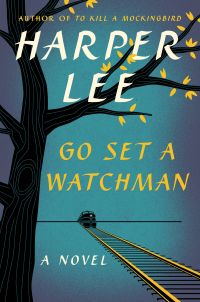
Credit: Jarrod Taylor/HarperCollins.

Credit: Jarrod Taylor/HarperCollins.

To Kill a Mockingbird is considered one of the great American novels. If you’re between the ages of 16 and 65, odds are you read it in high school. Harper Lee’s loosely autobiographical portrayal of racial tension in the American South in the 1930s has become one of the most enduring images in American literature. Even in Britain, it’s number one on the librarians’ must-read list, ahead of the Bible and five great books by British authors.

The reclusive Harper Lee never released another book and resisted personal publicity from just a few short years after the original 1960 release. Until, that is, an early manuscript of To Kill a Mockingbird entitled Go Set a Watchman, once thought lost, was discovered in Lee’s safe deposit box. Four years later, after significant editing to cut out parts that were nearly identical to Mockingbird, the book was finally published as a sequel, becoming the most highly anticipated book since Harry Potter and the Deathly Hallows.

I will note that there is some controversy surrounding this book. Even people close to the 89-year-old Lee disagree on whether she really wanted it published. I can’t pass judgment on that, but I can at least feel confident that Ms. Lee has reason to be proud of her work, as she produced a worthy “sequel” to the original. Indeed, if I had been told that Watchman had been deliberately written as a sequel to Mockingbird, I would have believed it.

Go Set a Watchman follows an adult Jean Louise “Scout” Finch as she returns home from college in New York just after the Supreme Court’s landmark Brown v. Board of Education decision in 1954. From Scout’s point of view, the Court’s decision has brought out the worst in the people of her hometown of Maycomb, Alabama, white and black, including, to her horror, her own father. She struggles greatly with these changes, but eventually comes to understand them and sees her father in a new, but still positive light.

Go Set a Watchman is not an exact sequel to Mockingbird. For example, in a flashback, it is revealed that Tom Robinson survived in this story, where he was killed in the original. And it seems likely that Harper Lee truly intended Atticus Finch to be the better man he is in Mockingbird than the ambivalently racist character he is in Watchman. And yet, Watchman feels like the perfect sequel in that regard. The ten-year-old Scout sees Atticus as a man who can do no wrong. The twenty-six-year-old Scout discovers that he is only human after all. Thus, Watchman humanizes Atticus in a way that Mockingbird was by its very nature incapable of, while still keeping him as a basically good man who is genuinely trying to do the right thing.

Granted, Watchman is not perfect. It’s an early draft, and it has a definite unpolished feel to it, which detracts from it a little, but the writing is still good, and the editor definitely did a good job. Go Set a Watchman does a wonderful job of deepening the story of To Kill a Mockingbird, and I would definitely recommend it for that reason.

My rating: 4 out of 5.

Posted in Book reviews | Tagged , , | Comments Off on Book Review: Go Set a Watchman by Harper Lee

How Many Seconds in Eternity?

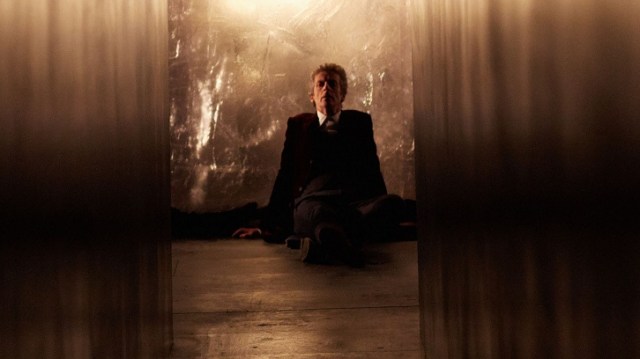
Credit: BBC.

Credit: BBC.

There’s this wall of pure Azbantium. It’s 400 times harder than diamond and 20 feet thick. Once every few days*, the Doctor comes and punches it a few times. And when the Doctor punches his way all the way through the 20-foot-thick Azbantium wall…he’ll escape to Gallifrey.

According to Doctor Who episodes “Heaven Sent” and “Hell Bent”, the Doctor spends four and a half billion years punching his way through that wall in one of the most epic scenes in Doctor Who history. But how long would it really take to do that? Is it even possible to punch through a wall 400 times harder than diamond? Just how many seconds are there in eternity?

First off, let’s establish that a soft material can, in fact, damage a harder one. A diamond is about 20 times harder than steel, but if you hit a diamond hard enough with a steel blade, it will crack. Place it in a heavy enough steel press, and it will shatter. Water can’t be said to have any hardness at all, and yet, given enough time, it can wear away rock.

There’s another factor at work here, too. After the Doctor has worn away a little bit of the wall, the Azbantium has to go somewhere. After a while, he probably gets microscopic bits of Azbantium dust on his fist just by being in the room, which will help him chip it away faster. Also, the wall doesn’t look like a single crystal, so he might be putting stress on crystal interfaces, which are much weaker than the crystal itself. And perhaps the oils of his skin react with it chemically over billions of years, wearing it away.

Now, how much Azbantium can the Doctor remove from the wall per punch? Honestly, I have no idea. Even if it were just ordinary diamond, I would have no idea. I have no reference from which to guess it. I wouldn’t even know where to begin to look for how diamonds react to being punched. (Also, the Doctor is implied to be stronger than a normal human.)

But let’s say each punch removes one layer of atoms where his fist strikes, just to give us a number to work with. His fist strikes with an area of about 25 square centimeters, and the tunnel he carves out has a cross section of about two square meters. That means it takes 800 punches to remove one layer of atoms from the tunnel. The tunnel is 20 feet long, or about 6 meters. We don’t know what Azbantium is made of, but the bond length between carbon atoms in a diamond is 154 picometers. That means the tunnel is about 25 billion atoms long, requiring 20 trillion punches to make.

The doctor is trapped in the castle for 4.5 billion years, or about 1.6 trillion days. This would suggest that he needs to deliver an average of 12 punches per day, quite a bit more than he appears to do in the show.** However, he wouldn’t be able to just punch his way through. After all, the wall extends all the way down to the floor. He would need to kick out the bottom part, which he could do much faster since he’s wearing shoes and wouldn’t need to break his toes.

So while the 4.5 billion years number was probably made up…it’s actually surprisingly plausible for the closest attempt we can make at even trying to figure out how long it would really take to get through that wall. Go figure.

(Also, I can definitely recommend the Christmas special, “The Husbands of River Song”, which is a delightful romp that offers excellent closure for a beloved character. 4.5 out of 5.)

* We see two nights take place in the episode, and the Doctor says it takes him a day and a half more to climb back to the top of the castle, so he couldn’t have reached the Azbantium wall any more often than once every four days. It could have been much longer, possibly as long as a hundred years, as in the story he tells, but that seems unlikely.

** Edit, December 26, 2018. On rewatching the episode, in the early cycles where he doesn’t have the extra few feet of the tunnel, the Doctor punches the wall exactly six times. Toward the end, he appears to get eleven punches in. He also strongly implies that he remembers all of the previous cycles, like Rory after “The Pandorica Opens”.

Posted in Science, TV Reviews, What If? Rejects | Tagged , , , | Comments Off on How Many Seconds in Eternity?

Retro Movie Review: The Star Wars Holiday Special

On November 17, 1978, back when Star Wars was only a single film, CBS aired a made-for-TV “movie” entitled the Star Wars Holiday Special. This movie was never rebroadcast and has never been officially released on video (except for a short cartoon segment introducing Boba Fett). However, you can see it by piecing together bits of VHS recordings from YouTube…if you dare.

I recently worked up the nerve to watch the Star Wars Holiday Special, and I can safely say it is the worst movie I have ever seen. Yes, worse than Battlefield Earth. Even worse than SyFy Channel B-movies. It’s so bad it blows right past So Bad It’s Good and becomes painful to watch. Even George Lucas doesn’t like it, and he disavows involvement in its production (although that claim is disputed). It’s so bad that it took me a whole day to get through it because I could only take about ten minutes at a time.

The plot of the movie involves Han Solo and Chewbacca trying to get past the Imperial patrols to get Chewie home to his family in time for Life Day, which seems to be the Star Wars Christmas. However, in practice, the movie is actually a glorified variety show, with Bea Arthur and other, lesser-known artists doing musical numbers for most of the running time.

But even that might–might–be forgivable if it weren’t just so badly done. Even with the original film’s actors involved, the whole thing looks and feels like it was made by amateur high school students. (And I’ve been in some of those, so I know.) There are long stretches with no dialogue besides Wookie grunting, and the parts that were intelligible mostly felt like they weren’t really trying. And the one part of the “movie” that is considered redeemable, the Boba Fett cartoon, is poorly written, poorly animated, and feels more like an episode of Star Trek: The Animated Series than anything else. It’s really that bad.

My rating–and I never thought I’d have cause to say this–is 0 out of 5.

Posted in Movie Reviews, TV Reviews | Tagged , , , | Comments Off on Retro Movie Review: The Star Wars Holiday Special

Movie Review: Star Wars: The Force Awakens

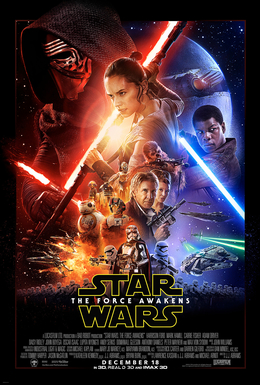
Credit: Lucasfilm Ltd.

Credit: Lucasfilm Ltd.

That. Was. EPIC!

Star Wars Episode VII: The Force Awakens is probably the most anticipated movie of the entire decade. Jurassic World was big, but the hype around that was nothing compared with the revival of Star Wars. Not only was it a massive event, but people were actually expecting it to be good because it was directed not by creator George Lucas, but by J. J. Abrams of Lost and Star Trek fame.

Better still, many fans were pleased to learn that Disney didn’t want George Lucas involved in the new movie at all. That could only improve the series; he’d botched the prequel trilogy so badly. Honestly, as a writer, I have to conclude that George Lucas isn’t all that good a writer, and the prequels were so underwhelming that even with the long-running Clone Wars series, many fans despaired of ever getting an Episode VII at all, much less a good one. And I don’t think J. J. Abrams is perfect either. I didn’t like Star Trek Into Darkness, and I was skeptical of giving the same man power over both Star Trek and Star Wars. But I still went into Star Wars: The Force Awakens with my expectations high, and it rose to meet them.

Say it with me. That. Was. EPIC!

The Force Awakens is the best movie of the entire series, hands down. The writing is better. The acting is better. The editing is much better. (Both the original and the prequel trilogies, I thought the editing was too choppy. The Force Awakens fixes that.) It gives us unforgettable characters and a classic hero’s journey with a twist: two heroes–both coming from humble beginnings (albeit in very different ways) before being thrust into the thick of things and rising to the challenge and saving the galaxy.

And there’s no Jar Jar. Not even an evil one. What more do you need?

My rating: 5 out of 5.

May the Force be with you.

Posted in Movie Reviews, Science Fiction | Tagged , , , | Comments Off on Movie Review: Star Wars: The Force Awakens

Theology and Doctor Who

One of the most epic scenes in the entire Whoniverse. Credit: BBC.

One of the most epic scenes in the entire Whoniverse. Credit: BBC.

“How many seconds in eternity?”

So this post is a little bit TV review, a little bit analysis, a little bit religious commentary, and a little bit blog recommendation. It’s complicated…or wibbly-wobby-timey-whimey, you might say. But Doctor Who tends to do that to you.

Doctor Who’s Series 9 (Season 9 to Americans) concluded a week ago, and I have to say that it was great. The previous two series were so-so, in my opinion, but this one had Peter Capaldi in top form, on par with Matt Smith’s best, and there was a lot going on.

In the very first episode of Series 9, which I reviewed before, the Doctor was effectively given the choice to kill baby Hitler a month before the NYT Magazine proposed it. In the second two-part episode, he explored the philosophy of the bootstrap paradox. (“Google it.”) In “The Girl Who Died”, he reaffirmed his call to save people, even in the face of dangerous and unpredictable consequences. With the Zygons, he tackled war, peace, and terrorism. And in the epic finale, well, let’s just say the last two episodes are called “Heaven Sent” and “Hell Bent”, and they earn those titles. The newest series takes on social, philosophical, and ethical commentary that really makes you think more than ever, and it entertains the whole way.

It’s odd the way the Doctor changes with every regeneration, and sometimes even in between, and this series was no exception. In what I considered a surprising move, they gave him sonic sunglasses and an electric guitar for a sort of Mick Jagger-esque old-rock-star look. It was about the last thing I expected of the Doctor in general or Peter Capaldi in particular, but bizarrely, it worked. Even the old rock star is completely believable as the Doctor.

My rating for Series 9: a solid 5 out of 5.

But what I really noticed in this series (and starting at the end of the last series) were the theological references. The Doctor has become a Christ archetype, and once again, it works surprisingly well.

Now, there have been previous incidents where the Doctor has appeared as a Christ archetype: his victory in “Last of the Time Lords”, the imagery in “Voyage of the Damned”, and his death in “The End of Time”, to name a few. But this series has really made him own the role through his words and actions, and not just in beating the bad guys.

Now, people have been talking about religious overtones in Doctor Who for a while. For example, Cracked.com ran an article in 2011 entitled “How Doctor Who Became My Religion” (warning for language). Briefly, the article said the Doctor is a savior who regularly defeats evil that we couldn’t hope to overcome ourselves. He is a personal savior who desires a relationship with us. And he solves the problem of evil by being fallible.

Mind you, this was in the middle of Matt Smith’s tenure, and I thought it was silly and more of a parody at the time, but this changed when Peter Capaldi took the reigns. The writers are serious about it now.

The first big WHOA line for me came in last series’s “Dark Water”.

Do you think I care for you so little that betraying me would make a difference?

WHOA.

I don’t think much more needs to be said at that point. That line alone is enough to make the Doctor one of the best Christ analogues I’ve seen in fiction, even though he doesn’t sacrifice himself for anyone…well, not in that particular story. Still, in our modern, secular world, and especially in the even more secular Britain, I wasn’t really sure that it was deliberate. I thought it might be intentional, but I also thought it might have been some writer being clever on his own. But it wasn’t. I’m sure now that it wasn’t. This, in the penultimate episode of the current series, “Heaven Sent”–this was the moment when I knew.

“How many seconds in eternity?” The Shepard’s Boy says. “There’s this mountain of pure diamond. It takes an hour to climb it, and an hour to go around it. Every hundred years, a little bird comes and sharpens its beak on the diamond mountain. And when the entire mountain is chiseled away, the first second of eternity will have passed!”

You might think that’s a helluva long time. Personally? I think that’s a helluva bird!

The final ten minutes of “Heaven Sent” are probably the best ten minutes of Peter Capaldi’s entire tenure so far, right up there with Matt Smith’s “I AM TALKING!” and David Tennant’s “Don’t blink.” That little story was adapted from Grimms’ Fairy Tales (the Doctor even mentions them by name), but most people will probably be familiar with it from Sunday school, as a parable to convey the magnitude of eternity. And given the title of the episode, there is no way the writers weren’t thinking about the religious references, and what’s more, I think they used them both respectfully and effectively, which is not a given in this day and age. So I feel they enrich the story all the more.

Now, I could go on all day about this, but I’m already at 900 words, and frankly, there’s someone else who is already doing it better than I could. So I’d like to recommend you check out the blog Whovian Theology, which analyzes not just the religious, but also the social, political, and ethical issues raised in Doctor Who. I don’t agree with them on everything, but it’s well worth the read.

Allons-y! Geronimo! And who needs a catchphrase?

Posted in Religion, Science Fiction, TV Reviews | Tagged , , , , | Comments Off on Theology and Doctor Who

Happy Back to the Future Day

Credit: Terabass (Wikipedia).

Credit: Terabass (Wikipedia).

Today is the day that Doc Brown and Marty McFly arrived in The Future! So put on your self-lacing shoes, load up the Mr. Fusion, and kick back and enjoy Jaws 19.

(Also, try driving in New Jersey for a while and then tell me if you really want flying cars.)

Posted in Current events, Science Fiction | Tagged , | Comments Off on Happy Back to the Future Day