In this episode, I review the recent history and current status of science fiction on television during the streaming era. TV recommendation: The Orville
H. P. Lovecraft brought the Gothic horror of the previous century into the modern era with his new genre of cosmic horror, which placed humankind at the mercy of vast and inscrutable alien entities. Despite a tarnished legacy, he is still considered the master of sci-fi-horror and a great influence on the genre ever since.
And here’s one for the category of “Posts where you need a degree in physics to even understand the question.” Okay, there are probably a fair number of you who don’t have a degree in physics who can understand this question, even if you don’t know the calculus. But consider this a dry run for some stuff on quantum field theory I want to do down the road.
This post is an attempt to answer a question that confused me when I was an undergrad physics student, and if the internet is any indication has plagued many other physics students.
Why is the Lagrangian kinetic energy minus potential energy?
In this episode, I review the recent history and current status of science fiction on television during the streaming era. TV recommendation: The Orville
The hallmark of early science fiction was the pulp magazines, which continued the tradition of larger-than-life adventure stories. Despite the sometimes silly and over-the-top writing style, this was an important step in the development of the genre.
Book recommendation: The Lost World by Sir Arthur Conan Doyle.
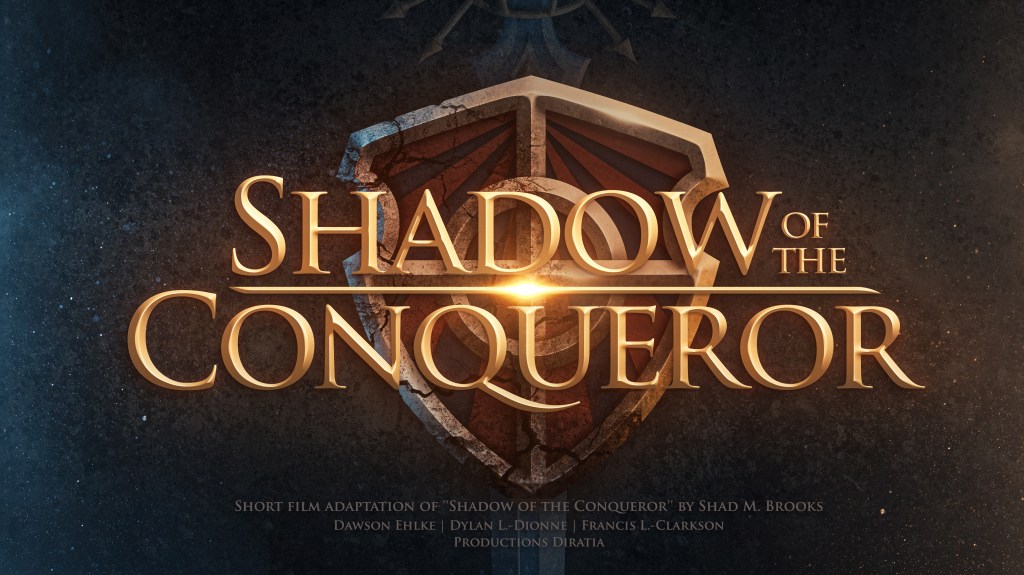
Image credit: Diratia Productions, Shadow of the Conqueror press kit.
Last year, I reviewed Shadow of the Conqueror, the debut fantasy novel of medieval enthusiast Shad Brooks, also known as Shadiversity. I thought it was pretty good—a little rough around the edges, but with a lot of potential.
Well, it seems that I wasn’t the only one who thought so. A group of “Everfans” of The Chronicles of Everfall (the series to which the book belongs) at Diratia Productions have begun an effort to produce a 15-minute short film of selected scenes from the novel, and they’re asking for your help on Kickstarter.
Diratia Productions is a Montréal-based, independent video production company whose staff have professional experience in Hollywood studios, TV shows, and theater. They’re just getting started on the project, but I was impressed by their dedication. They have a YouTube channel, where you can see updates on the production, and in just a few weeks they’ve already made significant progress, including in casting, composing music, and test filming.
The team is working with experts in historical European martial arts (in simplistic terms, traditional swordfighting) to ensure the historical accuracy of the film (you know, aside from the magic). And crucially, they are working with Shad himself to produce a faithful adaptation of the book, so this is a serious effort. You can see Shad’s announcement video for the project here.
The next step for the team is securing funding, and today Diratia Productions began a Kickstarter to fund the project. They are looking for $65,000 Canadian to fund the short film, and they made one third of that in the first 12 hours, so they’re off to a pretty good start. They’re also prepared to expand the project with pretty much any level of support. The Kickstarter runs through July 8, so if you enjoy Shadow of the Conqueror, Shadaversity, or fantasy in general, consider donating.
Disclosure: this post was made at the request of Diratia Productions.
In this episode, I review the recent history and current status of science fiction on television during the streaming era. TV recommendation: The Orville
H. G. Wells was in many respects the first real science fiction author, where earlier writers wrote more or less in existing genres. This episode is an overview of his work and legacy.
The Falcon 9 and Crew Dragon on the launchpad today. Credit: NASA/Bill Ingalls.
Astronauts have not blasted off to space from American soil in nearly nine years. But tomorrow, that finally changes. SpaceX will launch its first ever crewed mission, Crew DragonDemo-2, tomorrow at 4:30 pm Eastern Time. The rocket will ferry NASA astronauts Douglas Hurley and Robert Benkhen to their scheduled rotation on the International Space Station.
This is a big deal. It’s especially a big deal if you work in a space-related field, like I do, but it should be a big deal to everyone. In 2011, this could have been the news story of the week. Maybe even of the month if it was a slow month.
I don’t even remember the last time we had a slow month in the news media. I think it was in 2015.
The United States has not had the capability to launch our own astronauts into space since the retirement of the Space Shuttle Atlantis in 2011. Ever since, every astronaut to go into space has had to hitch a ride with the Russians.* Elon Musk, although he’s not the only person in the game anymore (Boeing is planning to do it next year), was arguably single-handedly pushing us in this direction for years, and that work is finally paying off.
The mission will go on tomorrow, weather permitting. You’ll be able to see it live on NASA TV, SpaceX’s live stream, and on the Discovery and Science Channels. So if you’re stuck at home for quarantine, or if you otherwise have some time to set aside, be sure to check out this historic event.**
**Full disclosure: I am a postdoc at NASA’s Goddard Space Flight Center. However, this post represents solely my own opinions and does not necessarily reflect the opinions of NASA or the United States Government.
In this episode, I review the recent history and current status of science fiction on television during the streaming era. TV recommendation: The Orville
Jules Verne was perhaps the first author to systematically incorporate the latest science into his work, becoming one of the biggest minds behind the idea of science fiction. Yet his focus wasn’t so much on sci-fi as it was on adventure fiction. In this episode I explore how he contributed to the development of the genre.
Disclaimer: not a sponsored post. I just really like Scrivener.
It’s been a long time since I’ve given any proper writing advice on this blog, but I had one thing I wanted to tell you after seeing recent developments in the community.
I’ve been using Scrivener for my writing since…well, since it was still in beta for the Windows version. Novels, essays, podcast scripts, and even these blog posts: all in Scrivener. If you don’t know about it, Scrivener is a writing program designed specifically for writers, and if you’re a serious writer, I highly recommend it. It’s not free, but it’s definitely worth the price.
The thing is, over the past…oh, about a year or so, I’ve seen a number of YouTube creators talking about a website called World Anvil. Long story short, World Anvil lets you create your own wiki for your fictional worlds. These YouTubers are more into worldbuilding than they are writing, but some of them are writers, too. Recently, I’ve also seen a similar website called Campfire mentioned.
(Edit: on further review, I’ve learned that Campfire is a one-time purchase, not a subscription service. However, while Campfire may be comparable to Scrivener, I think the rest of my conclusions still stand.)
And here’s my problem: I’ve looked into World Anvil multiple times, and…I just don’t get it.
I’m sure World Anvil is a fine website, and it might be of more use for certain kinds of projects, but I honestly don’t see the point. It seems like it would be more work to curate wiki articles instead of your own notes, with a dramatically poorer organization system. (It’s hard to pull up a comprehensive, organized list of articles on a wiki.) It just doesn’t seem like it would be useful to me when I can do almost everything it does in Scrivener.
Yet, I see so many writers and worldbuilders whose opinions I respect recommending World Anvil that I wondered if I was missing something. So, I started poking around, and it turns out, it’s a lot simpler than I thought. A quick Reddit search told me all I needed: a lot of people use Scrivener as an alternative to online services like World Anvil. I’m not missing anything. I just already have exactly what I need.
I think I’ve been using Scrivener for so long that I’ve forgotten how revolutionary it was when I first got it. Scrivener is offline. It’s a one-time $50 purchase instead of a subscription service, so it’s better value than those websites if you use it for more than a year. It lets you organize all your work (including external files and images) in a nice, intuitive folder system. You don’t have to write your whole novel in one long document, and you don’t have to write your notes separately. Everything goes on separate pages of a single project, where you can call up a specific chapter easily and even rearrange them if you want. Plus, it will compile those pages into a standard manuscript format for you. It’s like night and day compared with a normal word processor like Microsoft Word.
(As for being offline, I know people swear by the Cloud these days, but I much more trust computers that I own outright, despite needing to back them up manually. And with my career/lifestyle, I’m rarely far from my computer when I want to work on my writing. Also, you don’t have to worry about your internet connection with an offline program.)
So, basically, my advice to serious writers is to get Scrivener if you can. Maybe for a group project or something that’s all worldbuilding like an RPG campaign, a website like World Anvil would be better (indeed, that seems to be World Anvil’s target audience), but if you plan to use your worldbuilding for writing stories, stick with Scrivener.
In this episode, I review the recent history and current status of science fiction on television during the streaming era. TV recommendation: The Orville
Note: WordPress seems to have a new option for an embedded podcast player, although it still has to be inserted manually. I may continue to tweak the post format once I have a better idea of how it works.
Several books widely regarded as the first science fiction novels date back as far as the sixteenth century, but most of these weren’t dramatic stories at all, but were satirical instead. In this episode, I explore how satire contributed to the genre of science fiction.
Edit: LibSyn’s player doesn’t work on WordPress basic, so I will be manually editing the podcast posts with the direct-linked MP3. If you don’t see the player on a future episode, it should be up by the next day, or you can click the LibSyn link.





 Science Meets Fiction